Boids is a classic artificial life model proposed by Craig Reynolds to simulate the collective motion observed in flocks, herds, and schools. The word “boid” derives from “bird-oid object,” a term used to describe autonomous agents that behave according to simple local rules rather than centralized control. Instead of following a leader or global script, each agent reacts only to nearby conditions. From these limited interactions, coherent group behavior emerges.
Embodied Boids is a physical, embodied simulation of a Boids system, where participants enact simple local rules that generate emergent collective behavior. Instead of digital agents, human bodies perform the algorithm through movement, perception, and spatial negotiation. The model offers a way of thinking that applies across algorithms, social formations, organizational systems, and designed environments, highlighting how structure and complexity emerge from relational processes rather than centralized design. This game was designed for the interaction design anthropophagic studio.
Phase 1 – Core Flocking Rules
Participants move freely within the space while continuously applying three fundamental BOIDS rules:
- Fill empty spaces: Move toward areas of low density. Avoid leaving large gaps in the group formation.
- Avoid crowding: If too many participants accumulate in one region, redistribute.
- Match Direction: Adjust movement to approximate the average direction of nearby participants.
Conceptually, each participant responds to an imagined vector representing the mean heading of the local group.
Phase 2 – Obstacles
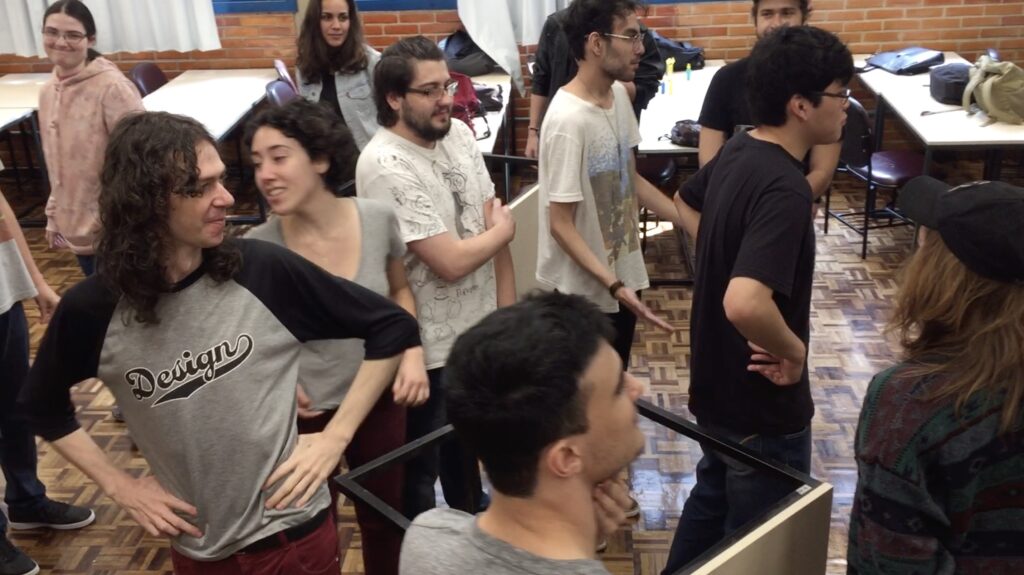
Obstacles are introduced into the environment.
- Participants must perceive and avoid collisions.
- Movement reorganizes as the group flows around constraints.
- All previous rules remain active.
Phase 3 – Attraction and Repulsion
Each participant secretly selects:
- One participant to approach / pursue
- One participant to avoid / distance from
Rules:
- Move toward the chosen attraction target.
- Maintain distance from the chosen avoidance target.
- No verbal communication allowed.
After a period of interaction, the rule set is inverted:
- Participants now pursue the previously avoided individual.
- Participants avoid the previously preferred individual.
This phase reveals how relational rules reshape collective dynamics.
Phase 4 – Coupled Movement
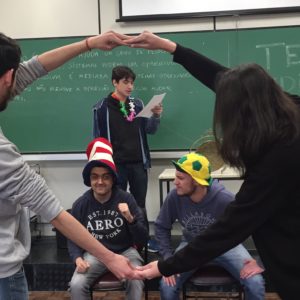
Participants form pairs or chains by holding hands.
- Physical coupling constrains individual freedom.
- The group continues executing the same behavioral rules.
- Coordination, tension, and negotiation become visible.