Andrade Tavares, P., Freese Gonzatto, R., and van Amstel, F.M. (2026) Collective handiness in prospective design: philosophical musings on a serious play workshop on articulation work, in Simeone, L., Gray, C. M., Verhoeven, A., de Götzen, A., Bakırlıoğlu, Y., Zohar, H., Stead, M., and Buwert, P. (eds.), DRS2026: Edinburgh, 8–12 June, Edinburgh, United Kingdom. https://doi.org/10.21606/drs.2026.2538

Abstract: Building on the German philosopher Heidegger, design philosophy has historically dealt with handiness (zuhandenheit/vorhandenheit) as an ontological relationship between an individual, a technology, and an artificial world. Such handiness conceptualization does not account for the social accumulation of work necessary to bring technology ready-to-specific-hands. Building on the work of Brazilian philosopher Vieira Pinto, this investigation foregrounds the collective aspect of handiness to account for the articulation work behind a new design philosophy program, prospective design. This program embraces philosophy through design; therefore, this investigation includes a description of a stakeholder mapping workshop in which serious play was used to develop the prospective design program’s collective handiness, both in theory and in practice. By mapping who is “at-hand” (and who is not) for this program’s ends, the collective body of researchers realized their fundamental relationship with their world.

Download the paper from its publisher (open access)
Online remote presentation
Audio recording
Full transcript
Hello, my Brazilian friends, Latin Americans, and everybody else from other parts of the world. I am Frederick van Amstel, speaking on behalf of my colleagues, Polyana Andrade Tavares and Rodrigo Freese Gonzatto. I speak from Curitiba, in the southern part of Brazil, in another hemisphere of the world. It is important to mention this because, since this track is about amplifying the unheard in Design Philosophy, by being part of it I am representing the philosophical work developed in Brazil and other places in the Global South. This hybrid conference format is very welcoming and inclusive for us. Otherwise, we would not be able to present this work due to funding restrictions and the fact that most of such conferences takes place in the Global North. This is also an invitation for you to come and have great conversations in the Global South in the future.
Let me now move into this presentation: Collective Handiness in Prospective Design. First of all, there are different ways of thinking and being in the Global South. One example is reframing the famous maxim “I think, therefore I am” in collective terms. Álvaro Vieira Pinto did this by reformulating cogito ergo sum as “We think, therefore we are.” In doing so, he resonates closely with African philosophies such as Ubuntu.

I do not want to discuss this broad ontological question. In this work, we were interested in the relationship between being in the world and the mediators we use to inhabit and transform it. It is unavoidable to discuss the work of the German philosopher Martin Heidegger when addressing this topic, because he wrote extensively about what became influential concepts in design philosophy: readiness-to-hand and presence-at-hand. According to Vieira Pinto, these can be understood as modes of handiness.
By handiness, I refer to a concept that connects these two notions, which in German are expressed through distinct terms. Heidegger coined neologisms for them, and Vieira Pinto later proposed a broader concept that unifies them: handiness. It concerns how human beings are present and interactive in the world. Following Heidegger, human beings are sometimes immersed in the world and experience it as ready-to-hand. Someone hammering a nail into a wall, for instance, is not thinking about the hammer itself. They are focused on what they are doing—perhaps hanging a portrait. However, when the hammer breaks, they enter another mode of handiness. The hammer becomes present-at-hand because it no longer functions as expected. They must now repair or redesign it, which generates symbolic reflection about alternative possibilities.

Heidegger’s two modes of handiness. Alexandre do Nascimento, 2015 (CC-BY)
Vieira Pinto identified a third mode of handiness, which constitutes one of his contributions to existential philosophy. This third mode corresponds to the Marxist notion of work. He argues that all tools, artifacts, and environments that are ready-to-hand for certain bodies are socially produced through the labor of other bodies. Sometimes the people who produce what is ready-to-hand for others—for example, workers producing goods for employers or customers—cannot enjoy the same degree of readiness-to-hand themselves. They experience a different relationship to the world due to the inequalities that shape being-in-the-world through geopolitical relations, colonial histories, and other forms of domination.

Vieira Pinto’s three modes of handiness. Alexandre do Nascimento, 2015 (CC-BY)
This is the most advanced philosophical discussion I will present today. Let us now return to design philosophy. Before showing some practical examples, I should mention the early work of Terry Winograd, Fernando Flores, and Gui Bonsiepe. They also built on Heidegger’s philosophy of handiness, although they did not engage with Vieira Pinto’s work. What we are proposing in design philosophy is a move away from individual handiness—one person interacting with one hammer and one nail in a particular setting—toward collective handiness, in which collective bodies interact with multiple artifacts and tools across multiple environments.
We are not the first to take this direction. Luis Garcia recently defended a PhD thesis advancing the concept of designing from handiness. He describes it as “a design practice that interacts with the world in ways that respect how the world is already interacting with the collective design body”. By this, he means an endogenous design practice that is not imposed individually upon the world but emerges collectively from what a collective body is already doing in that world.
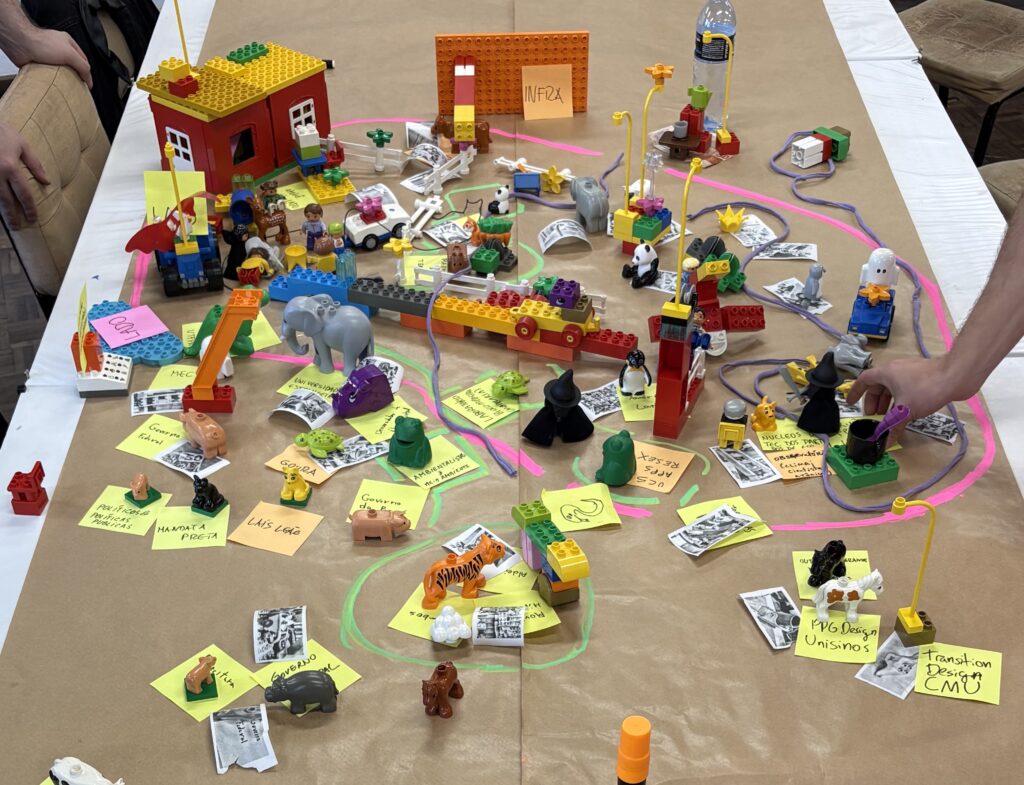
Let me provide an example of how we experienced and empirically studied collective handiness within the new Prospective Design Philosophy Program we are developing at Federal University of Technology – Paraná (UTFPR). We conducted a workshop in which participants first created a conceptual mirror of our program using Lego Serious Play. We first asked: “What is this program about?” for me and, then, in the second stage, for us. In the third stage, we mapped all stakeholders involved with the program, as well as those who should become involved in the future. We distinguished stakeholders who were at hand—those already engaged with the program—from stakeholders who were farther away and not yet closely engaged. These were still considered at hand in the sense that they remained reachable, but with a lower degree of handiness.

We then discussed their perspectives and interests, documented the process through photographs, and finally mapped the entire network of interests surrounding the program. Through this exercise, we sought to understand what new relationships with the world might become possible through engagement with these stakeholders.
From the perspective of design philosophy, this workshop led us to advance four concepts. The first is prospective design itself as a design-philosophy program. The second is the notion of existential structures, understood as collective bodies interacting within collectively shared worlds. The third is a dialectical existential philosophy, a philosophical tradition developed in Brazil through thinkers such as Vieira Pinto and Paulo Freire. The fourth is the concept of collective handiness, extending the work initiated by Luis Garcia.
We relate collective handiness to the prospective-design concept of infrastructures, which is also discussed in infrastructure studies and participatory design literature. The shift from readiness-to-hand to presence-at-hand often occurs when infrastructures break down. It can also occur when metastructures—ideologies, concepts, and theories—are questioned, as I am doing here with Heideggerian approaches to design philosophy, which remain highly influential as an ideology of design.

Our conclusion is that, although individuals may acquire the capacity to act and reshape existential structures through social interaction, it is only by coalescing into a collective body and recognizing their collective handiness—their collective relationship to the world and their collective capacity to reach beyond individual action—that they can reshape existential structures from the ground up. Doing so requires us to move beyond hammers, nails, and walls. If you feel drawn to this existential project, please take your time to read our paper. Thank you very much.