Trial lecture for the Associate Professor of Design and Visual Communications position at the University of Florida, United States of America, 2023.
Paulo Freire was a Brazilian educator who, in the 1960s, developed a highly efficient method for enabling illiterate people to learn to read by introducing political topics into literacy education. He was persecuted, forced to flee the country, and thus worked in many places in the world, including the United States. Paulo Freire became very influential in U.S. education, especially secondary education.
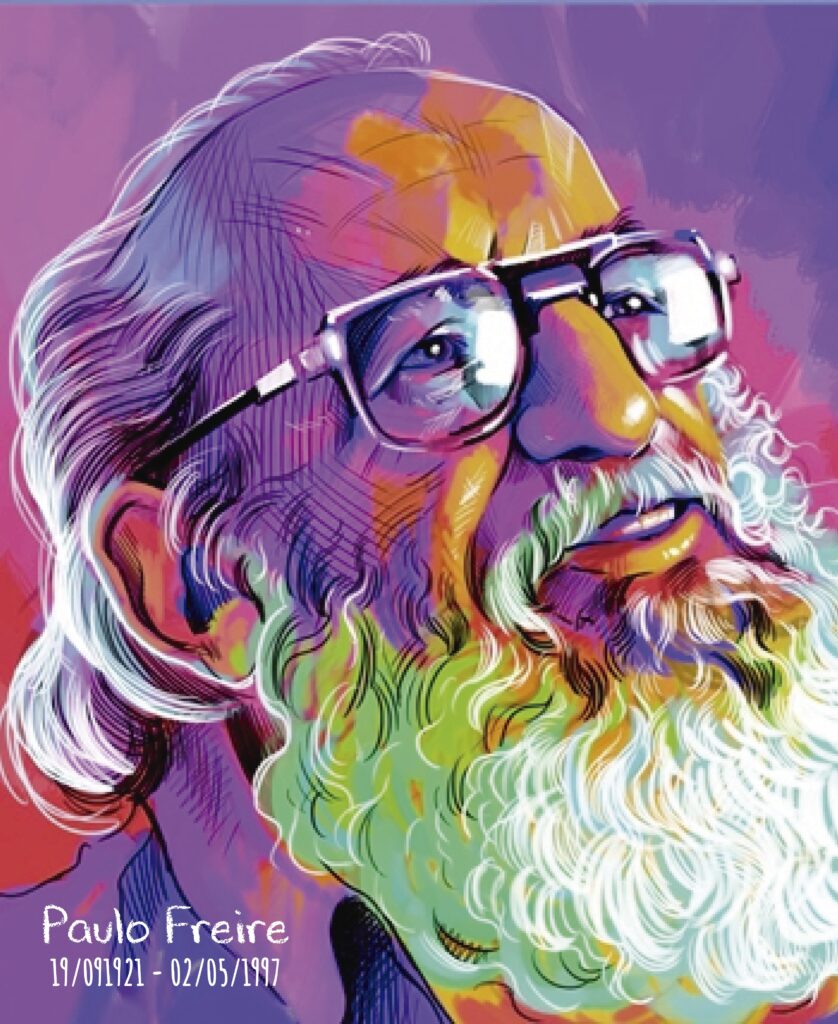
I am interested in the U.S. because of Paulo Freire’s legacy here. Many people practice critical pedagogy, particularly in fields such as critical race theory and ethnic studies. In design studies and graphic design research, critical pedagogy remains uncommon, but I am trying to introduce, develop, and experiment with it alongside our students and the Design & Oppression Network.
The basic point of critical pedagogy is problem-posing education. It is not only about finding solutions or understanding theory, but about understanding the world as something we can criticize. That is why it is called critical pedagogy. It also requires accepting that the world contains multiple perspectives. Each person lives in a different world. Sometimes we share worlds; sometimes we do not.
Knowledge is not a product that can be placed into someone else’s head and transferred. Knowledge must be created through dialogue and conversation. That is why I chose a workshop rather than a traditional lecture format to demonstrate what I can do. This approach also invites action in response to what we are learning. If you see a problem in the world, the point of this education is to recognize yourself as part of that problem and then do something about it from within.
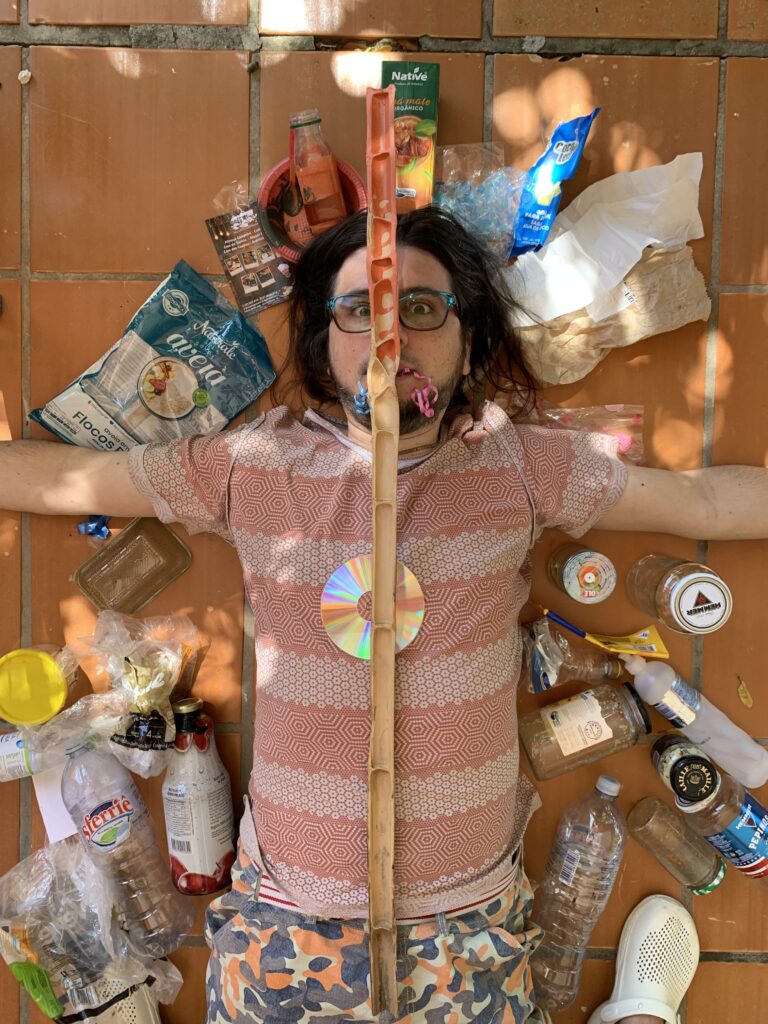
This leads to my first invitation to dialogue. You see this picture that I produced; roughly at the same time, you will have to produce your own image. The title is I Am My Trash (2023). This is the material I saved for one week. I will explain later why I did this, because I want to begin with a dialogue.
What do you read in this picture? What can you see? Which items do you recognize? I am Brazilian, like Paulo Freire, and the items are labeled in Portuguese. You may not be able to read the language, but you can read graphic design language. Which kinds of items do you think I consumed that week?
I can see you identified items such as a bag of chips, water bottles, juice, bamboo, and glass containers, possibly for pickled vegetables. I know you are engaging with a different culture, a different world. How would you characterize the person who consumed these items? What do these objects suggest about me?
You may also interpret my body position. Why am I in this posture? Why am I lying on the ground? I see you observed patterns in how the trash is distributed around my body. This distribution likely communicates something about me, don’t you think?
These CDs might indicate someone for whom technology is central. You are right, my facial expression suggests surprise at the amount of trash. Plastic appears to be the predominant material. Some of you felt I looked unaware, lost, or not particularly bothered. Others noticed details such as the ribbon in my mouth and the red circular object near my head.
Considering the composition, you divided the image into four sections and noticed contrasts between organized and disorganized areas. Trash is usually chaotic, and we try to hide or dispose of it rather than organize it. Only recently have some people begun separating dry waste from organic or human waste.
Now consider traditional positionality categories discussed in critical race theory. What can you infer about my race, gender, sexuality, nationality, ethnicity, or religion from this image? The labels are not in English, but graphic design communicates beyond text. Some of you associated the pose with a cross, referencing Christianity. Christianity is the predominant religion in Brazil, and Paulo Freire was also a Christian. I am not Christian, but its influence on my upbringing cannot be denied.
You also considered clothing. My dress clearly expresses sexuality, gender, and race impositions and preferences. Some of you interpreted the items as suggesting health-conscious habits. For example, there is no soda in the image.
I will not explain my intended meaning because the point here was to create a work open to multiple interpretations. This helps to reconstruct the underlying contradiction behind the image through dialogue, which is much more interesting. Now I am going to give my perspective about it.
The things we consume shape who we are. The things we produce also shape who we are. In a way, every consumption act is also a productive act. As for designers, they learn to produce while consuming, constantly imagining how things could be redesigned. Because we are what we consume and produce, and because we rely on others’ production, our bodies are designed by others. However, bodies are not designed equally. People are shaped by different groups and have unequal access to consumption and production opportunities. Therefore, design constructs privilege.
If my body represents my position in the world, that position is not defined solely by me. I cannot fully describe my position because I am unaware of all the influences shaping me. That is why I ask you to read my image; I would miss things you see. Your perception contributes to who I am. At the same time, I produce myself in ways that sometimes counter and sometimes reinforce your assumptions. These are the central matters of positionality.
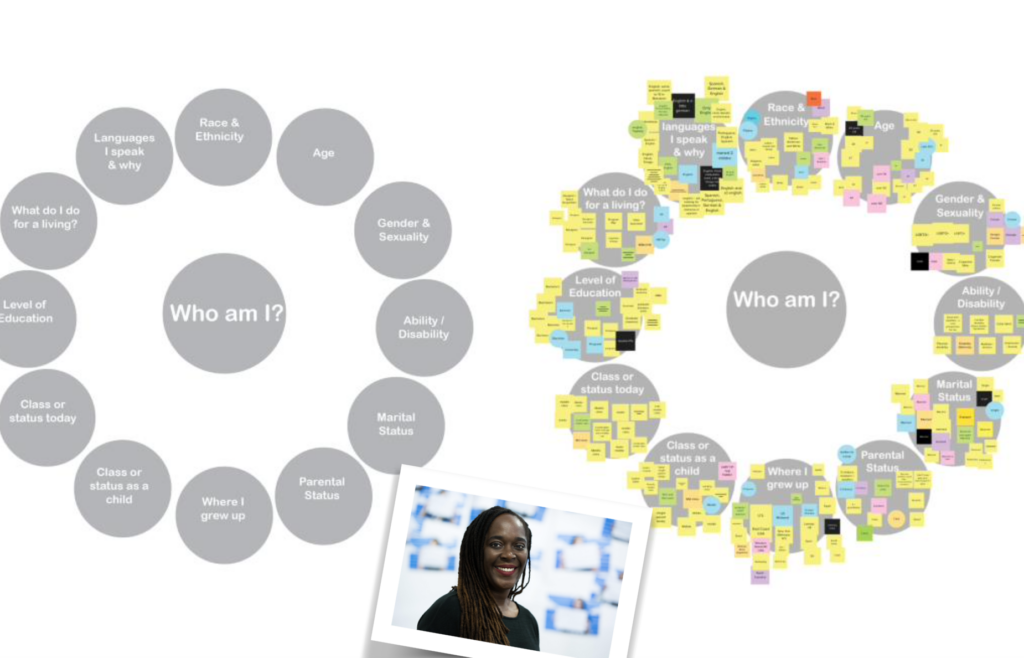
Lesley-Ann Noel from North Carolina State University developed a positionality wheel, a workshop framework where participants answer questions about language, race, ethnicity, age, and so on. Patterns and differences emerge. She is also developing a positionality radar focused on privilege and unequal access to design products and services. I find these tools very useful for longer projects, but we don’t have enough time to use them today. Here, we will create our own ways of expressing ourselves rather than fit into predefined classifications.
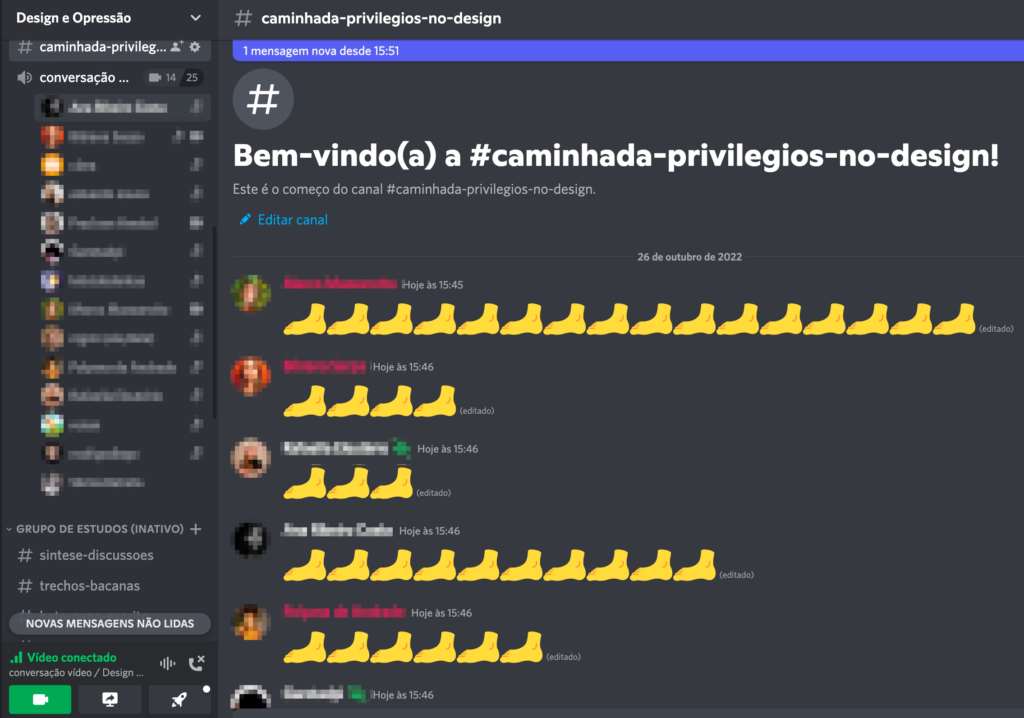
At the Design and Oppression Network, we do something similar to what Lesley-Ann Noel does, but through an adapted “privilege walk” activity. Participants answer questions such as whether their building has a graphic design logo. They step forward or back depending on privilege. We then compare results and discuss why some people have more privileges, often correlated with being male, white, and heterosexual in Brazil.
Our key question is how to turn privilege into a right. If you share the benefits you receive from privilege structures—such as university access—you are “hacking” privilege, which is meant to be exclusive. Sharing can challenge its exclusivity. This begins with disclosing positionality: who you are, your privileges, what you can share, and also your lack of privilege. Most people are privileged in some areas and underprivileged in others. The I Am My Trash activity expresses this.
The first inspiration is a Theatre of the Oppressed activity called Human Being in Trash, conducted in Brazilian favelas, where participants created collective bodies from trash to reflect shared community features. My second inspiration is Vic Muniz, who created self-portraits from trash at a Rio de Janeiro dump, collaborating with waste pickers. The project, documented in a film, helped participants gain recognition and income, illustrating socially engaged art and shared privilege. The third example is Greg Segal’s Seven Days of Garbage (2014) project, which asked people worldwide to save a week’s worth of trash and be photographed, revealing cultural differences.
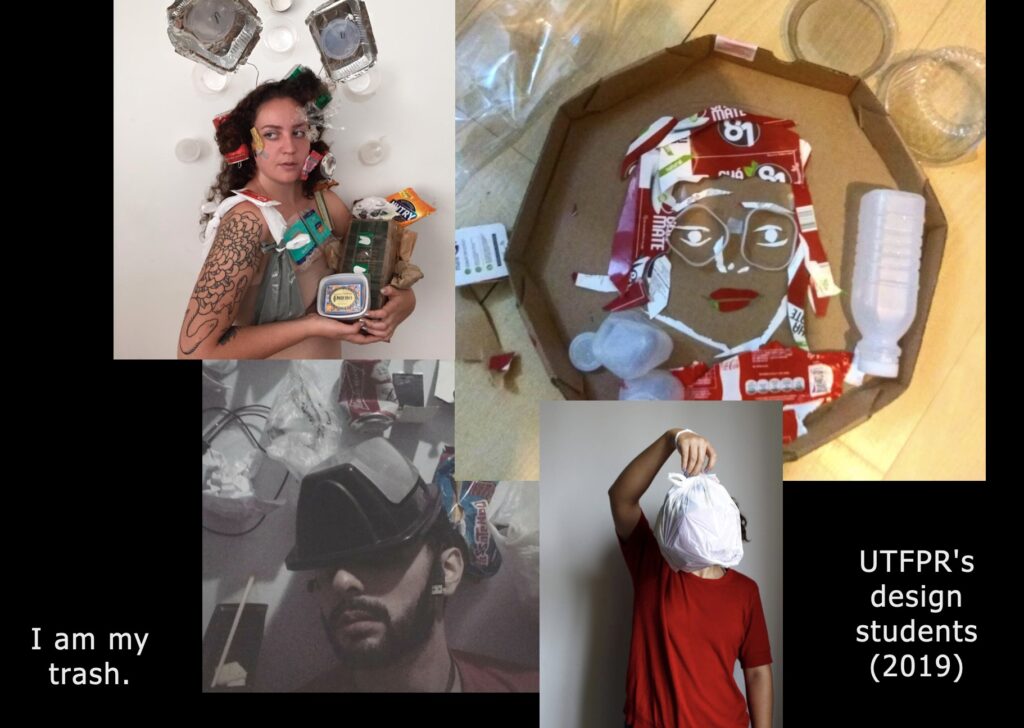
Here are examples from my students. One placed a trash bag over his head. Others drew with trash. These are quick responses to the prompt. Each one was discussed in class to uncover its underlying contradictions.
Now, let’s begin the work here. Disclose your privileges and let them go. If you do not feel privileged, express that through how you arrange your trash. Open your trash bags, sort, arrange, cut, or assemble. Take a picture. You may help each other. Be mindful that everyone’s time is limited. You have 15 minutes, so work quickly and focus on expressing your ideas creatively.
We will compare the results afterward. Finally, we will discuss these general questions:
- What do you think about trash as a design material?
- What is similar and what is different in these portraits?
- How does trash speak about privileges?
- What is the role of graphic design in keeping and challenging privilege structures in society?
- What is the environmental impact of privileged and underprivileged designs?
To conclude this workshop, the design body is the body that is designed by the world while designing the world. Reflecting on positionality means positioning our design bodies critically in the world, including their privileges and lack thereof. I hope you learned something about positioning your body more critically today.