Algorithms are mathematical and logic structures that sort, transform, and create information in computers and, increasingly, in society. Algorithms change human-to-human interactions in ways that are difficult for users to understand. Most people cannot grasp algorithms implications to everyday life solely by reading academic papers or, even less, by reading source code.
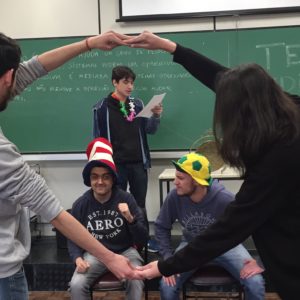
Embodied algorithm helps users with little computer knowledge to understand and manipulate these logical and mathematical structures in everyday life. The method translates the operational structure of an algorithm to human body interaction rules that can be followed by players, workshop participants, or learners. Participants assume the functional role of agents within a system and enact explicit rule sets that govern movement, attention, interaction, and decision-making.
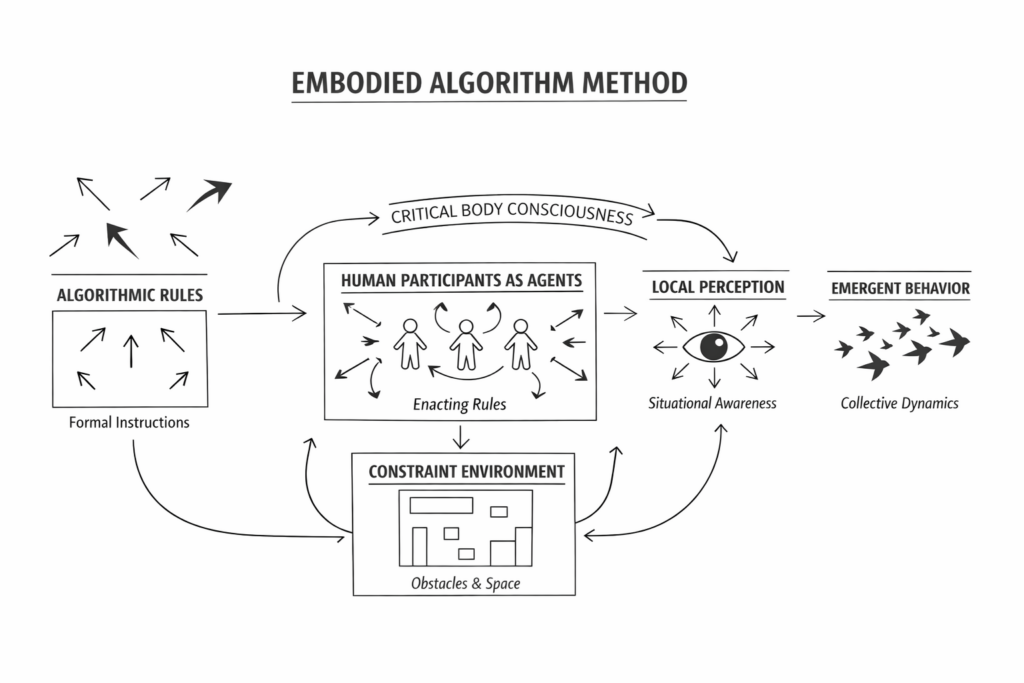
By translating procedural logic into situated human action, the method makes system dynamics perceptible at the scale of bodily experience. Emergent phenomena such as coordination, instability, feedback, congestion, and adaptation become directly observable as collective effects rather than as abstract outputs.
This method stems from Theater of the Oppressed‘s dramatic games, which aims at demechanizing the body by scrutinizing the everyday postures, gestures, and rituals that reproduce oppression in society. In these games, players actively construct and interrogate a model of society through embodied interaction that require little speaking and a lot of body language. Critical body consciousness emerges through the tensions and adjustments produced by participation in a rule-bound environment.

This method aligns closely with the pedagogical tradition known as Computer Science Unplugged, a framework developed to teach computational concepts without reliance on digital devices. Within this tradition, algorithms and data structures are explored through physical games, role-based exercises, and tangible manipulations that externalize the logic of computation. The underlying rationale is that core principles of computer science — including recursion, distributed control, search, sorting, and synchronization — can be meaningfully understood through structured activity in the material world. Algorithms are treated as organizational structures that can inhabit bodies, artifacts, and environments as readily as they inhabit machines.
The embodied algorithm method occupies an intermediate space between simulation, pedagogy, and critical inquiry. It does not seek to replace computational modeling but to complement it by foregrounding the experiential, perceptual, and relational dimensions of systems that are typically encountered only through symbolic representations. Through these examples, we aimed to reveal the human-to-human interactions embedded in computer algorithms. When people understand these interactions, they can engage more critically with computers.
Examples: