I Am My Trash is a self-portrait created as an example of process art to stimulate design students to practice self-criticism. I saved my trash for seven days, then lay down on top of my pile. Bottles, wrappers, packages, plastic, food containers, CDs. The things that had passed through my hands came back as a strange landscape around my body. This was my surrealist self-portrait. But it was also a portrait of a world neither I nor my students knew much about. At that moment, in the Spring of 2023, I was a Latino professor living and teaching in Florida, United States.
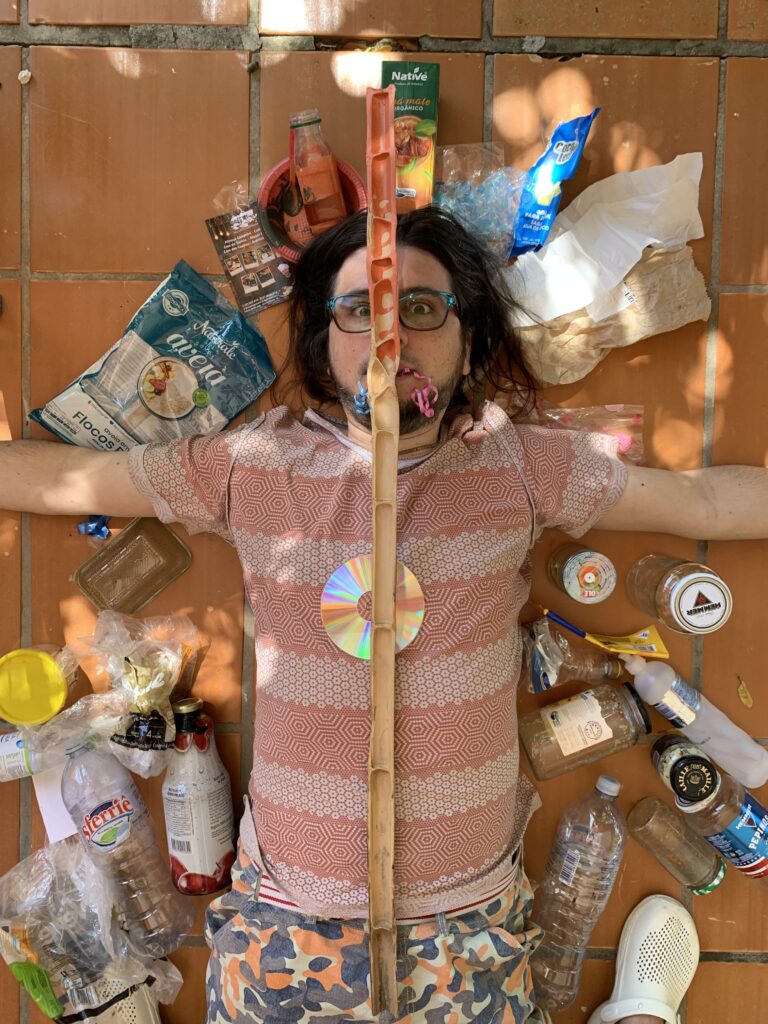
Trash is usually collected to be out of sight. In this artwork, trash is collected to remain present at hand. The ready-made becomes present-made: its packaging, origin, branding, materiality, and quantity can be examined as evidence of the multiple designs shaping who we are and who we make ourselves out to be. In this sense, I Am My Trash plays with the fact that we do not only produce trash; we are trash. Still, we may or may not remain in that passive state. We may reduce consumption, choose products made out of biodegradable materials, and boycott products that cause invisible harm in other worlds.
A seemingly insignificant act of consumption mobilizes many worlds to the benefit of the consumer’s world. Due to the coloniality of making, some worlds have greater power to produce technologies, brands, standards, and designs, while others are positioned primarily as users or consumers, or even as consumers of consumers.
From the moment we assume we are trash, we take responsibility for our world (because we are more than just trash) and begin our journey out of the existential conundrum we got ourselves into. Then, we can realize that consumption is never just that: it is always the production of a self, a position, or an individual action that makes up massive collective actions in the world.
Process description
Workshop participants collect their waste for seven days, use it to construct a self-portrait, and then discuss the resulting images collectively. The photographs become occasions to examine privilege, inequality, desire, consumption, and the social conditions through which identities are produced. Participants discuss how everyday consumption can be connected to racialization, gender norms, class habits, multinational corporations, and visual identities produced elsewhere. They, ultimately, realize that they cannot make themselves without also being made by the designs surrounding them.
The objective is not to imagine a completely autonomous, self-made man. Rather, participants are invited to take hold of the processes through which they are made by others: to recognize the designs embedded in their desires, reconsider their consumption, and potentially transform inherited habits and relationships. In that way, they can make themselves conscious of this gigantic transnational yet mundane activity of self-making.

The artwork consequently treats self-making as an existential project subjected to an ontological design. If people are continuously produced through their relations with designed worlds, they can also participate in redesigning those relations. I Am My Trash thus turns the self-portrait into a surrealist critical mirror: a way of seeing not only what an individual consumes, but the worlds, desires, labor, and designs that make the individual—and the possibilities for making oneself otherwise.
Potential learning outcomes
I Am My Trash can be embedded in design education as part of a critical pedagogy: an artistic process through which students examine their own participation in the systems they are learning to design. Rather than introducing sustainability, ethics, or visual composition as abstract professional requirements, the activity makes these concerns tangible through students’ own material lives.
Commonly addressed topics in design education that are covered by this activity:
- Sustainable design and packaging: material selection, material quantities, packaging layers, recyclability, durability, disposability, production and waste, and the environmental consequences of seemingly minor packaging decisions.
- Design ethics: responsibility for consequences beyond the immediate user, unequal distribution of benefits and burdens, labor and resource extraction, corporate influence, consumption, and the social implications of design decisions.
- Graphic design: visual hierarchy, arrangement, contrast, repetition, scale, color, typography, visual identity, branding, information, and the communicative potential of materials normally excluded from graphic composition.
Rather than treating these as abstract professional criteria, the activity turns them back toward the students themselves: how do the designs they consume shape their desires, habits, and identities—and what kind of designer do they become through them?
Do it yourself guide
The challenge of I Am My Trash is to create a self-portrait using personal dry waste accumulated over the previous seven days. Treat the waste as a design material rather than simply as something to discard. Arrange, transform, combine, or compose the materials to express something about how you are positioned in the world.
The portrait may use trash alongside the body, around it, on it, or entirely instead of it. There is no required visual style. The important part is to make your everyday consumption visible and use the resulting composition as an opportunity to reflect on your place in the world.
After creating the portrait, the images will be displayed and discussed collectively among the workshop participants. We will look for differences and similarities between the portraits and consider what the materials, compositions, and absences might reveal about how people make themselves and are made by the world.
How to prepare for the workshop:
- Save your dry waste for seven days before the activity.
- If an item was consumed collectively, keep only the waste that you feel responsible for.
- Do not collect hazardous materials such as broken glass, razor blades, or other sharp objects.
- Clean or dry any waste that contains food or other wet material.
- Bring your collected waste to the workshop, preferably in the bags or containers where you have been keeping it.
- Come curious about what your colleagues’ waste might reveal—and what your own might disclose to them.
How to make the portrait:
- Open and sort your collected waste.
- Look at the materials before deciding what they should become.
- Arrange, cut, combine, stack, or otherwise compose the waste.
- Place it around your body, on your body, or construct a self-portrait entirely from waste.
- Ask colleagues for help if you need someone to photograph you.
- Take the photograph with a personal smartphone.
- Print the portrait or display it on a shared computer screen.
- Discuss what becomes visible when everyone’s personal waste is placed side by side or in a slideshow.
Required tools
- Personal smartphone
- Thick and thin adhesive tape
- Scissors
- Wall or other surface for displaying the prints
Optional tools
- Big screen connected to a computer with an easy photo sharing feature (airdrop, dropbox, and others)
- Box cutter and cutting board
- Photo booth
- Wifi enabled printer (with an easy way to print from the smartphone)
- Instant cameras
References
Souza, E.A., Saito, C., van Amstel, F., and Freese Gonzatto, R. (2026) Who designs the designer? An anticolonial response to the world that design us back, in Simeone, L., Gray, C. M., Verhoeven, A., de Götzen, A., Bakırlıoğlu, Y., Zohar, H., Stead, M., and Buwert, P. (eds.), DRS2026: Edinburgh, 8–12 June, Edinburgh, United Kingdom. https://doi.org/10.21606/drs.2026.2410
Van Amstel, Frederick M. C., Gonzatto, Rodrigo F., and Saito, Carmem. Coloniality of Making in Design Philosophy. In: Secomandi, Fernando and Verbeek, Peter-Paul (Eds.). Design Philosophy after the Technology Turn, 41–60. London,: Bloomsbury Visual Arts, 2026. http://dx.doi.org/10.5040/9781350494480.ch-3
Saito, C., Freese Gonzatto, R., and van Amstel, F. (2024) Anticolonial prospects for overcoming the coloniality of making in design, in Gray, C., Hekkert, P., Forlano, L., Ciuccarelli, P. (eds.), DRS2024: Boston, 23–28 June, Boston, USA. https://doi.org/10.21606/drs.2024.255