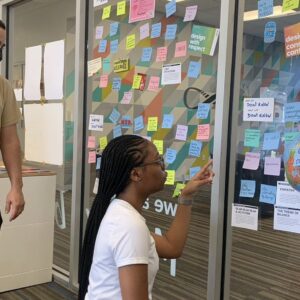
Reflective writing complements the design studio learning experience with a theoretical challenge that is as important as the practical challenge of learning design: to know oneself and the world around it. Studio environments typically privilege reflection-in-action, or reflecting while designing, which is great for learning the materials of a design situation, but poor for learning about the self who designs.
Reflective writing puts reflection-on-action on equal weight to reflection-in-action: a temporally detached, analytical stance that turns experience into explicit, interrogable knowledge that can be shared, debated, and extended by studio peers and instructors.
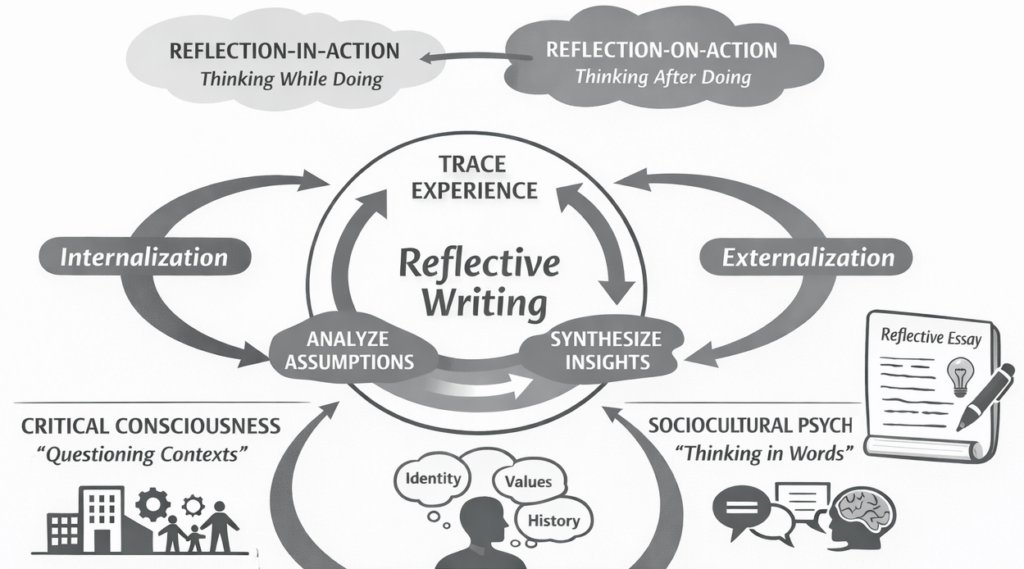
Reflective writing requires participants to interrogate how their own standpoints, experiences, and normative assumptions influence perception and judgment. Reflexivity operates as a methodological stance rather than personal disclosure, acknowledging that the observer is inseparable from the phenomena observed. Design choices, evaluations, and interpretations are analyzed as effects of perspective rather than expressions of universal reasoning.
Design students, in particular, benefit from this emphasis. A typical design curriculum cultivates perceptual acuity, material fluency, and iterative prototyping — all forms of reflection-in-action. What is less common is structured writing practice that supports reflection-on-action. By foregrounding writing as a cognitive tool rather than an academic requirement, this method expands designers’ representational repertoire. It teaches students to articulate how they learn, how they decide, and how they position themselves within the design situation.
The reflective writing assignment is typically a free-form self-reflection that critically analyzes the learners’ learning process, focusing on metacognition and the act of designing. Unlike an academic paper, which builds an argument based on external sources and structured methodology, this essay emphasizes personal insights, reflexivity, and synthesis of experiences.
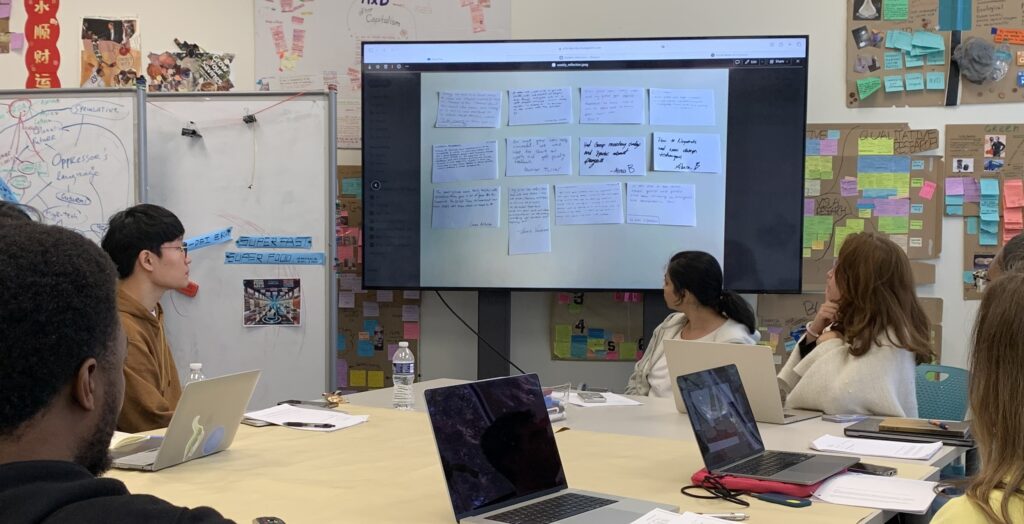
Before turning in the full assignment, students are prompted to write reflective notes on a card right after experiencing key turning points in the studio experience: project definition, field study presentations, user testing results, and other moments. Later, they can use these cards as drafts for their final reflective writing. The cards can also be discussed to find patterns and generative themes among students and their projects, which can be thematized in the final writing as well.
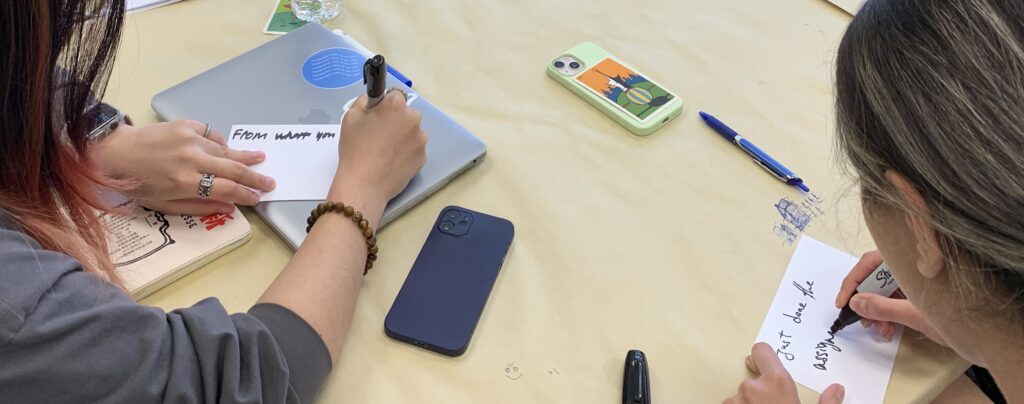
Design students, who often experience writing blocks, can be stimulated with visual creativity methods such as Intùiti cards. By drawing a card and first projecting their intended meaning onto a figure and later onto verbal and textual expression, they can gradually unfold their thoughts in a guided environment.
References
Dors, Tania M.; van Amstel, Frederick M.C.; Binder, Fabio; Reinehr, Sheila dos Santos; Malucelli, Andreia. (2020). Reflective Practice in Software Development Studio: findings from an ethnographic study. In: Proceeding of the 32nd Conference on Software Engineering Education and Training (CSEE&T), Munich. https://doi.org/10.1109/CSEET49119.2020.9206217