Design and Culture is a 45-hour course in UTFPR’s Bachelor of Design.
In this course, culture and design theories are presented to encourage students to develop their own explanations of the different forms of design cultivation. Classes are structured around the culture circle, a participatory educational method developed by Paulo Freire to promote literacy and critical awareness through dialogue. In them, dialogue arises from generative themes collected from the participants’ everyday lives. A theme can be presented through words, images, objects, games, and theater. Through Theater of the Oppressed, Dramatic Games, and Object Theater, the dialogue is expanded to the entire body.
This critical pedagogy prioritizes reading the designed world over reading the designed word. A visual diary is required to mediate between these two ways of reading. Students read their surroundings, record them in their diaries, expand their reading capabilities by reading academic texts, and return to their world to see it differently. The culture circle is where they share their readings and generate new design themes.
Through this course, students develop critical semiotic coding and decoding skills that is not just useful to graphic design, but also to industrial and experience design.
Assignment 1 (50% of the grade): Visual diary
A graphic diary is a creative, regular, and personal activity in which a notebook is used to record daily life in a mainly visual way, with drawings, doodles, diagrams, collages, or other graphic resources. Words may appear, but the focus is on visual expression. Unlike a personal diary, a graphic diary is not limited to recounting what happened. It also serves to imagine what could happen in other futures, or to reinterpret alternative pasts and presents. It is a space to observe, reflect, and imagine how design manifests itself culturally in everyday life.
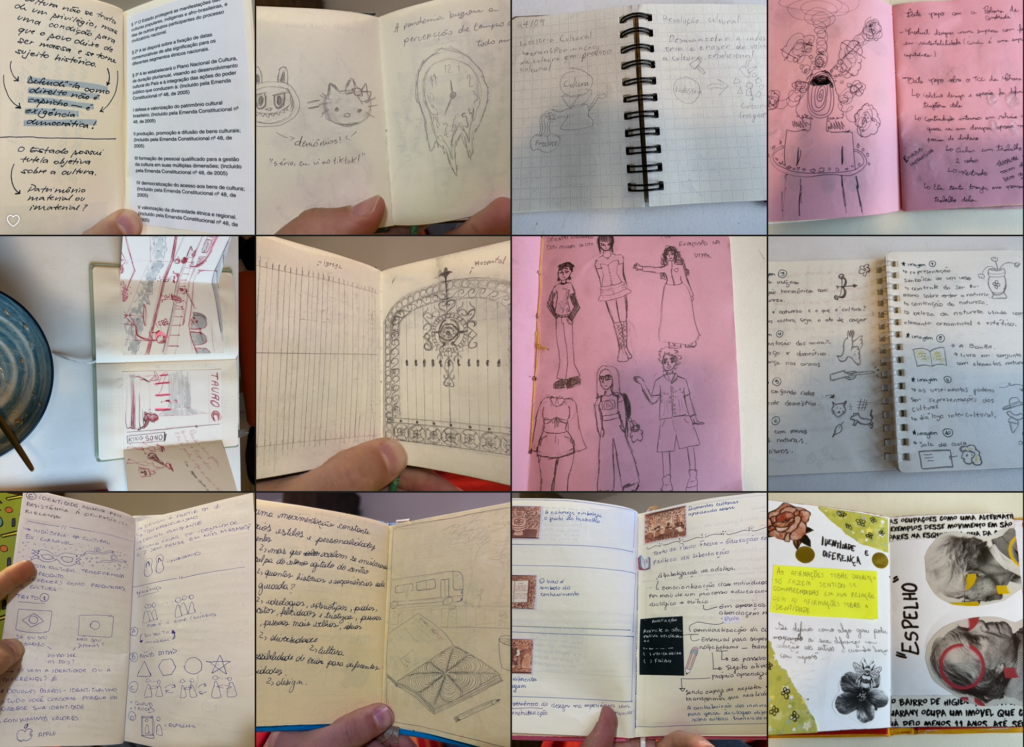
Throughout the course, the diary will help you to exercise your reading of the world — that is, to interpret the different designs we find or do not find in our surroundings. This reading is not restricted to objects, but also to services, spaces, media, ways of dressing, and social practices. It is suggested that you fill out the journal every week before and/or after class.
Assessment criteria
- Continuous and varied observation of the world
- Ability to frame design as culture
- Direct or indirect mention of concepts and theories found in the recommended readings for previous classes
Only graphic diaries in analogue notebooks will be accepted due to their portability and the difficulty of generating them with artificial intelligence. The graphic diary must be handed in to the teacher in class before or by the stipulated deadline.
Assignment 2 (50% of the grade): Visual essay
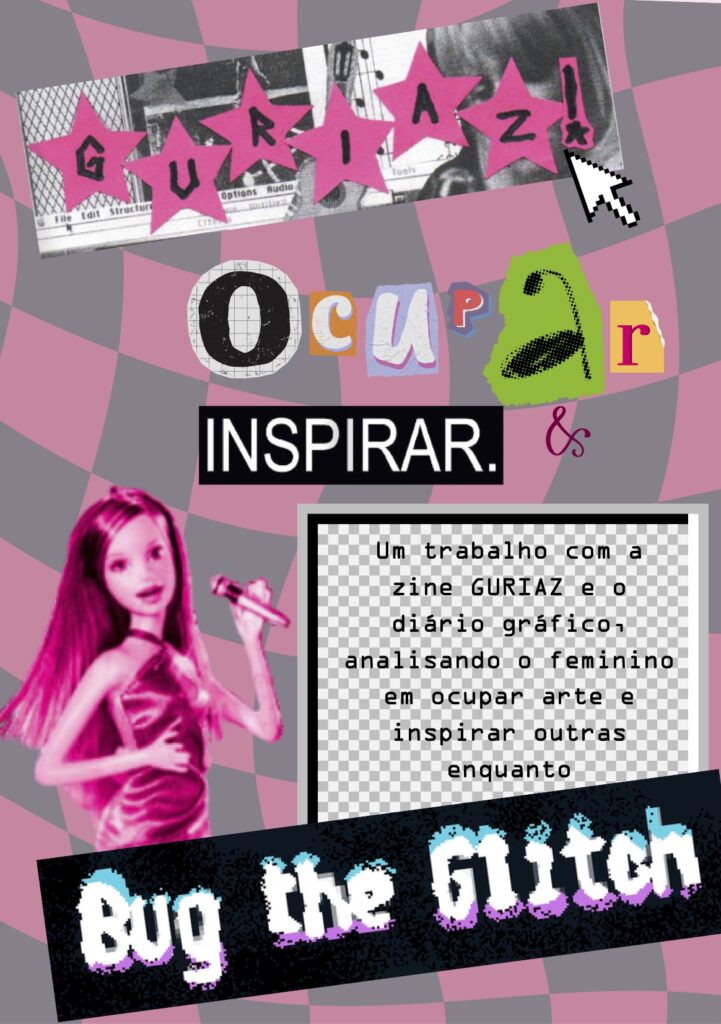
The second assignment for the course consists of a group visual essay, in which teams (2 to 4 people) must theorize the cultural patterns found in the individual observations registered in the graphic diaries. This essay is not just a traditional academic text, but an academic-artistic text, in which images and words carry equal weight. Paintings, drawings, photographs, collages, and graphics should be incorporated as a central part of the argument, not as illustrations. The images need to be inserted throughout the essay, in direct dialogue with the text, to broaden, deepen, or question what is being written.
Each essay should contain images from the graphic diaries of all team members, treated as material for collective analysis and creation. The essay can be produced in digital (PDF) or printed format, as long as the images are incorporated throughout or alongside the text. The graphic project is free, as long as it meets a minimum level of legibility for the teacher to evaluate the work.
The critical and reflective use of Large Language Models (such as ChatGPT) is encouraged as a support in the writing process. Final decisions on text and images are the responsibility of the authors. As part of the reflection, it is recommended to declare and comment on the use of these tools when applicable. It is important to note that automatic generation does not replace the physical material produced in graphic diaries, which is irreplaceable in this proposal. The idea is to encourage students to think with different media — words, images, machines, notebooks — and compare their effects on thinking. Neither the drawings nor the texts (human or artificial) should be taken as truths in themselves, but as starting points for critical reflection.
Assessment criteria
- Integration between text and image
- Clarity and theoretical depth in the interpretation of cultural patterns
- Creative and critical use of visual materials from graphic diaries
- Consistency and cohesion in group production
- Reflexivity about the process (including the use of digital tools, where applicable)
The work is exclusively group-based because it requires engaging with others to understand the relationships between culture and design. Individual work will not be accepted, except in special cases and circumstances that must be disclosed to the teacher in private communication.
Semester outline
13/08/25 – Design as culture
This introductory class frames design as part of culture. It explains the culture circle method and the critical pedagogy approach. The teacher discloses his positionality, past experience with the topic, and the possibilities for learning more about this topic beyond this course.
Readings:
- Cultural alienation in design
- Visual diary instructions
- Design Issues journal
- Design e etnocentrismo
- Tendências, clichês e reprodução cultural no design
20/08/25 – The anthropological concept of culture
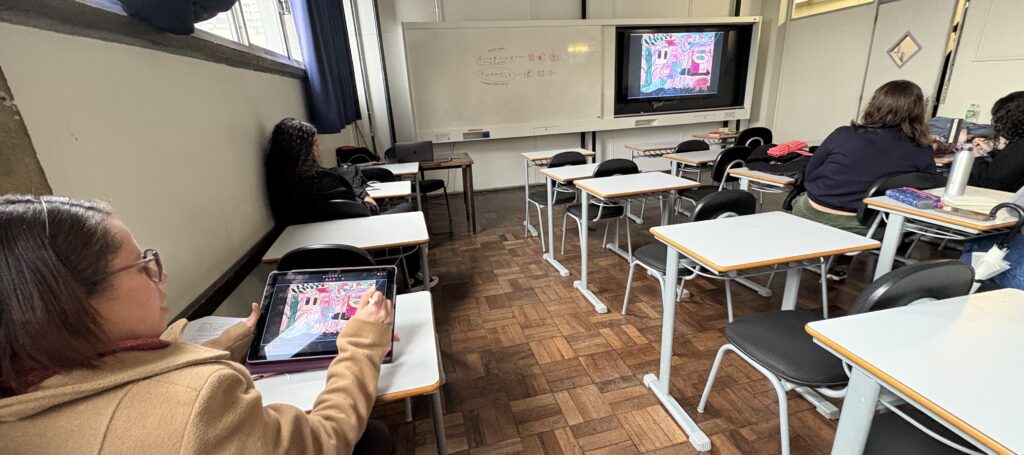
The first culture circle reenacts the classic preparatory workshop in which Freire invites students, competent readers of the world, to read images of the world before learning to read words of the world. The goal here is to reflect on what nature and culture are, how they relate dialectically, who can produce culture, and what design culture may mean in critical pedagogy. To reach that goal, generative images are projected onto the screen and annotated in real time using a tablet that passes from speaker to speaker, like a talking stick. Design students are encouraged to leave traces of their visual thinking as they share their readings through speech. No particular analytical framework is employed here, precisely to facilitate comparison with subsequent theoretically guided readings.
Reading: Education for Critical Consciousness (Chapter 4, Postcript, and Appendix)
27/08/25 – Designers as cultural consumers and producers
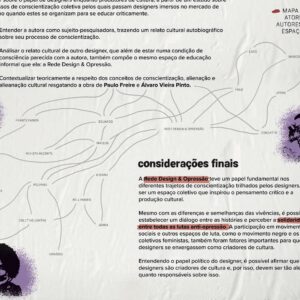
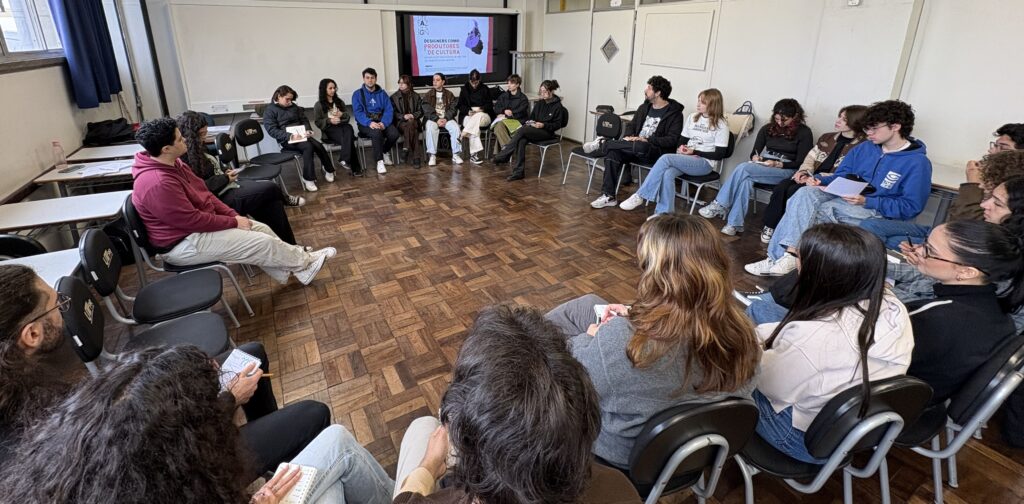
Alumna Polyana de Andrade Tavares joins the third culture circle to share her final work reflecting on the conscientization process promoted by the Design & Oppression Network, of which she was an active member. She also shares her industry experience as a user experience designer and the inevitable alienation she had to endure to climb the company hierarchy. Even so, she stressed her responsibility in producing culture, particularly digital culture. The goal of this cultural circle was to demonstrate the course’s relevance to industry practice.
Reading: Polyana’s final work in Graphic Design (Chapters 1 and 2)
03/09/25 – Ethnographic studies in design
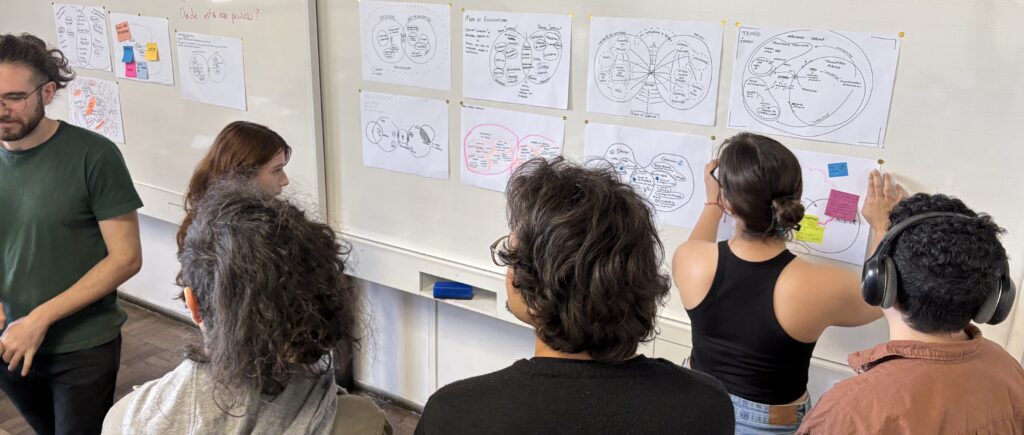
Another alumna joins the fourth culture circle, this time to share her academic and industry experience doing ethnographic studies in design. Rafaella Eleutério wove a women‘s coffee worker coalition in her final work and has since worked for government agencies, politicians, companies, and non-profit organizations, conducting rapid ethnographies for design projects. In addition to sharing her work, Rafaella hosted a brief workshop on ecosystem mapping.
Reading: Matters of Care in Designing a Feminist Coalition
10/09/25 – Ethnographic observation workshop
During the first part of the class, students took a walk around the campus while holding their visual diaries. The goal was to observe and take note of design in everyday life. After one hour in the field, they returned to the classroom to share their readings of the world in the culture circle.

Reading: DESENHO ETNOGRÁFICO: Onze benefícios de usar um diário gráfico no trabalho de campo
24/09/25 – The identity issue in Cultural Studies
After probing into the dense connections between design and culture through practice and seeing potential applications of Cultural Studies, design students are now ready to dig into theory. The first text is a Hegelian-Marxist appraisal of the identity-difference dialectic as it manifests in multicultural societies. The text frames racism, sexism, classism, and other negative body differentiation structures as part of intercultural and transcultural negotiations. The goal is to learn that designers need not always start and end with (visually) defining identity. A differentialist design, guided by positive differences, is also possible.
The reading dialogue is structured around the following questions:
- How did the text affect you?
- What have you read in its words that made you read the world differently?
- Does identity determine difference, or is it the other way around?
- How do you see the dialectics of identity and difference manifested in design?
After discussing the text, students experience the social production of identity and difference through Theater of the Oppressed dramatic games. The Mirror Games created by Augusto Boal position players facing each other, mimicking their partners so they feel as if they are in front of a mirror. They see themselves through the other’s seeing and reflect on the differences and identities so produced. In later phases, the game is played as a group, introducing the challenge of coordinating a collective body looking at the glass mirror.
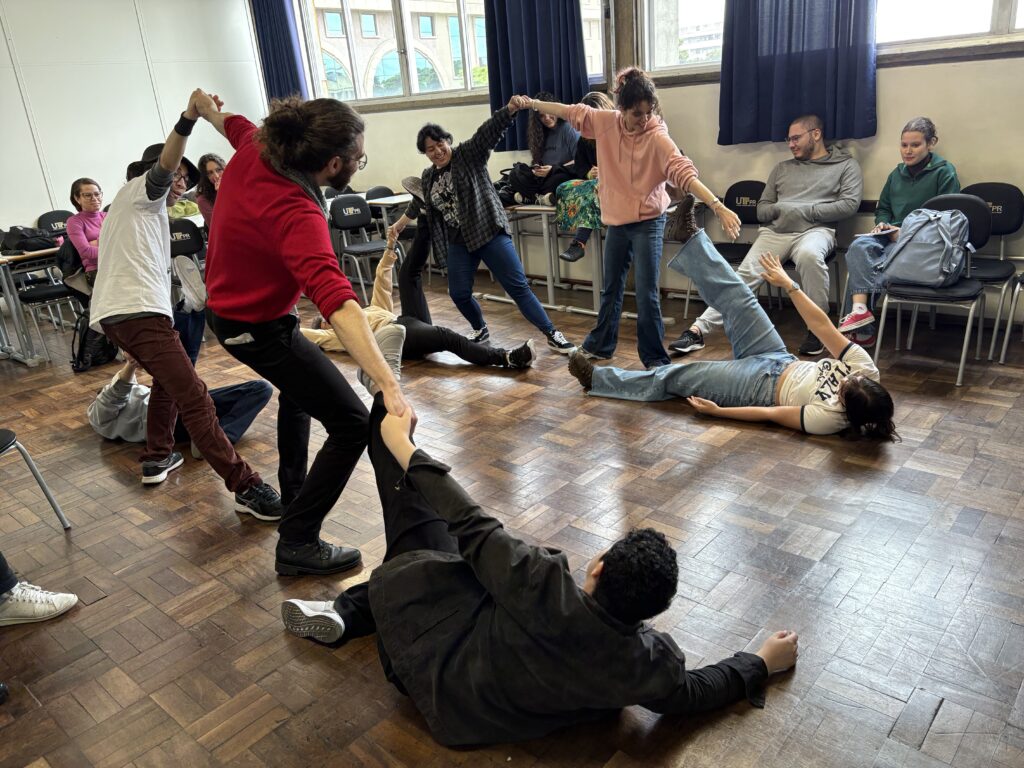
Reading: A produção social da identidade e da diferença
01/10/25 – Decoding identity and difference in design
After becoming conscious of how the dialectics of identity and difference shape their bodies, students decode how everyday objects function as mirrors in the long-term process of becoming human. In The Found Object, another Theater of the Oppressed game, each player is invited to bring a personal object they want to discuss with the others. The objects are introduced and sorted many times according to cultural categories:
- Beautiful and ugly objects
- Expensive and inexpensive objects
- Objects for boys, girls, and in-between
- Useful and useless objects
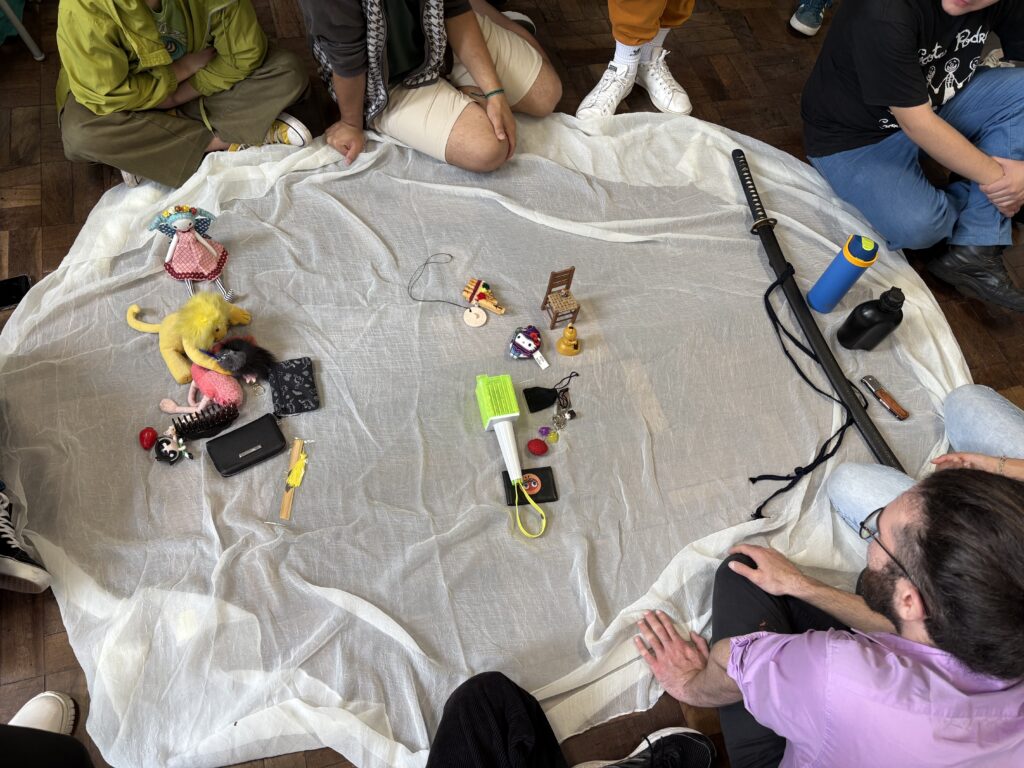
In this class, most of the objects were toys. Students wanted to reflect on the reading, which frames toy design as a gender technology. Some of them tried to find gender-neutral or gender-ambiguous toys, but failed.
The last part of the class turns into Object Theater. The objects are now characters in an improvised play exploring a particular dialectic of identity and difference. In this class, students wanted to explore the conflicts of a boy who is not supported by their parents and classmates while discovering his homosexuality and queer identity. While discussing the play in the forum, students shared real stories about how they faced similar conflicts in their own upbringings. In this class, students realize the personal relevance of reflecting on design and culture.
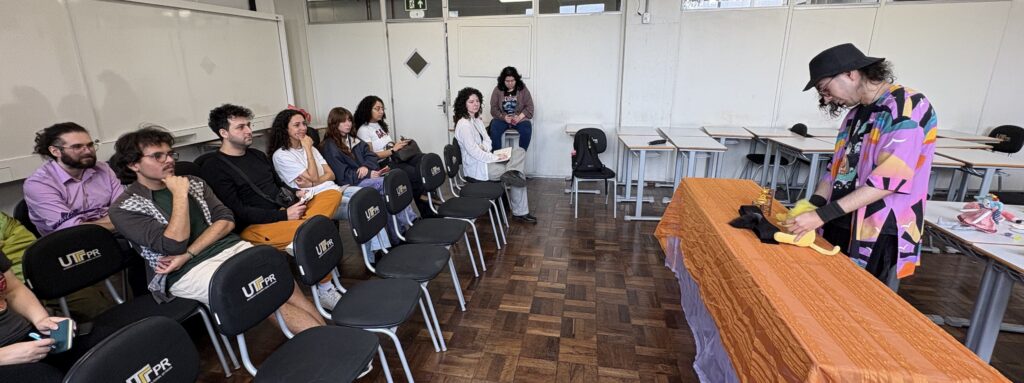
Reading: Azul para meninos e rosa para meninas? O design como tecnologia de gênero
08/10/25 – Coding identity and difference in design
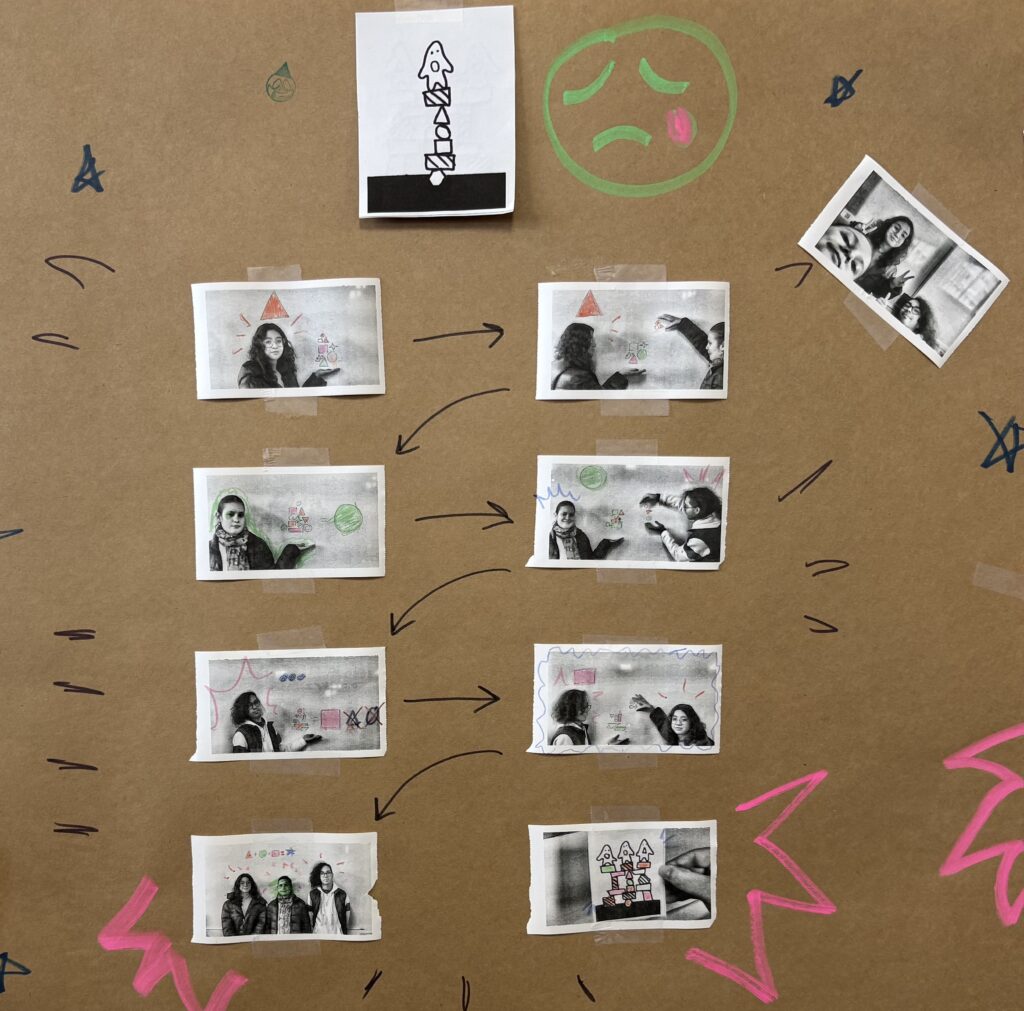
Designers are called in society to encode identity and difference in material culture, as were students in this class. After decoding how alumnae Zukowski and Kosake encoded a gender-ambiguous representation of existential crises in their crisis deck, students selected one of their cards and co-designed a photonovel depicting themselves in the corresponding existential crisis. The photos came from a kid’s instant camera, which supported quick, improvised photo shooting. In this process, design students experimented and reflected on the ethical dilemmas of encoding identity and difference.
15/10/25 – Nationalist, post-colonial, decolonial, and anticolonial designs
This is a traditional lecture-and-discussion class that expands the scope of design and culture to large-scale, planetary systems. The teacher begins by asking: What is the role of design in the process of decolonization in Latin America? First, to combat the various forms of coloniality and, second, to combat its specific form of coloniality: the coloniality of making. The coloniality of making is characterized by the maintenance of underdeveloped practices that are neither recognized nor considered sufficiently developed by the Global North. Combating it means redefining what good design means beyond European aesthetic taste.
Reading: Anticolonial prospects for overcoming the coloniality of making in design
12/11/25 – Multicultural, diverse and pluriversal designs
The class begins with students making Lego Serious Play metaphorical models of their experiences with institutional diversity. Each student present their model, they discuss their learning in the course so far, and a horizon expansion lecture follows.

Lecture summary: Universal access to high-quality design is one of the ethical principles of modernist design. However, in order to realize this modernist ethic in Europe, centuries of colonization in America and other territories were necessary. This legacy is still present in modern aesthetics as the coloniality of making. When design opposes coloniality, pluriversal design emerges. Instead of including those excluded from the modern world, pluriversal design aims to build a world in which multiple worlds can coexist.
Readings:
19/11/25 – Closing seminar
Students present their visual essay draft, composed from the group’s collected visual diary entries, and receive feedback before turning in their assignments.