Abstract: Reality is so hard to change these days and, at the same time, so easy to deny, that design research is increasingly about virtual, augmented, mixed, and speculated realities. Prospective design is a research program born at UTFPR, Brazil, Global South, that speculates on reality as part of a larger move of transforming reality. Building upon critical pedagogy, Theater of the Oppressed, and other radical approaches, prospective design aims at changing reality by intervening in the critical infra and metastructures of society. By articulating the spectacular with the banal at multiple levels of reality, prospective design opens up a new design space for engaging with social movements, government, companies, and other collective bodies interested in changing reality.
Recorded during a visit to the ArcK research group, Hasselt University.
Video
Full transcript
I’m a Dutch-Brazilian researcher currently living in Curitiba, in the southern part of Brazil, where I lead the recently created graduate program in Prospective Design. Since the program has existed for less than a year, this presentation is one of the first public opportunities to discuss its overall vision and its engagement with participatory design and related fields that inform our work.
Before discussing Prospective Design itself, I want to contextualize the contradictions that brought us here. The beginning will be philosophical and dense, but gradually we will move toward a more specifically design-oriented approach to dealing with these contradictions.
It is not new in philosophy to argue that a significant part of reality is invisible to the naked eye. Nor is it new to say that reality is untouchable or inaccessible through touch and other senses. The reachable reality conceals the unreachable in order to prevent the emergence of alternative realities. This concealment is intentional. It is designed. Some call this ontological design.
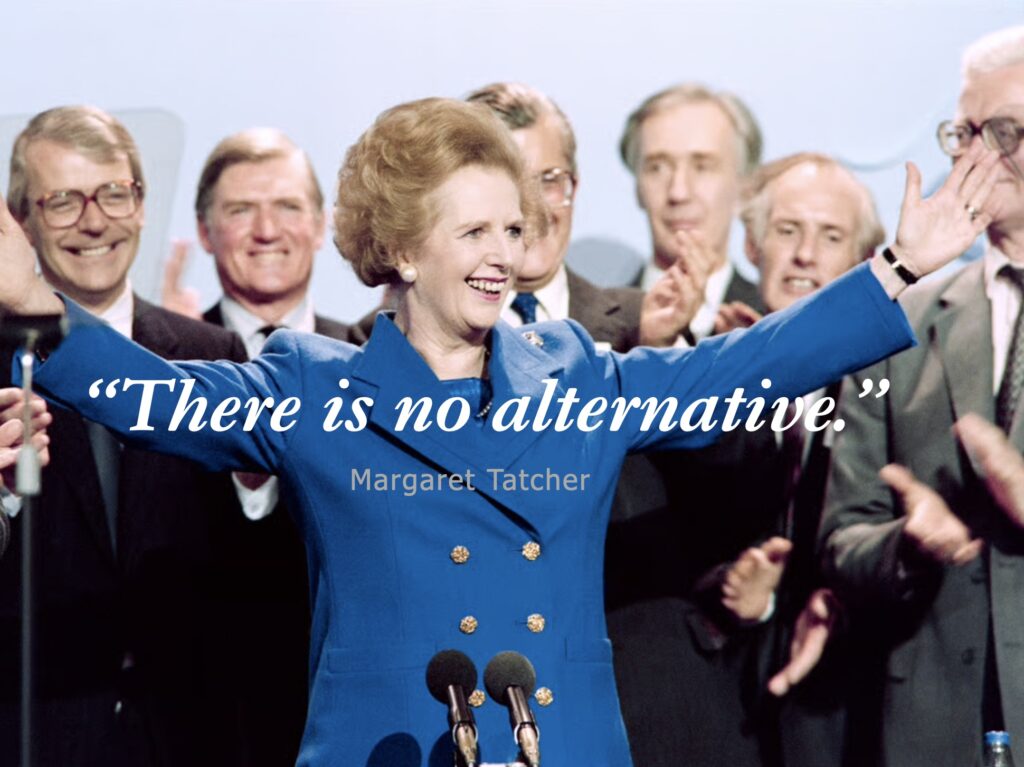
I prefer to invoke figures from the political arena who expressed this more directly, such as Margaret Thatcher. In many speeches, Thatcher insisted that there was no alternative to what we now call the neoliberal approach to government and society. In many ways, she became a trailblazer for what unfolded from the 1980s onward. Many of her strategies, suggestions, and predictions became unavoidable for some people—though not for those, like myself, who insist on seeking alternatives.
Looking critically at the history of reality production, we find that capitalist reality has indeed been socially produced, politically organized, and economically exploited as if there were no alternatives. This absence of alternatives is not a recent feature of neoliberal capitalism. Capitalism has always operated as a world system with a totalizing tendency, incorporating everything as a potential source of revenue. Whatever is not yet incorporated must eventually be absorbed, whether through trade, war, conquest, colonization, or other forms of coercion. Capitalism seeks to capitalize on everything possible; therefore, nothing can remain outside of it. There is nothing outside the reach of capitalism; hence, no alternative is left to think and make a world otherwise.
Critics of capitalism have captured this condition through concepts such as capitalist realism and the well-known phrase “it is easier to imagine the end of the world than the end of capitalism”. This framing is deeply fatalistic. Although it resonates with everyday political discourse, it offers little hope. Public debate increasingly revolves around different versions of capitalism rather than possibilities beyond it. One might hear proposals for a more conscious or ethical capitalism, but discussions extending beyond capitalism remain rare in economics, politics, and culture. Capitalism is not merely an economic regime; it is a total regime in which cultural production, cultural goods, and even our own bodies become capitalized.
Mark Fisher advanced this critique and searched for possibilities of hope before his death. Yet I increasingly struggle to find hope in his critique. I prefer to return to the 1960s, when critics of capitalism were directly engaged with social movements and willing to place themselves at risk within those struggles. One important figure from that period is Guy Debord, a member of the Situationist International and the Situationist artistic movement. In The Society of the Spectacle, he theorized the veil that conceals reality in a particularly relevant way for design. Debord described the spectacle as a project imposed upon reality—a distributed, participatory design process in which everyone, through everyday life, contributes to the continual production of the spectacle.
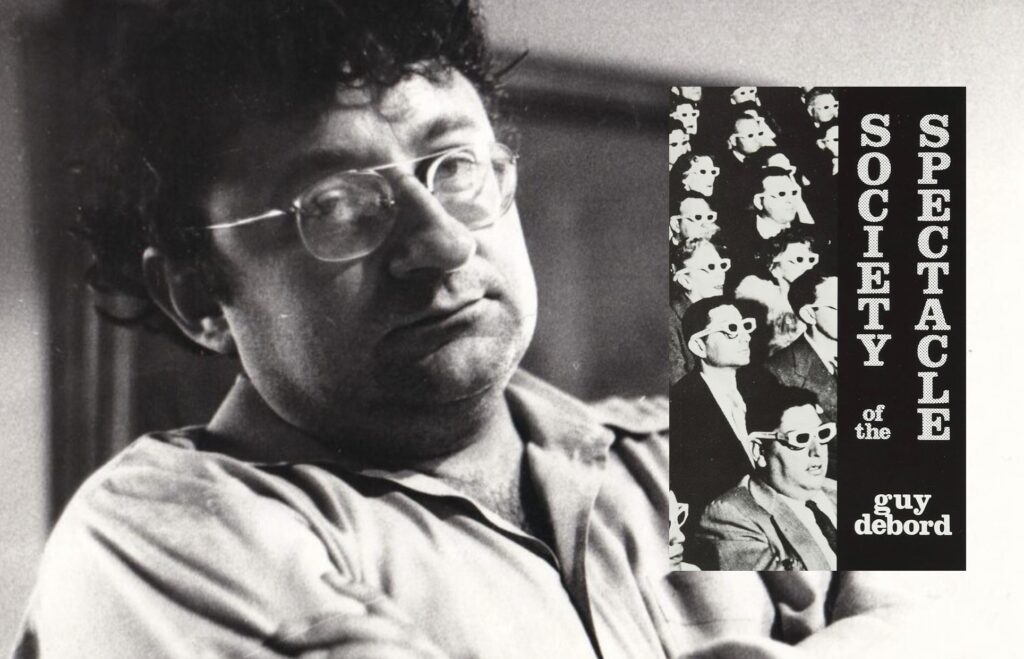
For example, when someone attends a 3D movie screening, they participate in designing or reproducing the spectacle just as much as the film’s designers or the 3D glasses designers. The spectacle is collectively maintained.
At the same historical moment in which Debord developed this critique in Europe, another process was unfolding in Latin America, where revolution appeared as a more immediate possibility. The Cuban Revolution generated considerable hope across the continent, and Paulo Freire emerged from this context. Freire pioneered a participatory approach to literacy that would later inspire Scandinavian designers to work with users in what later became known as participatory design.
During the 1960s, Freire worked with illiterate populations and developed what he called a Pedagogy of the Oppressed. While Debord’s writing often leads toward pessimism and deadlock, Freire offers hope for transforming reality. However, he insisted that there is no direct road to revolution. Revolutionary transformation requires the gradual creation of material conditions through education. Without education, even revolutionary movements risk reproducing the same oppressive structures they initially opposed.
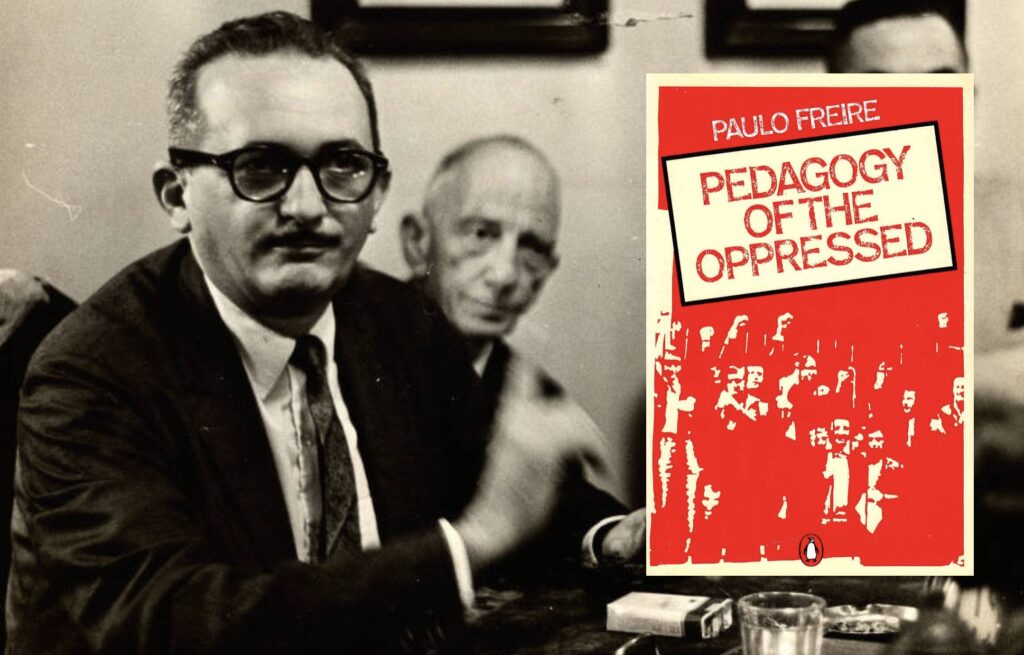
History has repeatedly demonstrated that many leftist revolutions failed to resolve the societal contradictions they confronted. For Freire, the task was therefore not simply to denounce oppression but to transform reality while unveiling it. Critical pedagogy removes the veil from reality through collective action aimed at producing alternatives.
Inspired by Freire and by other thinkers associated with critical pedagogy—such as bell hooks, Frantz Fanon, and Augusto Boal—we created the Design & Oppression Network during the COVID pandemic. Around 2020, many Brazilian researchers began organizing more systematically in response to the Bolsonaro government’s attacks on public universities, research funding, and academic autonomy. The network was one among many initiatives formed during that period. Bolsonaro has since faced imprisonment after a failed coup attempt, yet the far-right movement remains active. For this reason, we did not dissolve the network. Instead, we expanded it to other places facing similar conditions.
Our central research question became: Can design become part of a critical pedagogy that fights oppression on multiple fronts?
This is not an easy task because design is historically entangled with modernity. Design operates as an affirmative pedagogy of the modern world. In many ways, design functions as a spokesperson for modernity, continuously selling modernity to consumers and users, often through material forms rather than explicit discourse. For example, the colorful chairs in this room express a particular modern aesthetic while coexisting with an older architectural environment. This tension between the old and the new reproduces one of modern design’s recurring narratives: that the new is necessarily better. Capitalism presents itself through this same logic of novelty and progress.
Of course, historians of design have analyzed modern discourse more rigorously than I can do here. Guy Debord himself offered an important critique of modern design and its relationship to the spectacle. In his film adaptation of The Society of the Spectacle, modern design is portrayed as deeply complicit with capitalism. Fashion, interior, and product design are all presented as mechanisms for reproducing the spectacle. Debord ultimately suggests that modern design may be inseparable from capitalism itself.
At the same time, Debord did not fully engage with developments in the Global South, particularly in critical pedagogy and revolutionary movements in Latin America. Today, however, those historical separations are being challenged. Researchers from the Global South are increasingly showing up (invited or not) in discussions previously dominated by European and North American perspectives. This connection is necessary because capitalism itself is global and totalizing.
I nevertheless agree with Debord on one important point: despite claiming mastery over visual form, modern design often produces more invisibility than visibility. Contemporary discussions about virtual, mixed, and augmented reality rarely concern alternatives to capitalism. Instead, they reinforce existing structures under new technological forms.
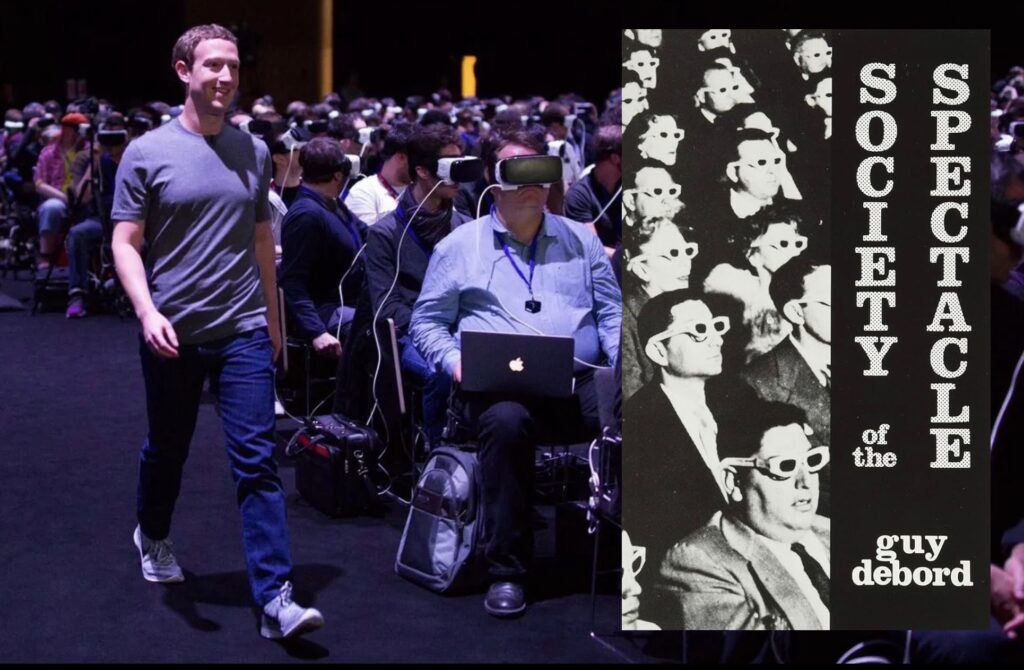
This became particularly visible when Mark Zuckerberg announced the Metaverse initiative. The widely circulated promotional image resembled the cover of The Society of the Spectacle: rows of people immersed in mediated realities while a single smiling figure oversees the system. The image unintentionally revealed the asymmetry of control embedded in these technological infrastructures.
Not all designers, however, reproduce these dynamics uncritically. Critical designers—often emerging at the intersection of art and design—attempt to challenge dominant structures. Industrial design, in particular, has produced important critical interventions, while also raising difficult questions such as: Who can afford to remain critical?
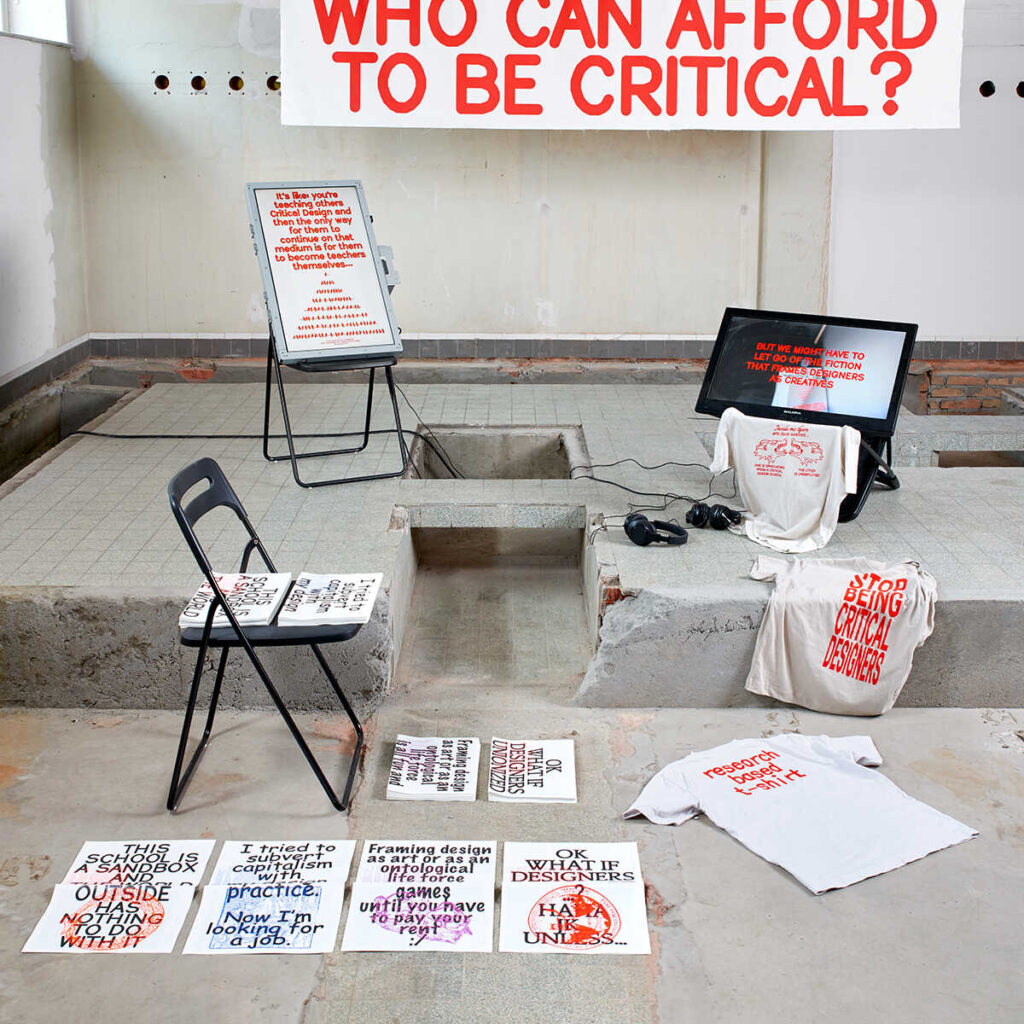
This question was powerfully articulated by Afonso de Matos, a former student at the Design Academy Eindhoven. Some interpret this dilemma as justification for simply conforming to the market and pursuing conventional industry careers. Yet critical practice can also emerge through volunteer work, collective organization, social movements, nonprofit initiatives, or alternative forms of entrepreneurship. This is the type of work we have been developing in Brazil.
Critical designers essentially place design against design itself. They use the familiar language of design to challenge design’s historical alignment with capitalist goals and agendas.
Earlier, before this lecture began, I projected a looping video to frame the discussion. The intention was to expand the notion of design beyond industrial products or visible interfaces. Design also includes the invisible infrastructures that organize everyday life: pipelines, electrical systems, scheduling systems, logistical networks, and temporal rhythms. Water infrastructures, for example, depend on predictive models of collective behavior. Utility companies must anticipate when water consumption will peak according to daily, weekly, or seasonal routines. These infrastructures are interconnected across national and transnational scales. What occurs in one world often depends upon extraction, labor, or deprivation occurring elsewhere.
This is a 2002 work by the French collective H5. The piece presents an apparently soothing, optimistic narrative while revealing how thoroughly human life is orchestrated by designed systems. Beneath its polished surface, the work asks whether we are willing to accept a reality in which nearly every aspect of life has been predesigned by others. Many viewers interpreted the work merely as an informative celebration of technological infrastructure. Yet hidden within the video is a split-second image of someone committing suicide as a response to extreme work exploitation (3’20” at the top right part of the canvas). This fleeting moment functions as a critical message inside an otherwise seamless depiction of modern life. It reveals how critical design messages can infiltrate popular culture without becoming immediately legible. I only noticed it after learning about karoshi and watching the movie again.
Critical designers also place futures against futures. At times, this produces deeply pessimistic scenarios. The work of Anthony Dunne and Fiona Raby often confronts audiences with catastrophic possibilities such as nuclear annihilation. Their project, Huggable Atomic Mushrooms, satirically imagines children becoming emotionally accustomed to nuclear war.
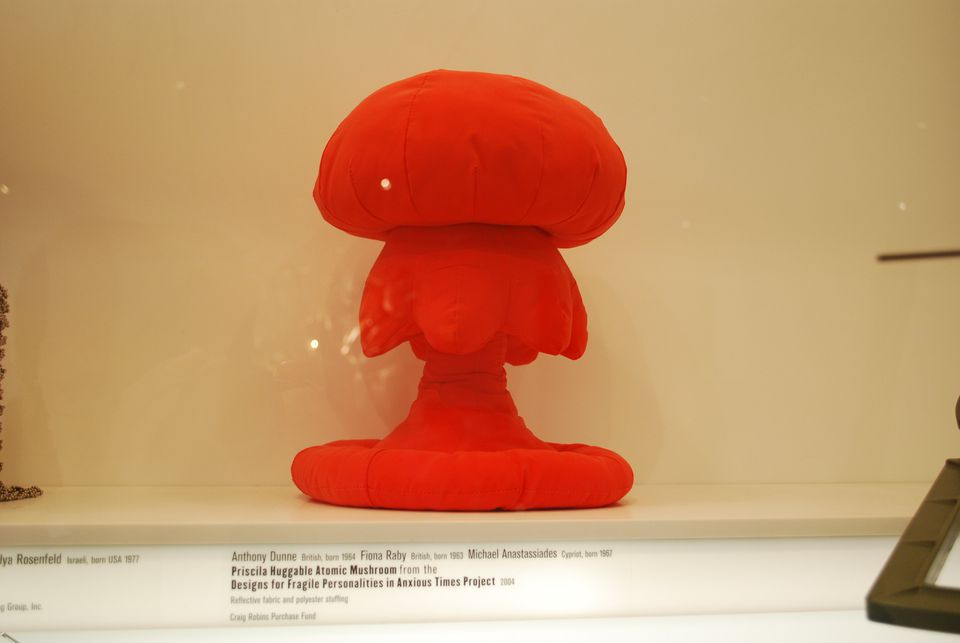
Revisiting this project today feels darker than it did twenty years ago. Nuclear conflict no longer appears as distant speculation. During the Cold War, anti-nuclear movements intersected with many other social struggles, including literacy movements inspired by Freire. Even illiterate rural populations in Brazil discussed the possibility of nuclear extinction. Today, critical consciousness around such issues often appears diminished.
Designers, therefore, need to consider not only how their projects function in the present, but also how they will be interpreted in future historical conditions. After many years of engaging with critical and speculative design, especially in Brazil, I concluded that these approaches often remain limited to denouncing the spectacle. They help reveal contradictions to broader audiences, but they rarely move beyond critique toward structural transformation.
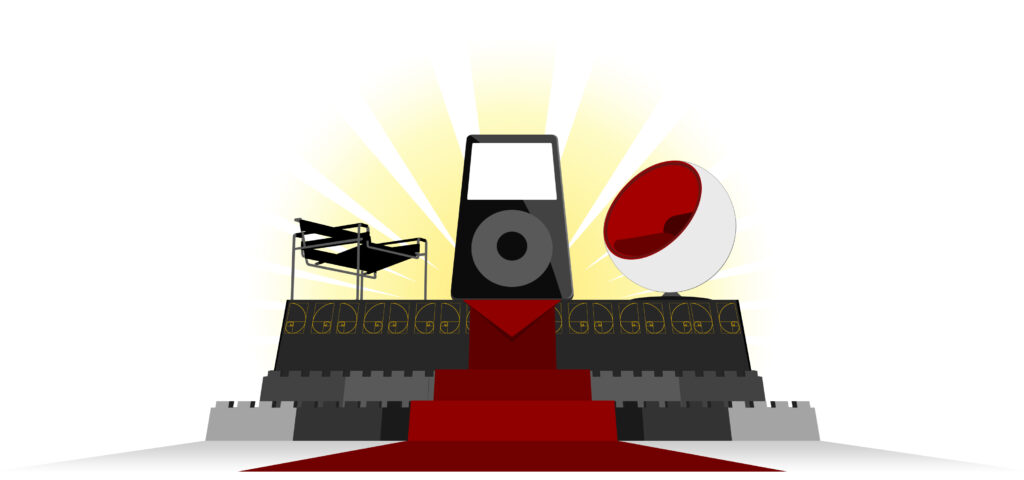
I also participated in these practices myself. One example was The Church of Divine Design, a project I developed with Rodrigo Gonzatto in 2013 to critique the growing influence of Protestant ethics and evangelical conservatism within Brazilian politics. The project connected the ideological authority of modern design—particularly imported European design traditions—with broader colonial and religious structures shaping Brazilian society. The project provoked strong reactions, especially from defenders of industrial modernism. Yet despite its critical force, it ultimately failed to generate a meaningful decolonial movement in Brazilian design. We realized that we were reproducing a model of critical design developed primarily in Britain and Europe rather than responding directly to Brazilian realities.
This dissatisfaction led us to move beyond critical and speculative design altogether. Over more than a decade, we gradually developed a different approach. That approach eventually became what we now call Prospective Design. This approach builds upon Latin American traditions of praxis and reality transformation rooted in the work of Paulo Freire, the Cuban and Chilean revolutionaries, and many other political movements across Latin America. At the same time, it engages with more recent developments in North American design discourse, particularly transition design.
When we encountered the limitations of speculative and critical design, transition design emerged as an important reference, seeking to expand design for social change through a systemic, community-based perspective. Unlike early speculative design practices associated with Anthony Dunne and Fiona Raby, transition design was not primarily concerned with isolated speculative objects or exhibitions. Instead, it focused on sociotechnical systems and the broader conditions that sustain life.
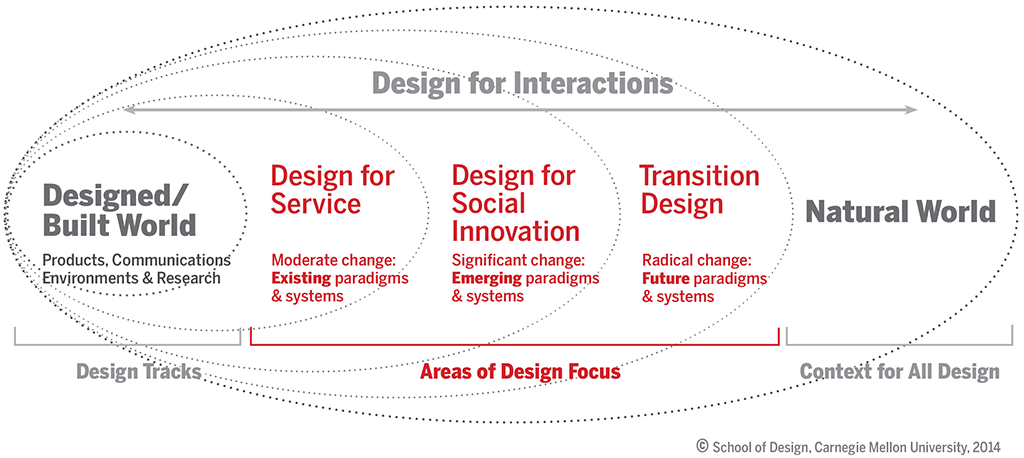
Transition design also integrated sustainable design and ecological thinking, particularly through systems theory and biomimicry. It sought to reconnect the human world with the natural world by treating human systems as embedded within ecological systems rather than separate from them. This was not entirely new. Figures such as Tomás Maldonado had already proposed similar ideas in the 1960s. Nevertheless, transition design remained one of the few contemporary approaches attempting to preserve this broad systemic vision within design education.
Again, we could not simply import or apply transition design to Brazil. The first obstacle was linguistic and cultural. In Europe and the United States, the word “transition” is strongly associated with ecological transformation and political change. In Brazil, however, the term transição is far more closely associated with transgender identity and LGBTQ+ agendas. It does not immediately evoke ecological discourse in the public sphere like, for example, indigenous cosmologies do. At first, we considered prospective design merely a translation equivalent, but eventually we decided to redesign the entire design philosophy behind transition design. If we were already creating a different name, we might as well rethink the philosophical foundations themselves.
This led us toward a critique of systemic thinking, which plays a foundational role in transition design. We revisited Brazilian and Latin American philosophical traditions to rethink the relationship among design, society, and transformation. The result was the development of a new design philosophy, which we are now sharing abroad. One of the central principles of this philosophy is that human beings are collective beings and that reality itself is collectively produced. If reality is collectively produced, then the educational program discussing it must also be collectively designed. Our graduate program therefore operates through participatory structures in which faculty members and students collectively shape the curriculum, concepts, and methodologies of the program itself.
The foundational concept of prospective design is the notion of existential structures. We deliberately avoid the term “sociotechnical systems” because systemic thinking can easily slip into formalism. Debord already demonstrated how systems reproduce themselves through self-correcting mechanisms and representations that absorb resistance and continuously expand their own reach. If everything is framed as a system, it becomes difficult to imagine exits from it.
Existential structures provide a different framing. Rather than emphasizing abstract systems, the concept foregrounds lived existence. Existential structures are structures built to sustain existence. They concern living beings and embodied realities rather than abstract machinic totalities.
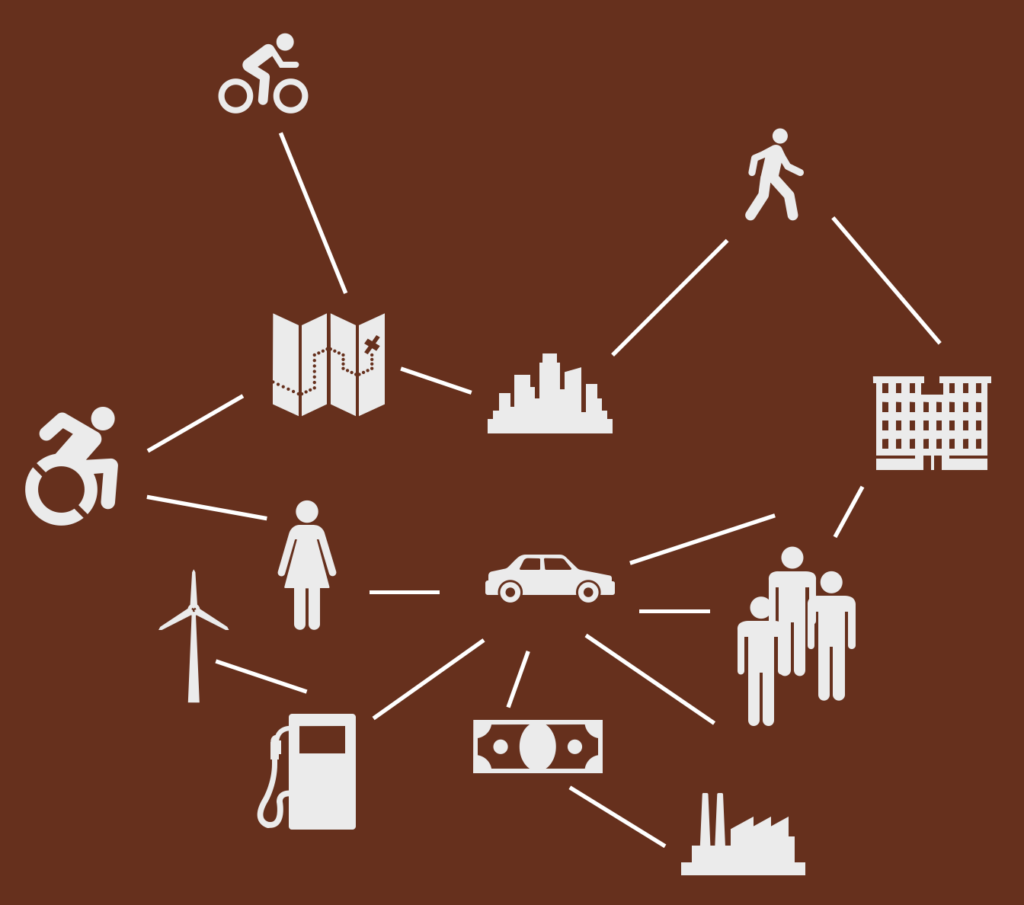
We also resist dissolving all distinctions into generalized notions of the “nonhuman.” While we recognize the importance of ecological interdependence, we remain cautious about speaking on behalf of entities that cannot participate directly in human political discourse. Our emphasis, therefore, remains grounded in embodied human existence while remaining attentive to broader relational ecologies.
A central concern of prospective design is that only a small range of relationships is socially recognized as possible. Society continuously narrows the field of imaginable possibilities. This is particularly visible in discussions surrounding ecological collapse or the oil crisis. We are repeatedly told that rapid transitions beyond carbon dependency are impossible. Speculative design often responds to this limitation by imagining alternatives and expanding the cone of possibilities. Yet imagination alone is insufficient. We are interested not only in speculation, but in transformation. The key question becomes: where can intervention generate the greatest expansion of possibilities with the least resistance to transformation?
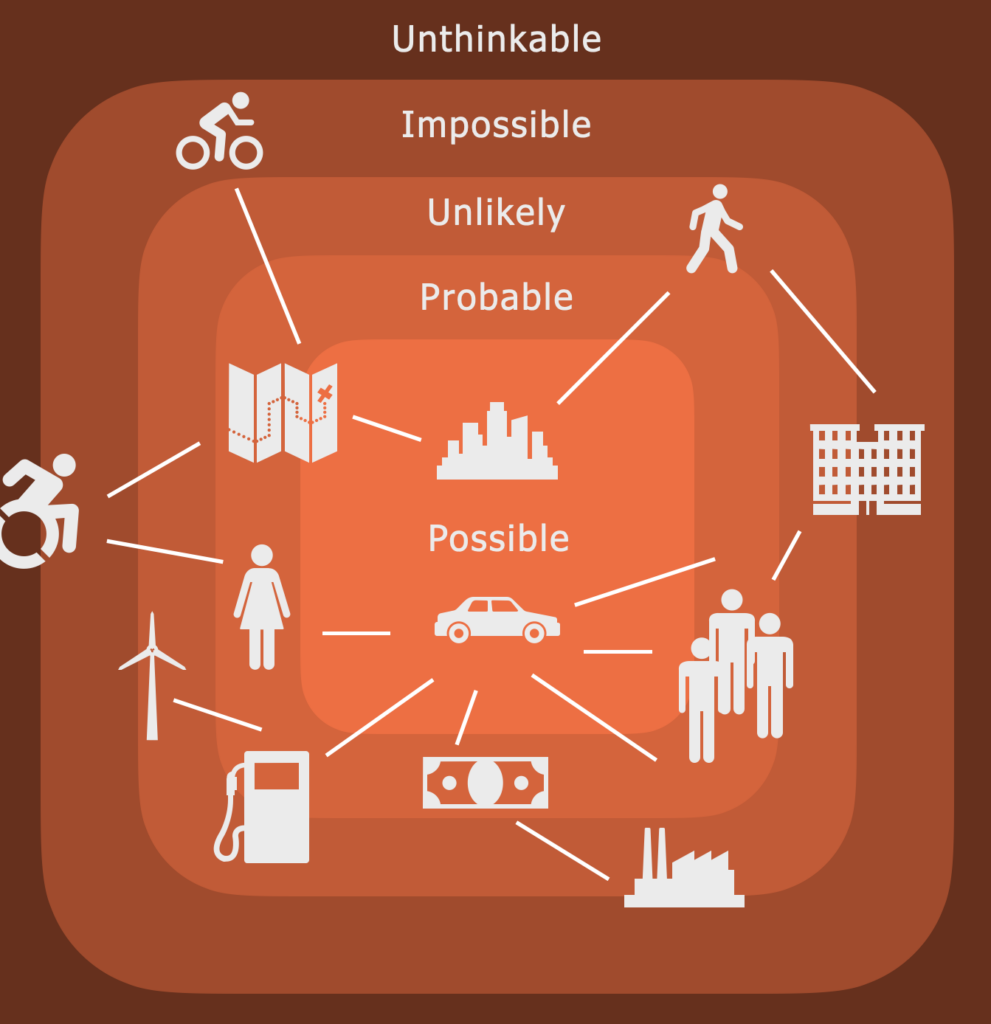
We found that infrastructures and metastructures function as powerful leverage points for expanding what is socially possible. Infrastructures and metastructures make invisible dimensions of reality visible. What usually remains in the background can emerge into the foreground, enabling designers to work across invisibility itself.
Infrastructure tends toward transcendence. It abstracts reality from specific contexts and universalizes it across many situations. Metastructure, on the other hand, deepens engagement with contextual and relational dimensions of existence. It reveals the contexts behind contexts. These concepts are difficult to summarize briefly, and their full meaning requires engagement with our published work. Still, they orient our efforts toward developing what we call a social sensibility for relational qualities.
For example, some experiences become perceptible only through particular embodied positions. In one classroom discussion about oppression during the Bolsonaro government, several female students suddenly realized that they were the only participants consistently present in those conversations, while male students were largely absent. This recognition sparked a powerful moment of collective solidarity. Such experiences reveal relational qualities that cannot easily be reduced to abstract systemic categories.
From this perspective, Prospective Design becomes a form of structuralist design aesthetics grounded in relational experience. We are deliberately returning to structuralism after its revision by post-structuralist theory. While systems thinking and post-structuralism remain valuable, we believe many contemporary approaches based on these lines of reasoning underestimate the material persistence of structures. Social structures are not easily transformed through isolated acts of individual choice. They involve collective formations operating across societies, nations, and worlds.
The prospective design framework, therefore, operates across three axes.
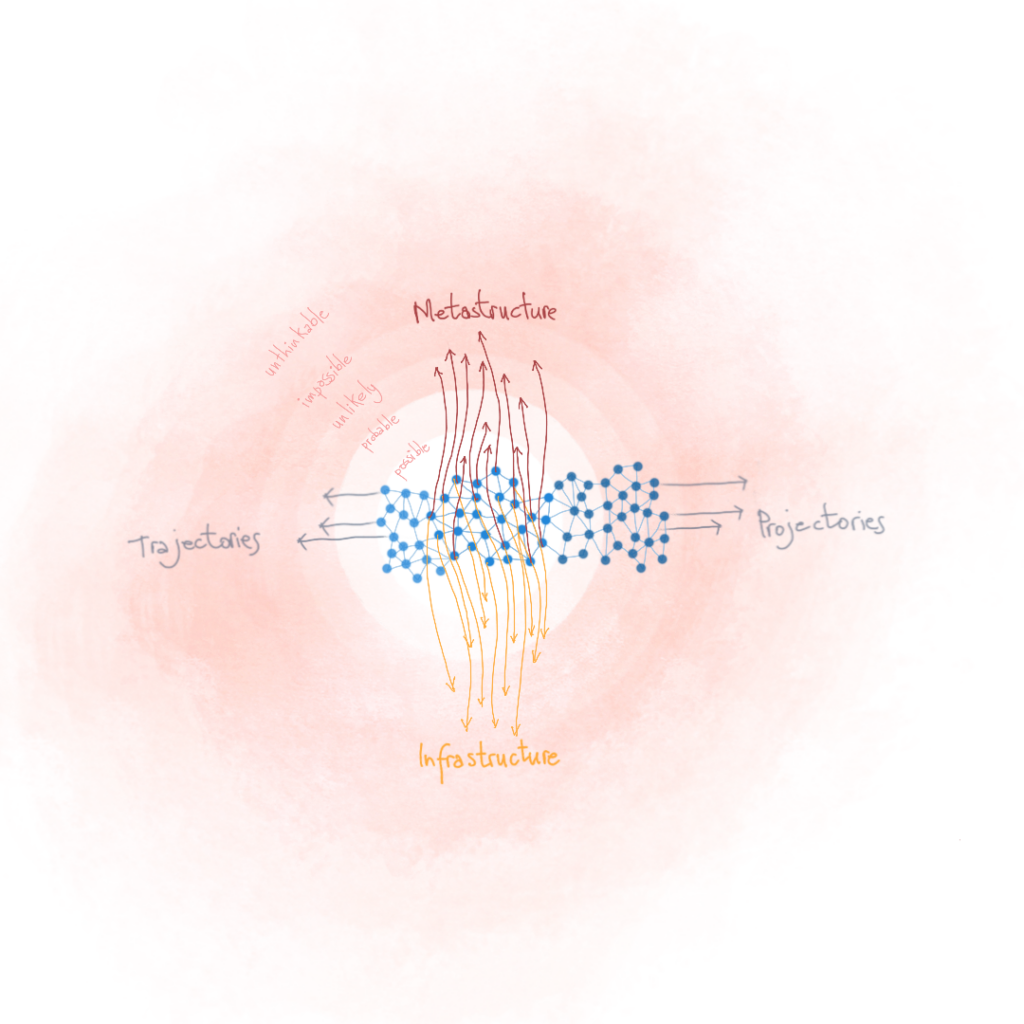
The first axis concerns trajectories and what we call projectories. Projectories refer to the historical repetition of projects within broader social tendencies. Design projects are never isolated; they participate in larger historical movements and patterns. This means Prospective Design also engages with design history, not by abandoning it, but by reinterpreting it prospectively. The second axis concerns the relationship between metastructures and infrastructures. The third axis concerns layers of possibility, ranging from the possible to the unthinkable. Prospective Design attempts to articulate these three dimensions simultaneously while intervening critically in society. In this sense, Prospective Design also functions as a critical pedagogy of trajectories and projectories.
In Paulo Freire’s literacy method, education expanded from text to context. Illiterate people could already interpret signs and meanings within the world around them before learning an alphabetic language. Freire helped them move from reading the world to reading the word. He used what he called generative images—a remarkably contemporary term given his engagement with linguistic and cybernetic theories emerging during the 1960s.
We reinterpret this idea through generative codesign tools. These tools are generative not merely because they produce ideas, but because they enable the creation of further tools, relations, and forms of participation. This also leads us to rethink codesign itself. If all design emerges from contextual relations, then every design process is already a form of codesign, even when power relations remain unequal or oppressive.
From this perspective, becoming a critical designer first requires becoming a critical user. Critical design practice cannot emerge from an uncritical relationship with technological infrastructures. It is contradictory to produce critical work while remaining fully dependent on proprietary software, extractive labor platforms, or fascist AI. For this reason, we have been developing generative models capable of representing complex relationships between metastructures and infrastructures.
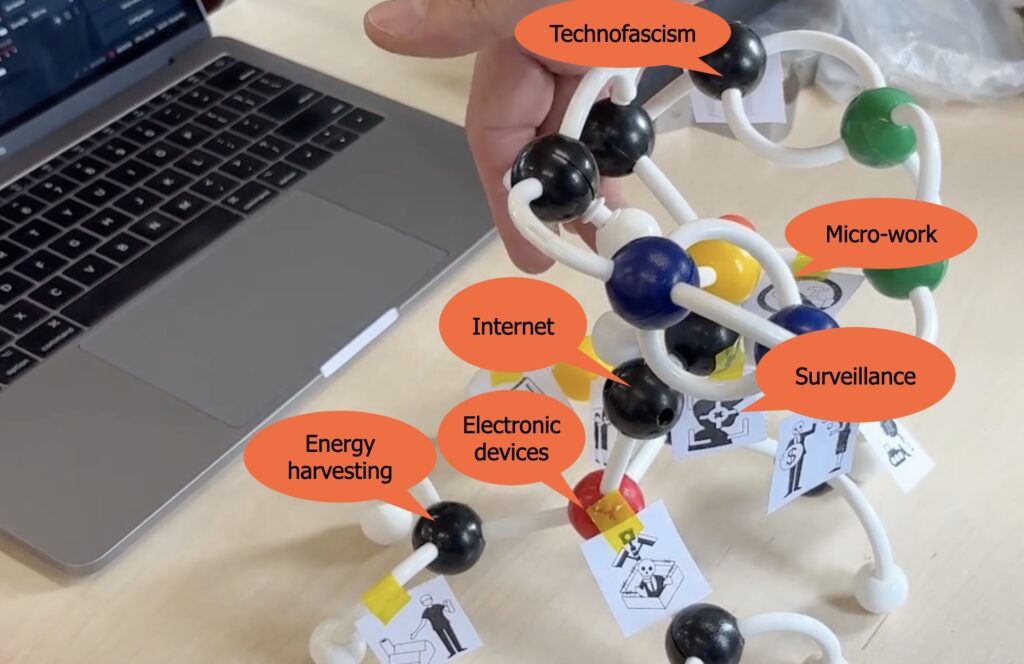
One example involved a collective exercise conducted by faculty members and students to map the energy structures sustaining contemporary technofascism. The exercise traced connections between energy extraction, electronic devices, internet infrastructures, mass surveillance, and exploitative digital labor. The point was to demonstrate that techno-fascism does not emerge spontaneously as fateful accident. It depends upon material infrastructures and metastructures that sustain and normalize it. At the same time, we realized that regulation alone is insufficient as a response. Expanding legal control over technologies may mitigate certain harms, but it does not fundamentally transform the structures that produce them.
When neoliberalism insists that there is no alternative, we must instead search for what we call alternatives. I am not using the same term in the same sense. Alter/natives refers to concepts and actions emerging from the Global South that seek to create worlds grounded in their own realities rather than reproducing metropolitan or colonial models.

An alter/native universal is not simply a local identity or isolated worldview. It is a universality constructed through interconnected localities. I do not fully align with some versions of pluriversal theory that oppose universality altogether. Local realities are crucial, but isolated localisms cannot effectively confront transnational phenomena such as technofascism. Reactionary forces already operate globally. They adapt their appearance to different countries while reproducing the same patriarchal, colonial, extractivist, and fundamentalist logics.
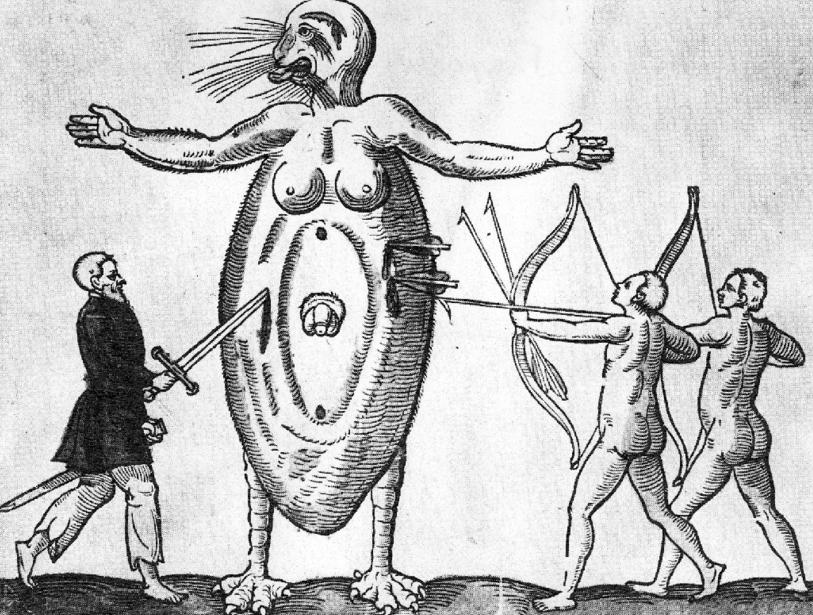
This discussion can be illustrated through the indigenous myth of the Ipupiara monster from Pindorama, the territory now known as Brazil. During colonization, indigenous peoples spread stories of terrifying creatures to frighten Portuguese colonizers. These stories functioned strategically, much like what today might be called counter-information. The aspect that most frightened the Portuguese was not the creature’s size or its big claws, but the fact that it possessed two sexes within the same body. From the perspective of the colonizers’ conservative worldview, this ambiguity itself became monstrous.
Today we revisit the Ipupiara myth as inspiration for collective and queer design practices. At the Federal University of Technology – Paraná, where I currently work, our Laboratory of Design Against Oppression and its associated Muvuca Studio organized a large public event called the Gender Disturbance Catwalk.
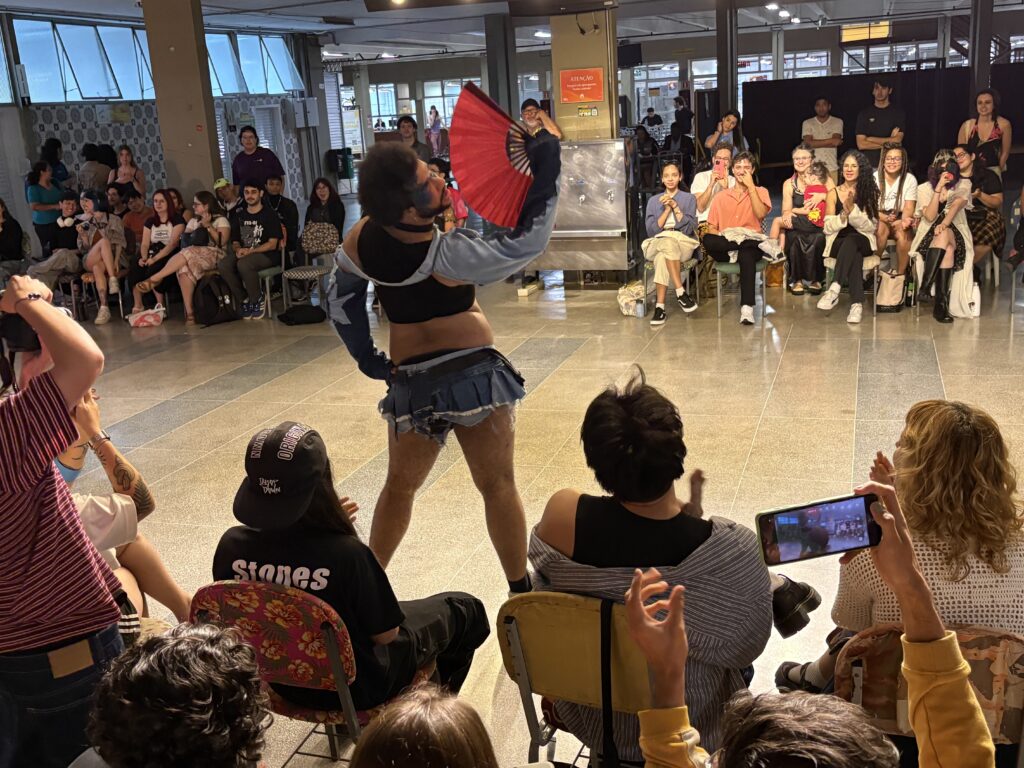
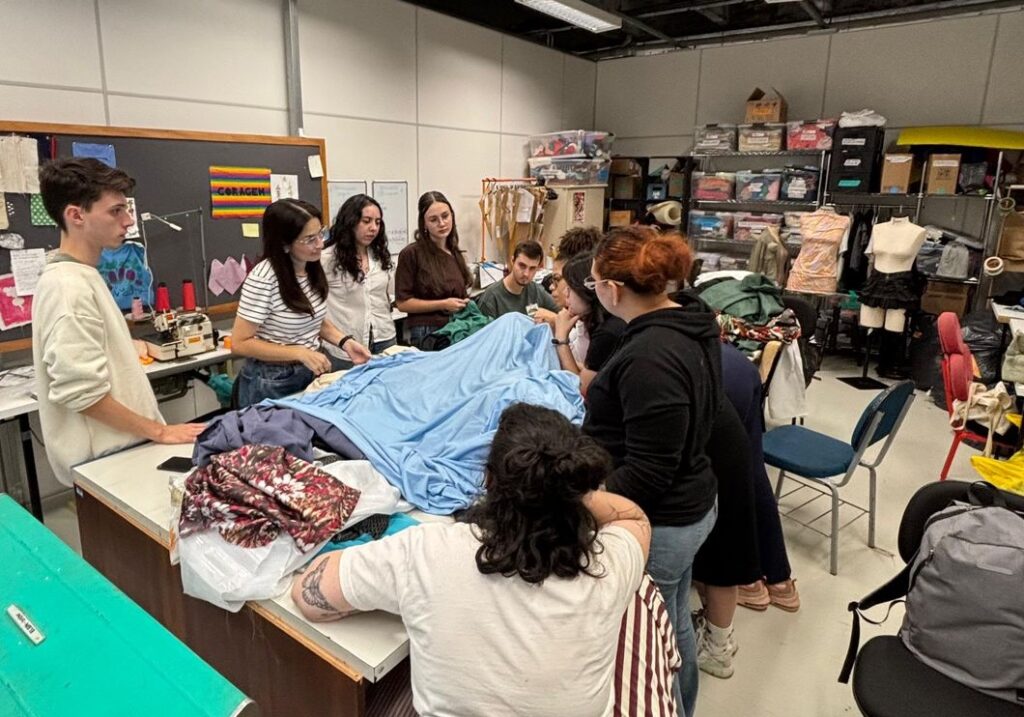
This was the first major LGBTQ+ public demonstration held at the university. Students created garments combining elements traditionally associated with masculinity and femininity, deliberately destabilizing normative gender expectations. The event culminated in a collective composition formed from donated sewing machines and participants’ bodies, producing a kind of contemporary Ipupiara figure: collective, hybrid, and scary to the oppressors.
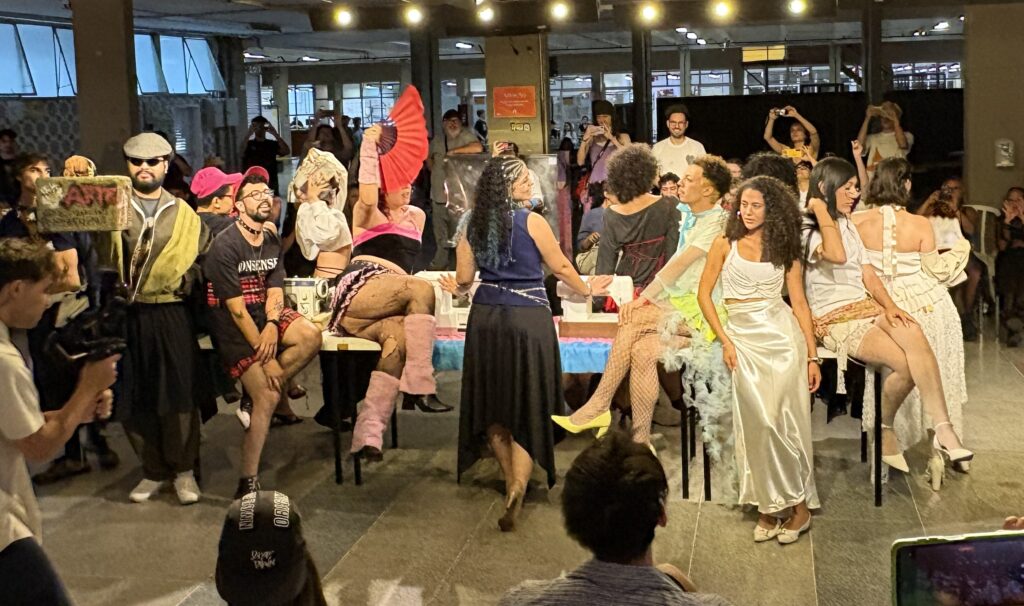
An important aspect of this project was that it emerged almost entirely through student self-management. Students occupied an abandoned room previously filled with unused computers and transformed it into the university’s first fashion design laboratory, despite the absence of a formal fashion design program. They effectively pressured the institution from below, demonstrating how collective action can create new educational structures before official recognition exists.
Looking toward the future of prospective design, I increasingly believe that we need models of society beyond the modern state itself. Much of contemporary political organization still operates according to the logic formulated by Thomas Hobbes in Leviathan. The state justifies its monopoly on violence by claiming that without centralized control, individuals would descend into mutual oppression and chaos. As a result, the state legitimizes its own oppressive capacity as a necessary mechanism for preventing greater disorder. This logic continues to shape contemporary geopolitics. The inability of states to collectively confront atrocities such as the genocide in Palestine reflects the persistence of this framework, where violence remains acceptable when aligned with perceived state interests.
Oppression ultimately acts most directly upon the human body, which is why embodiment occupies such a central place within our philosophy. Unlike approaches centered primarily on sociotechnical systems, Prospective Design insists that existential structures are embodied realities. This perspective draws heavily from Augusto Boal and the tradition of the Theatre of the Oppressed. In The Rainbow of Desire, Boal writes that “human beings are first and foremost bodies”. We should never lose sight of embodiment beneath abstract discussions of systems or technologies.
Theatre of the Oppressed is powerful because it transforms the spectacle into a forum. Traditional theater positions audiences as passive spectators. Boal instead created forms in which spectators become “spect-actors,” actively intervening in the performance itself. One example from our own work involved a Theater of the Techno-Oppressed session focused on Uber’s “ride in silence” feature in Brazil. The feature allowed passengers to pay extra to avoid conversation with drivers.
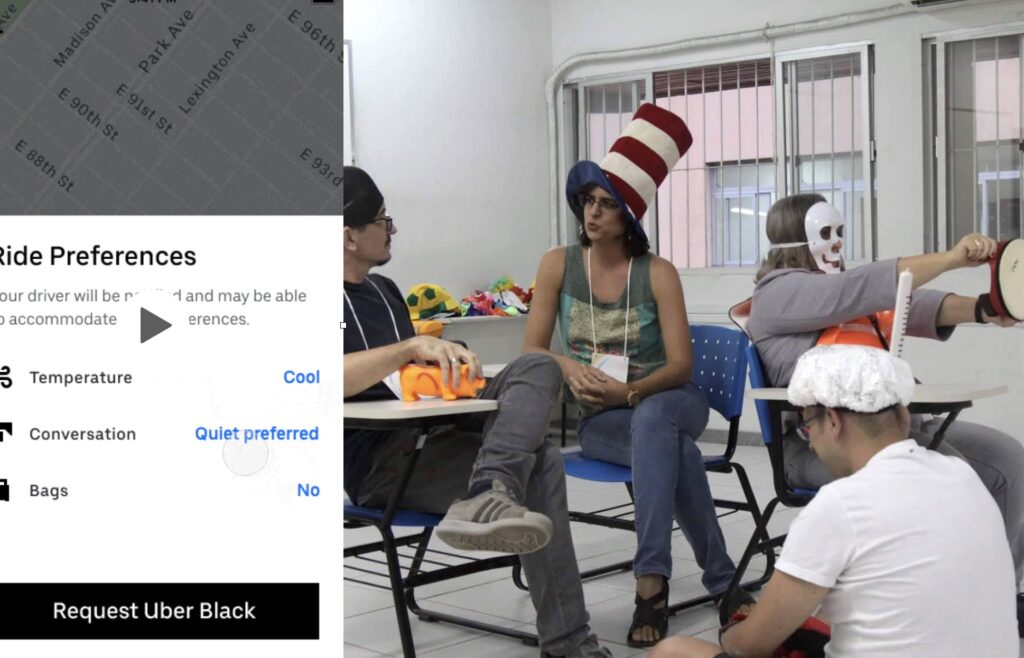
We considered this ethically problematic, especially in Brazilian culture, where conversation and cordiality are central to social interaction. The feature imported a model of social behavior associated with North American platform culture while subtly restructuring local relationships. During the forum portion of the performance, audience members entered the stage and attempted to transform the interaction between driver and passenger into something more reciprocal and solidaristic. These interventions often failed, but failure itself revealed the strength and complexity of the existential structures involved.
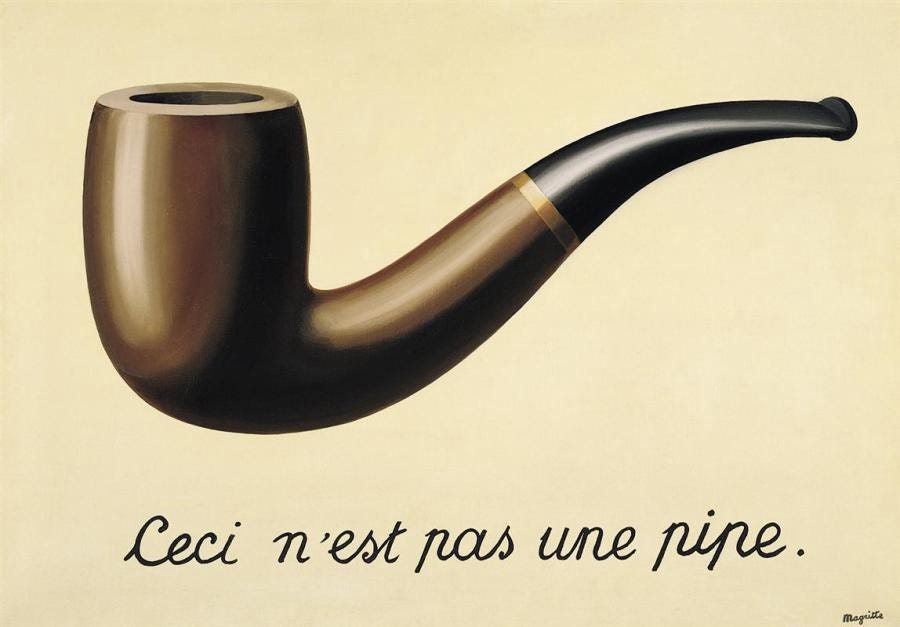
The forum, therefore, transforms the spectacle of oppression into a space where oppression can be collectively scrutinized and experimentally modified. Boal once wrote: “In theater, everything is true, even lies.” This idea deeply resonates with the work of René Magritte, especially The Treachery of Images. The image insists that it is not what it appears to be. Rather than accepting surface appearances, we are pushed to reflect on how images structure perception and social reality.
Boal extends this logic further, describing theater as a mirror we can penetrate and modify. This recalls Magritte’s The False Mirror, in which the eye becomes a portal to deeper layers of consciousness and reality. The point is not to recognize oneself at the surface level, but to move beyond appearances into the hidden structures shaping experience.
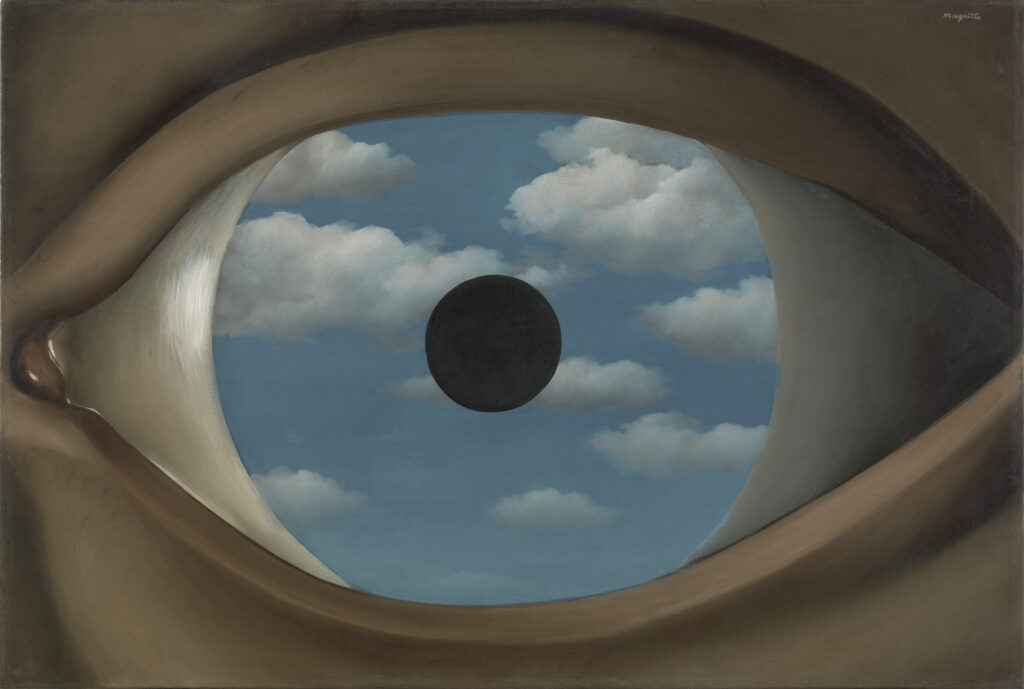
Prospective design draws upon these traditions—critical pedagogy, surrealism, situationism, and the Theatre of the Oppressed—to produce critical mirrors of society. The goal is to create spectacles within the spectacle: spaces where we can collectively perceive, question, and transform oppressive realities. We claim that the alter/native reality is already present, though often rendered invisible. Our task is not passive waiting, but active hope: the collective work of making these realities increasingly visible and materially possible.
References
Fisher, M. (2022). Capitalist realism: Is there no alternative?. Simon and Schuster.
Debord, G. ([1967] 2021). The society of the spectacle. Unredacted Word.
Freire, P. ([1968] 1996). Pedagogy of the oppressed (revised). New York: Continuum, 356, 357-358.
Van Amstel, F., Sâmia, B., Serpa, B.O., Marco, M., Carvalho, R.A.,and Gonzatto, R.F.(2021) Insurgent Design Coalitions: The history of the Design & Oppression network, in Leitão, R.M., Men, I., Noel, L-A., Lima, J., Meninato, T. (eds.), Pivot 2021: Dismantling/Reassembling, 22-23 July, Toronto, Canada. https://doi.org/10.21606/pluriversal.2021.0018
Matos, A. (Ed.). (2022). Who Can Afford to be Critical?: An Inquiry Into what We Can’t Do Alone, as Designers, and Into what We Might be Able to Do Together, as People. Set Margins’.
Dunne, A., & Raby, F. (2013). Speculative Everything, With a new preface by the authors: Design, Fiction, and Social Dreaming. MIT press.
Gonzatto, R. F., Van Amstel, F. M., Merkle, L. E., & Hartmann, T. (2013). The ideology of the future in design fictions. Digital creativity, 24(1), 36-45. https://doi.org/10.1080/14626268.2013.772524
Irwin, T. (2015). Transition design: A proposal for a new area of design practice, study, and research. Design and culture, 7(2), 229-246.
Tavares, Polyana Andrade, Gonzatto, Rodrigo Freese, Van Amstel, Frederick M. C. (forthcoming). Collective handiness in prospective design: a philosophical account of a serious play on articulation work. Proceedings of DRS 2026, Edinburgh. Design Research Society. https://fredvanamstel.com/publications/collective-handiness-in-prospective-design-a-philosophical-account-of-a-serious-play-on-articulation-work
Botter, F., M. C. van Amstel, F., André Mazzarotto Filho, M., and Guimarães, C. (2024) Prospective design: A structuralist design aesthetic founded on relational qualities, in Gray, C., Ciliotta Chehade, E., Hekkert, P., Forlano, L., Ciuccarelli, P., Lloyd, P. (eds.), DRS2024: Boston, 23–28 June, Boston, USA. https://doi.org/10.21606/drs.2024.883
Angelon, R., & van Amstel, F. (2021). Monster aesthetics as an expression of decolonizing the design body. Art, Design & Communication in Higher Education, 20(1), 83-102. https://doi.org/10.1386/adch_00031_1
Van Amstel, F. M. C. (2023). Decolonizing design research. In: Rodgers, Paul A. and Yee, Joyce (Eds). The Routledge Companion to Design Research (pp. 64-74). Routledge. https://www.doi.org/10.4324/9781003182443-7
Camenietzki, C. Z., & Zeron, C. A. M. Quem conta um conto aumenta um ponto: o mito do Ipupiara, a natureza americana e as narrativas da colonização do Brasil. Revista de Indias, Madri, v. LX, n. 218, p. 111-134, 2000.
Hobbes, T. (1651). Leviathan.
Boal, A. (2000). Theater of the Oppressed. Pluto press.
Boal, A. (1995). The rainbow of desire. Routledge.
Boal, A. (2006). The aesthetics of the oppressed. Routledge.
Van Amstel, Frederick M. C., Serpa, Bibibiana, Secomandi, Fernando. (2025). Systemic oppression in service design. In: Suoheimo, M., Jones, P., Lee, S., Sevaldson, B (Eds). Systemic service design. Routledge. http://dx.doi.org/10.4324/9781003501039-7