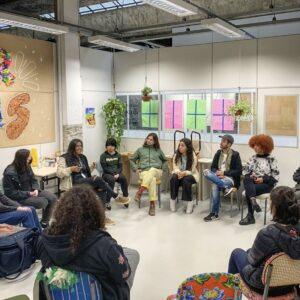
Paulo Freire developed in the 1960s an adult literacy method that politicized readers to learn to read the world while learning to read the word. Culture circles have since been extended to other forms of literacy, including design literacy. Design culture circles is a derived method that empowers users to critically read the designed world while reading the designed word. This talk shares the experience of using this method to unveil oppressive interactions formalized in design cultures (designed things, discourses, and spaces) in the United States and Brazil.
Recorded in the IDEA Phase 2026: Virtual Event hosted by AIGA Baltimore. The full recording, including the dialogue that follows the talk below, is available on YouTube.
Full transcript
I’m Frederick van Amstel. I go by he/him/his as pronouns. I speak from Curitiba, in southern Brazil. Here we have the first technology university in Brazil, called UTFPR, in Paraná State. I’m going to speak about design culture circles, a specific method I’m developing with my collaborators. Some of them are design practitioners, some are design students, and some are design researchers.
But before I get into the specific method, I need to explain its two parts: what a design culture is and what a cultural circle is. I will try to be very accessible in my explanations because I understand that sometimes academics like me can be overly complicated in their language. Since I’m not speaking about words, I’m really speaking about worlds and the differences between worlds, I’ll stick to the most concrete ways of explaining what I mean.
Design culture can mean many things, but I will stick to this particular academic definition by Guy Julier (2000). He’s a design scholar who has written an interesting book and published it in the 2000s, where he finds design culture as this mediation, or this process, between production and consumption that gives objects, spaces, and images a particular kind of connection between different objects, spaces, and images. They become part of a culture, much like any other kind of artistic cultural production, treating design as an everyday cultural element of our lives.
I’ve been to many different design cultures in my life. When I read this, I realized, “Wow, this helps us to figure out why, when you travel from a different city to another city or to another country, you see and face different design cultures, and sometimes you are surprised to see what comes out of that.” Sometimes design cultures use the term design; sometimes they don’t. For example, in Brazil, we talk a lot about projeto, which is similar to what Italians do with progetto.
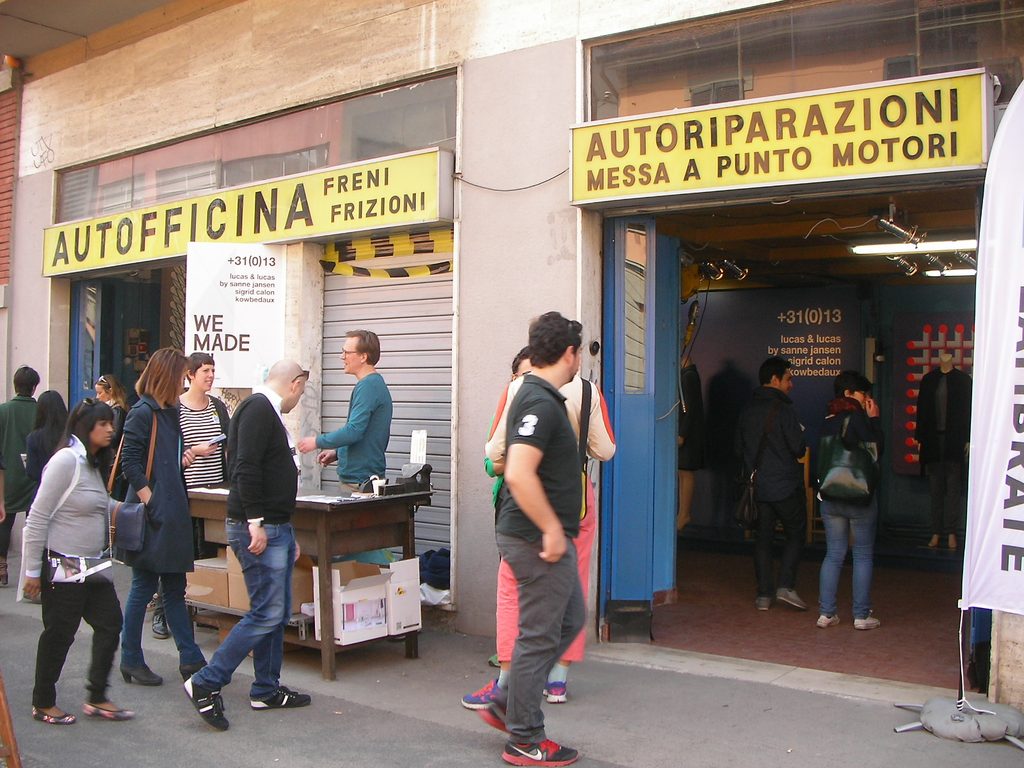
Here’s a picture of the level of design culture Italians have. During the yearly event the Milan Salone, there is a lot of high stakes and a lot of big companies putting their money in, but so are the regular citizens and the small entrepreneurs that offer their workplaces and their stores to host exhibitions in the Fuorisalone, pretty much like theatre festivals have their fringes. This is very peculiar. I was really surprised to see a car shop turn into a design exhibition space. As much as you walk through the city, many other small businesses are doing the same. Milanese citizens understand that design is an integral part of everyday culture, and they can also be part of the debate and host conversations in their own stores. I really recommend that, if you have the opportunity to visit this Salone in Milano one day, you also go out on the streets and check the grassroots events, which are sometimes even more interesting than the official ones.Gallery
Italians have also developed many interesting design theories. For example, Design Driven Innovation is a very accessible book on the distinctive characteristics of Italian design culture, in which Roberto Verganti (2009) describes how firms can harness it as a source of innovation. A lot of people in design thinking outside of Italy refer to this book as a means to an end: if you want to generate innovation through design, you should harness design cultures.
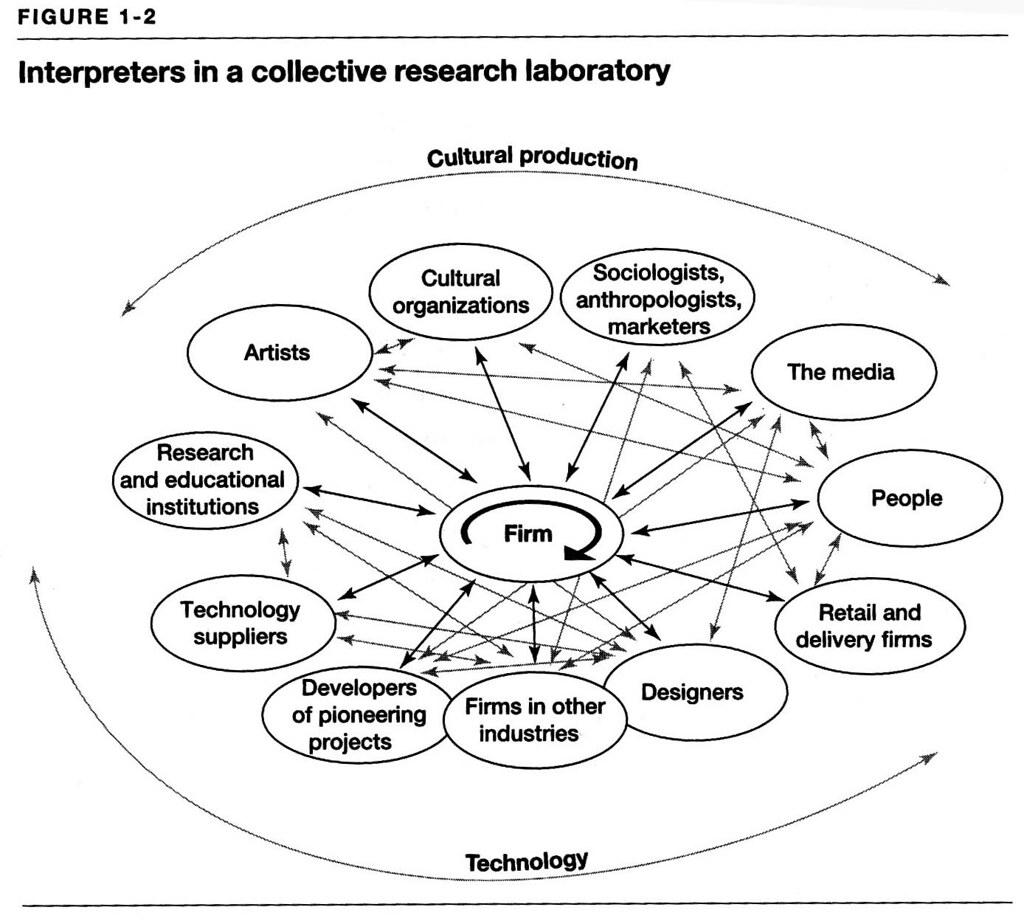
However, according to Verganti, design cultures cannot be created from scratch. They need a lot of investments from many different stakeholders, not just the government, not just the firms, and they need to gather up in different moments and in different situations. For example, the Salone in Milano is just one big event, but they have so many other smaller events where they gather up and feel like they are part of this cultural production and technology development.
It’s a very interesting book, but I’m not going to follow on that any longer because when I approach design culture, I approach it from a critical perspective. I currently don’t have a book that explains my point of view, but I do have an article published together with Rodrigo Freese Gonzatto, my design researcher and long-time collaborator. We have looked at design culture to find out whether users are oppressed just by being treated as users, and we figured out there’s a lot in current design, at least in the last 30 years, that makes people feel like they can only be users of design. They cannot and they should not; there’s no point in becoming a designer and reconfiguring things and doing it for yourself. Why making anything if can just use a ready-made?
Here is an example of the impact of userism, as we call it, in everyday life. This picture is taken from my personal archive. These are my son’s toys at the bottom of the picture, and his mother’s toys at the top. As you can see, initially everything seems normal, things are okay, but if you think deeply, my son, as a male child, is stimulated to become a designer right from childhood, to use Lego, which is a toy that allows you to create many toys. So it requires you to design your own toy.
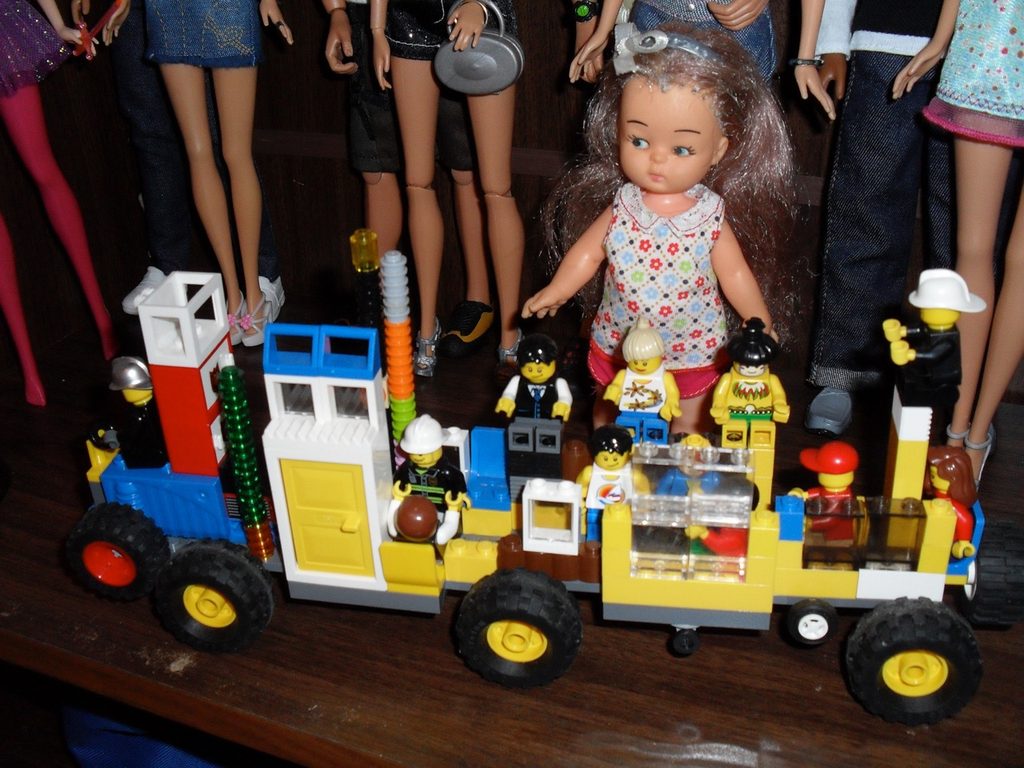
If you contrast this with his mother’s toy, these toys are meant to be used as designed. Girls have little room to change the appearance, function, profession, occupation, culture, or skin tone of their dolls. Of course, things have changed since then, and now Lego sets are no longer listed or exhibited in the boys’ alley. That’s a kind of third alley that emerged in the last 10 to 15 years here in Brazil, where Lego is targeting any kind of kid, not just girls and boys. But at that time, that gender division was still in place.
You can look at this and say it’s a sexist design culture, and I agree, but it’s also a userist design culture where women are meant to be just users of designs and technologies. And that’s one of the reasons why few women can get it up to become engineers in Brazil and other places in the world, because they haven’t been stimulated since childhood. Of course, this has already been acknowledged by feminist criticism of design culture, but we want to emphasize that sometimes we may have, let’s say, some reconfigurable dolls for girls, but they are not yet enabling girls to understand, let’s say, math and geometric planning that will enabled them also become designers and not just users in the future.
Well, this comes down to this long-term discussion of design studies. Some design scholars would say that design is for everyone, everyone should learn design, every human being is a designer. For that matter, the oldest citation of this particular phrase that I found was from a British educator called Norman Potter:
“Every human being is a designer […] Many also earn their living by design…”
Potter (1969, p.9)
He’s making the distinction between an amateur or everyday designer and a professional designer to legitimize designers’ privilege to shape their design culture. He didn’t use the term “design culture,” but that’s what he meant. In the same book, a few pages later, he says:
“Designers are not privileged to opt out of the conditions of their culture, but are privileged to do something about it.”
Potter (1969, p.42)
Because there’s always something wrong with design culture, there are designers to fix it, to solve problems, to change society. That’s a lot of power in the hands of, I don’t know, which kind of designer is speaking to or he’s training, maybe at the Royal College of Art, London, or maybe in Bristol, where he was also teaching, but they are probably locally, nationally, and globally in a privileged position to define what are worthy problems and proper solutions for the entire world.
That’s why, with my colleagues here at the Federal University of Technology, Paraná, we have been writing papers that encourage designers to become more critical of their positionality in the world. We have a particularly appealing sentence in the Learn X Design (2023) conference paper: we don’t deny that everyone is a designer. We’d like to begin with the basic premise that design is knowledge that is everywhere; everyone knows a little bit of design, even if they are just users, but some are more designers, so they create this distinction by dominating, let’s say, discourse, by dominating methods, by dominating technologies and tools to design their lives in the way they want.
This is exactly what I was saying about my child. He had more resources than his mother to design his own way of life, which is why he’s now in a technology occupation while his mother is not.
How do we turn design literacy from a privilege into a human right?
Welcome to Paulo Freire’s cultural circle. Let us see how Paulo Freire has done this in basic literacy, and then let’s see how we are adopting or transforming his method to this design literacy challenge.
First, a bit of historical background: Paulo Freire developed the cultural circle for literacy campaigns in Brazil in the 1950s, when Brazil’s literacy rate was incredibly low. Up to 80% of the population was illiterate at that time, and they could not vote because voting required being able to read and write their name. Of course, most of these illiterate people were people of color, black, brown people, indigenous people who were also being excluded not just through racist prejudice but also through knowledge prejudice, or as Paulo Freire called it, banking education.
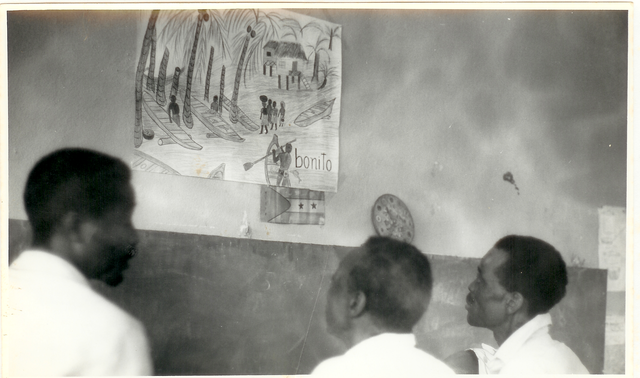
His method included images that expressed and mirrored the reality of the people going through the literacy program, and it made people realize that they already knew something about their lives through those images that they could talk about in the classroom before they learned how to read the word. So, as you can see in the picture here, taken in São Tomé and Príncipe, where Paulo Freire was working with revolutionary educators. The people in this village knew a lot about that village that they could talk about if you had a picture, which would let them learn how to read the word bonito (beautiful) which was written inside the picture. First discuss the world, then learn the corresponding word just to write it soon after. It is a learning continuum. The pictures of concrete situations enable the people to reflect on their former interpretation of the world before going out to read the word. It looks like a wordplay, but Paulo Freire really meant it, that people understand that words are part of worlds and they are not end goals. Learning how to read and write is not enough if you cannot change the world that makes you illiterate or that keeps you from voting.
These are the four general steps that Paulo Freire’s method goes through
- Reading the world. That happens before you come to the literacy program;
- Reading a generative model of the world;
- Reading the word and rereading the world through the word. For example, if you look at your village with more appreciation because it’s bonito, it’s beautiful, then you can probably be prouder of your heritage.
The design culture circle is an adaptation of Paulo Freire’s method for what I mean by popular design education, which aims to support everyone to become a critical designer, or at least a critical user. I developed this method while teaching at the University of Florida between 2023 and 2025. The university has an interesting graduate program in visual communication and design called MxD, where my students and I were trying to figure out how to engage more people with design and use design as a means to communicate about hard, complex topics, as I like to call them, the contradictions of society.
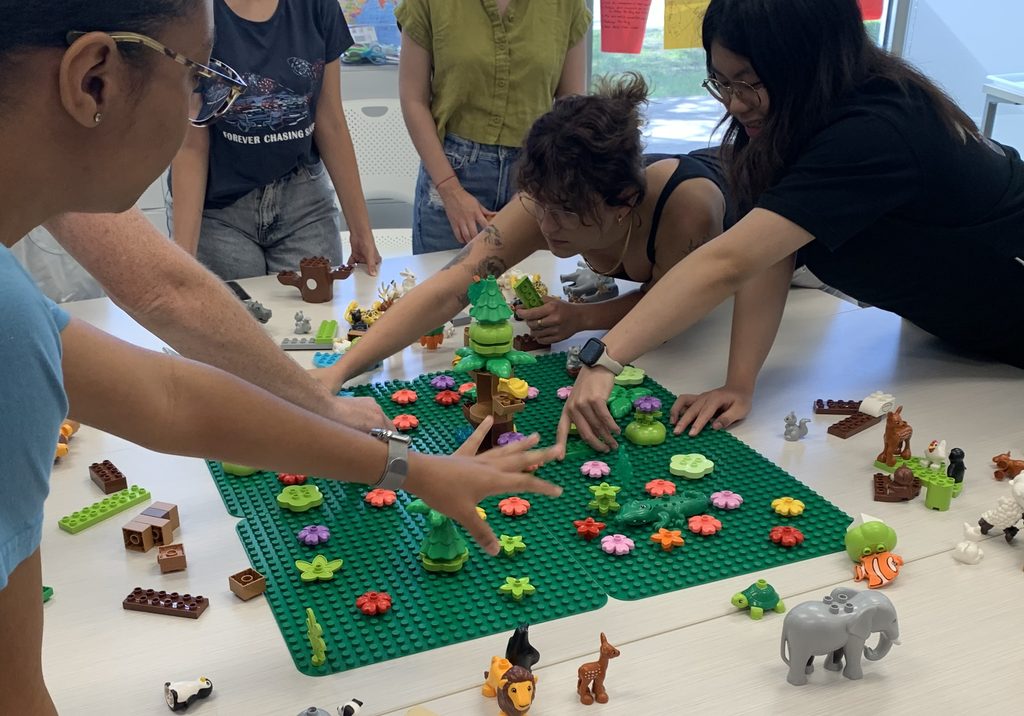
One day in 2024, while we were co-designing a mirror model of the MxD program and trying to figure out what this program is about, we created a Lego display model of the program. We had many parts that would metaphorically represent some aspects of that design culture. For example, the alligator could not be out of it, right? The gator represents this university’s sustainability ethos and the program’s desire to be part of a community that regenerates itself rather than one that destroys the environment. In the middle, you see a big tree that allows people to climb up in society and understand, to look from above, have this bird’s-eye view of society.
Soon, I realized that this was similar to what Paulo Freire was doing back in those days in Brazil. The difference is I was using a 3D model instead of having a picture on the wall to read the world. This was indeed a generative model of society, and I generated many other models with my students there. This particular called Pixelated Dreams features the Stable Diffusion algorithm behind generative AI technologies that are now disrupting graphic design occupation and raising a lot of other interesting, but also threatening, challenges to our profession. Instead of merely reading the paper that describes the algorithm, which is very hard for a designer who doesn’t have a math or computer science background, instead of doing that, I suggested them to generate images using physical pixels that were mixed in a similar way to how the Stable Diffusion algorithm works, using noise and denoising and all of these steps to generate a picture out of different inputs. This yields a similar result as reading the original diagram that shared with the world how the Stable Diffusion works.
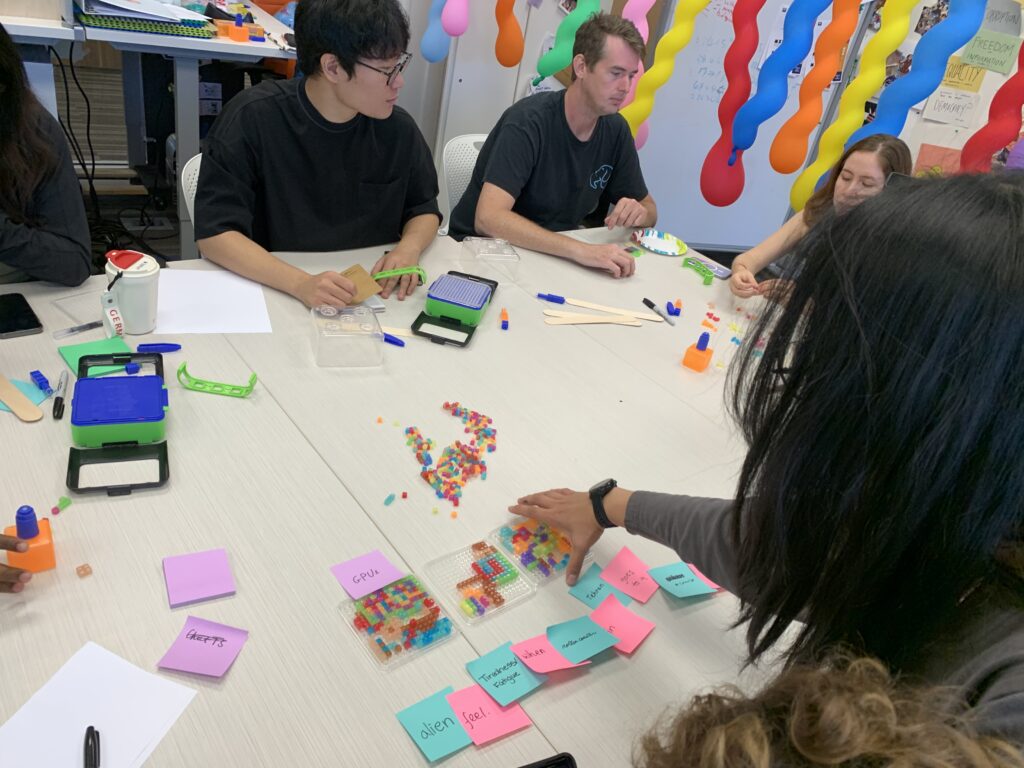
It’s very sad to see how the computer scientists behind Stable Diffusion fail to address the impact of what they are doing on society. For them, they’re just mixing up data. They don’t grasp that they are mixing together a lot of different artists’ and designers’ work, along with everyday art, without giving any credit whatsoever, and not letting us, for example, trace back who contributed to this particular picture.
Then you have designers that created generative artificial intelligence interfaces. Now users are also paying to this naive way of using technology, and they will go ahead and type a prompt like, say, “a color photograph of a housekeeper,” similar to how Bloomberg has tested it out. Then you generate a lot of pictures of women of color. And that’s a prejudice, that’s a bias on the technology that is departing from the assumption that only females of color can be housekeepers, not males or white females. That is based on the training data, but also based on a design culture where prejudice and oppression is not challenged enough in the public spaces. That looks only bad only after a newspaper went ahead and published this news item and generate a debate and some people become mad about the lack of critical consciousness from the designers of these tools. The tools are sometimes updated after events like these, but then the damage is already done, and new technologies are being developed without incorporating such criticism.
At that time, the University of Florida received millions of dollars from Nvidia to become the AI University, and a naive design culture quickly spread across campus. Just using AI technology in whatever silly way was considered to be enough. Of course, this was also connected to the major attack on academic freedom that the state of Florida, the board of governance, and various entities and institutions were carrying out, passing laws and regulations that would limit our ability to teach, for example, critical race theory.

How do we teach students to critically use artificial intelligence if critical courses were being banned from the university, as happened at that time? Well, I understood that critical consciousness in that situation had to be fostered in the not-yet-targeted courses, like design courses.
I did my best in the Design + Identity in Everyday Life 2024 course. This course was open for students from all colleges, not just for design majors. Together with my teaching assistants, we followed the basic method of Paulo Freire, with some special additions to deal with design culture.
- Reading the world and everyday life before the class
- Reading selected design literature that would stimulate to look at the invisible aspects of design in the world differently,
- Sketch the rereading of the world on a visual diary. Even if students didn’t know how to draw, they would be encouraged to write very simple drawings of what they see and reflect upon in their worlds, because every time you sketch the world, they are already interpreting the world; you’re not just copying it. And that’s the problem with AI: AI cannot interpret the world.
- Students would bring those visuals in their sketchbook, and share with the class, compare what each other had seen in the same or similar situations.
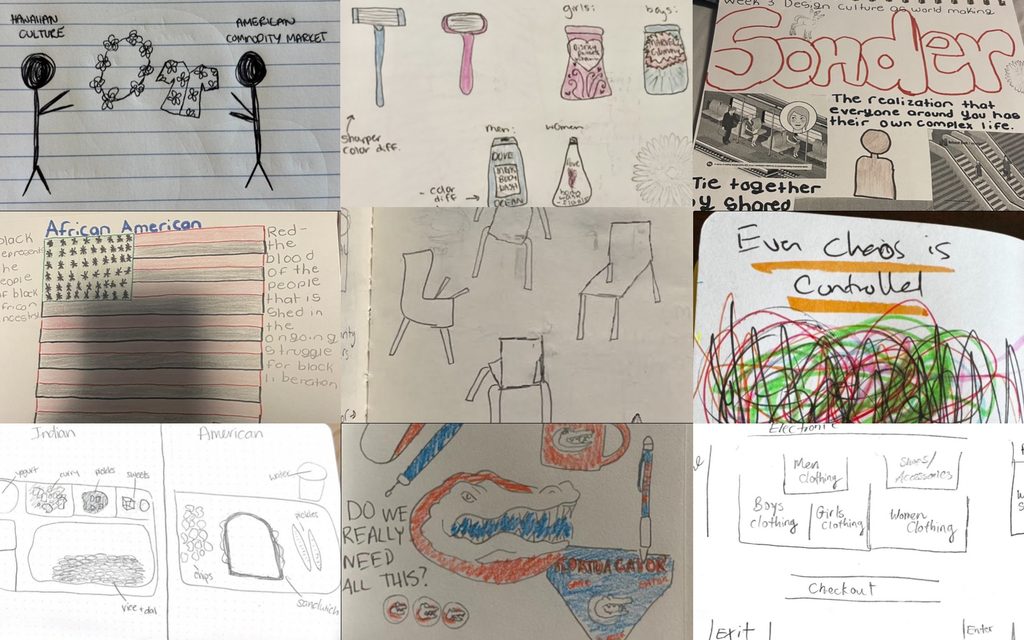
You can see a glimpse of a few of the excerpts from those visual diaries. Women were pretty much enraged to figure out how much gender, their tools were still being done even after so many design historians have written about this past. Immigrants and second- and third-generation immigrants were also complaining about the misappropriation of their cultural signs. Students were talking about excessive consumption fueled by certain designs that always make you feel like you need the latest Labubu item. Students would also compare different design cultures, for example, how you sort your food on your plate and similar practices. This made students understand that design is everywhere in their lives, shaping their identities, but also enabling them to subvert those identities so that they could be reclaimed for their own purposes as critical users.
Florida’s war on woke intensified after Trump’s anti-immigration laws and politics became effective in 2024. At some point, I felt really threatened that any policeman could stop me on the road and by mistake, deport me back to my homeland. I was also scared that billionaire tech bros were part of the state, enabling mass surveillance and automatic academic restrictions. Now I feel okay to deliver this talk online because I’m based in Brazil, but if I was in the United States, I would be very afraid of doing this. That is why I fled Florida and the United States in 2025. Of course, it was really terrible experience, as my American dreams became nightmares. Nevertheless, after I got back on my feet, I resumed the method development because I thought this was something important to support the fight against technofascism in the United States.
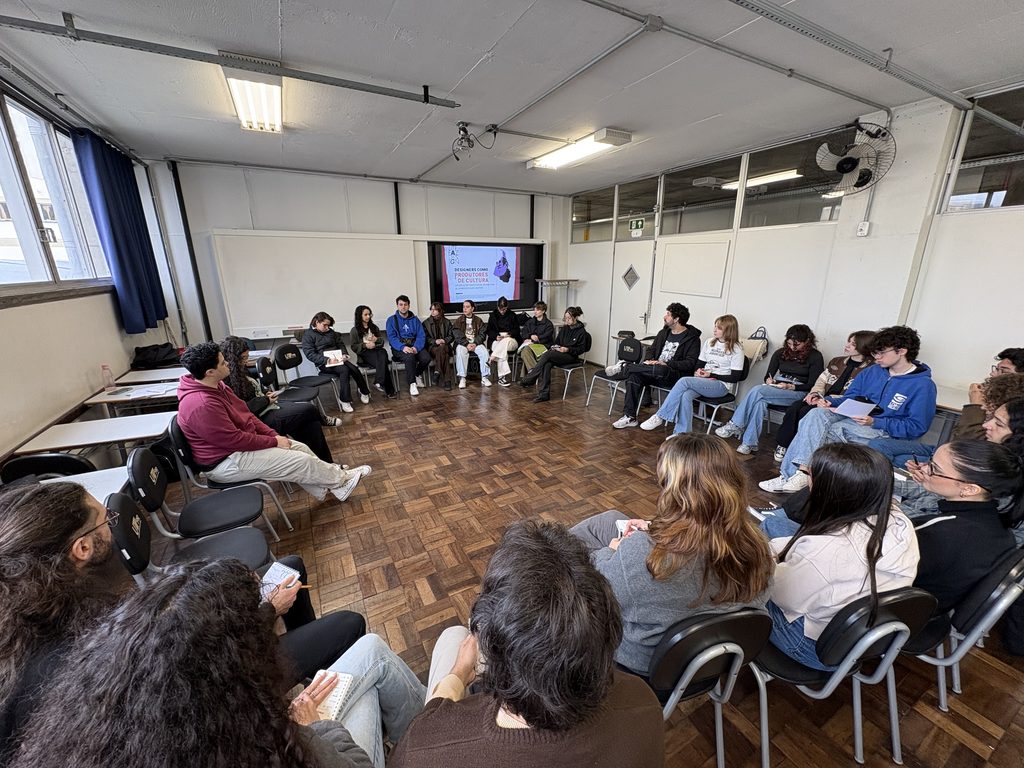
In my 2025 Design and Culture class, I complemented design culture circle with object theater. First, students were sorting out everyday objects that they brought from home to discuss many different cultural differences, for example, gender differences. To the extent those objects embody gendered norms and expectations about us and identification, and toys for girls on the left, boys for boys on the right, and the middle place for all. It’s nice to see that there’s a lot of toys for all growing up in this design culture, but we didn’t stop at that classification. We also wanted to explore what happens when these norms and practices clash with each other and are articulated in everyday life situations.
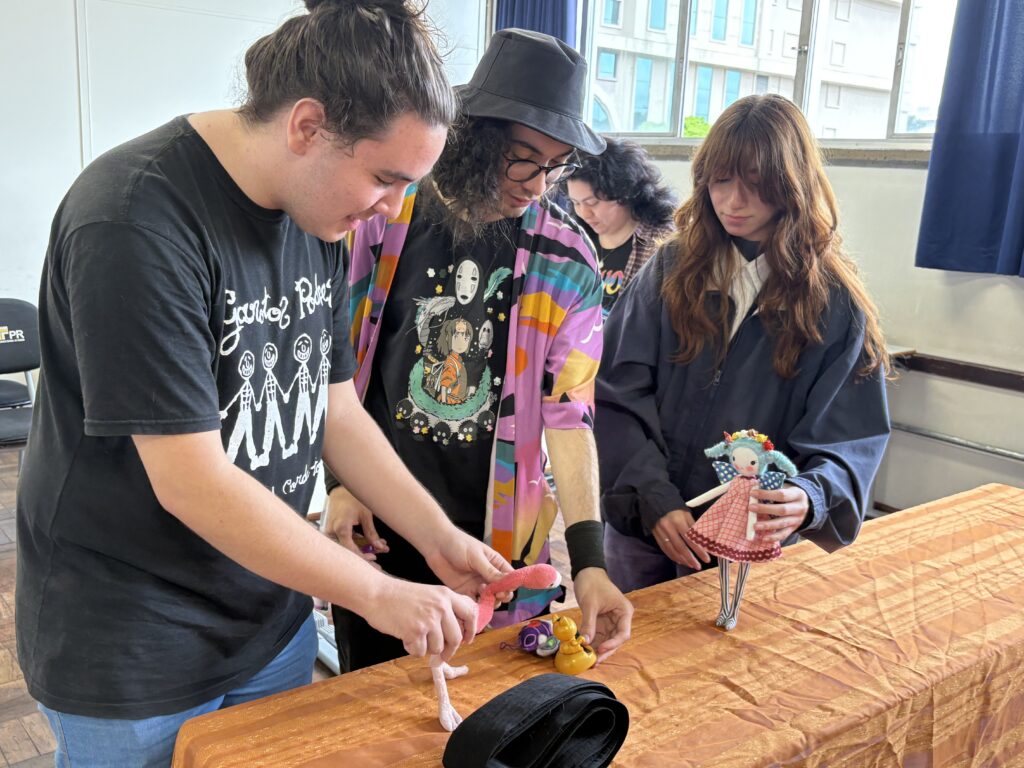
We explored object interaction by improvising an object theater play. Here you see the story of a boy who always wants to be with another boy, and then the teacher on the right comes in with a, let’s say, heteronormative approach to teaching proper behavior. She’s saying, “Why do you keep so close to each other? Why don’t you go and do something else with other people?” Students wanted to discuss how children and adolescents handle school restrictions to figure out and learn about sexuality.
I realized through this experiment that design culture circles can create things, not just analyze existing ones. In this case, an object theater play, but I think there’s a lot more that is possible to create from design culture circles. They are not just fit for rereading the world, like I was doing in the United States; they also can prepare a collective design body, let’s say, people who are going to work together to design something in a participatory design project. They can use design culture circles to remake the world, which is their goal of working together, after all.
The next step toward a popular design education is hosting design culture circles outside the university, connected to participatory design projects. These are some references I mentioned during my presentation, and you can probably find more on my website, which I will put in the chat box in a few seconds. Thank you for being here today!
References
Julier, Guy. (2000). The culture of design. London: Sage.
Verganti, R. (2009). Design-driven innovation: Changing the rules of competition by radically innovating what things mean (Vol. 5, pp. 11-12). Boston, MA: Harvard Business Press.
Van Amstel, F. M. C, Noel, L.-A., & Gonzatto, R. F. (2022). Design, Oppression, and Liberation. Diseña, (21), Intro. https://doi.org/10.7764/disena.21.Intro
Potter, N. (1969). What is a designer: education and practice. Studio Vista.
Dos Santos, W.B., Mazzarotto, M.,and Van Amstel, F.(2023) Learning design as a human right: the beginnings of a design lab founded on critical pedagogy, in Derek Jones, Naz Borekci, Violeta Clemente, James Corazzo, Nicole Lotz, Liv Merete Nielsen, Lesley-Ann Noel (eds.), The 7th International Conference for Design Education Researchers, 29 November – 1 December 2023, London, United Kingdom. https://doi.org/10.21606/drslxd.2024.104
Freire, Paulo; Donaldo Macedo. (1987). Literacy: Reading the word and the world. Routledge.
Freire, P. (1983). The importance of the act of reading. Journal of education, 165(1), 5-11.
Rombach, R., Blattmann, A., Lorenz, D., Esser, P., & Ommer, B. (2022, June). High-resolution image synthesis with latent diffusion models. In 2022 IEEE/CVF conference on computer vision and pattern recognition (CVPR) (pp. 10674-10685). ieee. https://doi.org/10.48550/arXiv.2112.10752
Nicoletti, L. and Bass, D. (2023). Humans Are Biased. Generative AI Is Even Worse. Bloomberg. https://www.bloomberg.com/graphics/2023-generative-ai-bias/
Hamann, T. Van Amstel, F. M. C. (2026). Prospecting fourth-order design research objects. 16th Brazilian Congress of Research and Development (P&D), Recife.