Prospective Design Studies is a 60-hour graduate-level course in the Master’s in Prospective Design at UTFPR. The 2025 cohort was co-taught with Rodrigo Fresse Gonzatto and Geraldo Augusto Pinto.
As an introductory course, Prospective Design Studies aims to provide an overview of the field, discussing the categories of structures, relational qualities, trajectories, projectories, and prospecting. The goal is to highlight the role of technology and socio-technical systems in our society, addressing the environmental, cultural, and economic crises that global society currently faces and the urgent need for structural changes in these.
Through case studies, literature reviews, and state-of-the-art reports, students have the opportunity to deepen their understanding of the philosophical, sociological, ethical, and technical concepts that underpin the praxis of intervention in complex structures. Discussions will be held on the conceptualization and difference between the categories that form the program’s lines of research: Infrastructures and Metastructures. At the end of the course, students should be able to understand the complexity of situations where Prospective Design can be applied to propose changes and recognize their impact.
Learning journey
In this first edition of the course, the objective will be to include those who are taking the course in the founding activity of Prospective Design as an area of academic research. Students will not be perceived as passive individuals, mere “recipients” of content; on the contrary, they will be seen as a collective of active researchers, capable of producing knowledge in this area.
The main concepts cultivated in the Graduate Program in Prospective Design (PPGDP) will be presented as classroom discussion topics, following a model similar to Freire’s culture circles. Themes will be presented in the following formats: academic articles; books and book chapters; other textual forms (websites, journalistic material, literature, etc.); and audiovisual content (music, films, animations, illustrations, etc.).
In addition to the presentation and analysis of the material planned for each meeting, techniques for decoding and recoding topics in the classroom will also be used, such as visual thinking, graphic representation of synthesis, Theater of the Oppressed, collaborative visualization, speculative photography, and Lego Serious Play. These techniques are part of the repertoire of Prospective Design, which will be addressed in an introductory manner, with a view to encouraging further study. Finally, beyond the classroom, there will be an ongoing task of observing the surrounding reality and recording reflections in a graphic diary.
Assessment
There will be three assessments in this course, as follows:
- Analog visual diary for reading the world (daily observations) and reading the word (texts from this discipline). Due halfway through the semester (20% of the grade). This will receive a grade, and teachers will be available for any clarifications in class or during their office hours.
- Seminar analyzing/summarizing an existential structure experienced/to be experienced by the student (reading of the world) based on the reading of a book available in the UTFPR libraries (reading of the word). Only books included in the recommended bibliography will be valid for this assignment; however, other available titles not listed may be approved by the instructors upon prior request. The presentation must be accompanied by slide decks, which must be sent later for evaluation. The presentation will take place during the last classes of the course (30% of the grade). Presenters will receive verbal comments immediately after their presentation and a grade after sending the slide decks.
- Visual essay on a Prospective Design theme, using the evidence collected for the graphic diary and seminar as examples. The text must be at least 4,000 to 6,000 words long (excluding bibliographical references), include 10 images, and directly address the concepts found in the book used in the seminar, in addition to the texts discussed throughout the course. Due at the end of the semester (approximately one month after the end of classes, worth 50% of the grade).
AI policy
The critical and reflective use of Large Language Models (such as ChatGPT) is encouraged as support for the preparation of assignments for this course. However, they will be considered choices and decisions made by the work’s authors. Nevertheless, the work proposals were configured so that 100% automatic generation would be impossible due to the mandatory physical material required for the graphic diary. This measure aims to encourage student-researchers to think with different media and compare their effects on thinking. Students are expected to be critical of what they generate with both tools, not taking either the drawings or the artificial words as if they contained truths in themselves. Therefore, we recommend stating and reflecting on the use of these tools in the assignments, when applicable.
13/08/25 – Introductory class
Introduction to the course and subject (topics, assessments, schedule, bibliography, what is basic/complementary reading, policy in English). General presentations. (discussion of the topic + dramatic games from the Theater of the Oppressed for class integration).
- VAN AMSTEL, Frederick M.C. Prospectando um Design Prospectivo. Blog Usabilidoido, 2022. Acesso em 09/08/2025. Disponível em: http://www.usabilidoido.com.br/prospectando_um_design_prospectivo.html
- VAN AMSTEL, Frederick M. C. Design prospectivo como uma nova profissão. Blog Usabilidoido, 2025. Acesso em 09/08/2025. Disponível em: http://www.usabilidoido.com.br/design_prospectivo_como_uma_nova_profissao.html
- BOAL, Augusto. Capítulo A – Uma experiência de teatro popular no Peru. Teatro do Oprimido: e outras poéticas políticas. Editora Cosac Naify, 2014.
20/08/25 – Reading the world vs. reading the word
Reading the world vs. reading the word (topics: how to study, Freirean pedagogy, culture circles, visual thinking, graphic diary, graphic representation of synthesis, comments on the book list).
- FREIRE, Paulo. Capítulo 1: A importância do ato de ler. In: FREIRE, Paulo. A importância do ato de ler: em três artigos que se completam. São Paulo: Cortez editora, 2022. p.15-25
- FREIRE, Paulo. Primeira Carta: Ensinar – aprender Leitura do mundo – leitura da palavra. In: FREIRE, Paulo. Professora sim, tia não: cartas a quem ousa ensinar. Olho d’água, 1997. p. 19-26.
- FREIRE, Paulo. Segunda Parte: Alfabetização e Conscientização. In: FREIRE, Paulo. Conscientização: teoria e prática da libertação: uma introdução ao pensamento de Paulo Freire. São Paulo: Cortez & Moraes, 1979. p.15-30
- VIEIRA PINTO, Álvaro. As concepções ingênua e crítica de educação. In: VIEIRA PINTO, Álvaro. Sete Lições sobre Educação de Adultos. 8 ed. São Paulo: Cortez Editora, 1993. p. 59-67.
- VIEIRA PINTO, Álvaro. O problema da alfabetização. In: VIEIRA PINTO, Álvaro. Sete Lições sobre Educação de Adultos. 8 ed. São Paulo: Cortez Editora, 1993. p. 91-105.
- VITÓRIA, Mário. Escrevendo no verso das folhas: diário gráfico como ferramenta de trabalho no ensino das Artes Visuais. Dissertação de Mestrado. Universidade do Porto (Portugal). 2011. Disponível em: https://repositorio-aberto.up.pt/bitstream/10216/56931/2/29665.pdf
- FREIRE, Paulo. A concepção “bancária” da educação como instrumento da opressão. Seus pressupostos, sua crítica. In: FREIRE, Paulo. Pedagogia do oprimido. Rio de Janeiro: Paz e Terra, 2005. p. 65-87.
- FREIRE, Paulo. A dialogicidade, essência da educação como prática da liberdade. In: Pedagogia do oprimido. Rio de Janeiro: Paz e Terra, 2005. p. 89-139.
- VIEIRA PINTO, Álvaro. A alienação educacional como característica da atividade pedagógica do país em vias de desenvolvimento / O imperativo da desalienação. In: VIEIRA PINTO, Álvaro. Sete Lições sobre Educação de Adultos. 8 ed. São Paulo: Cortez Editora, 1993. p. 52-55.
27/08/25 – Design, avant-garde and revolution
In this class, students produced a visual synthesis of their week’s reading and interacted directly with its author, Iraldo Matias, through a hybrid conference.


- MATIAS, Iraldo. Projeto e revolução: um processo de pesquisa. Revista Recorte, 2021. Disponível em: https://revistarecorte.com.br/artigos/projeto-e-revolucao-um-processo-de-pesquisa/
- MATIAS, Iraldo. Capítulo 1.3: Design, vanguardas e revoluções sociais. Projeto e revolução: do fetichismo à gestão, uma crítica à teoria do design. Florianópolis: Editora Em Debate, 2014. p. 93-162. Disponível em: https://editoriaemdebate.ufsc.br/catalogo/wp-content/uploads/PROJETO-E-REVOLUCAO.pdf
- MARGOLIN, Victor. Historia del diseño y estudios sobre diseño. In: MARGOLIN, Victor. Las políticas de lo artificial: ensayos y estudios sobre diseño. Local: DR Editorial Designio, 2012. p. 303-322 (Nota: existe uma edição em português deste livro na biblioteca da UTFPR).
- SERPA, Bibiana Oliveira. Objetos de luta cotidiana: Design e feminismos na América Latina. In: BUCKLEY, Cheryl. Design no Patriarcado. São Paulo: Clube do Livro do Design, 2025. p. 7-34.
03/09/25 – The managerial turn and the four orders of design
- BUCHANAN, Richard. Wicked problems no pensamento de design. Estudos em Design, v. 30, n. 1, 2022. 22p. Disponível em: https://doi.org/10.35522/eed.v30i1.1382. Acesso: 07 ago. 2025.
- BUCHANAN, Richard. Design research and the new learning. Design issues, v. 17, n. 4, p. 3-23, 2001. Disponível em: https://www.jstor.org/stable/1511916
- BOTTER, Fernanda; FUKUSHIMA, Kando; GOGOLA, Milena Maria Rodege. Prospectando futuros para a educação superior no contexto pós-pandemia COVID-19. Estudos em Design, v. 28, n. 3, 2020. 14p. https://doi.org/10.35522/eed.v28i3.1021
- VAN AMSTEL, Frederick M.C. Rumo à Quarta Ordem de Design. Blog Usabilidoido, 2022. Acessado em 09/08/2025. Disponível em: http://www.usabilidoido.com.br/rumo_a_quarta_ordem_de_design.html
- VAN AMSTEL, Frederick M.C. Problemas capciosos requerem soluções éticas e graduais. Blog Usabilidoido, 2020. Acessado em 09/08/2025. Disponível em: http://www.usabilidoido.com.br/problemas_capciosos_requerem_solucoes_eticas_e_graduais.html
- SAITO, Carmem; SERPA, Bibiana O.; ANGELON, Rafaela; VAN AMSTEL, Frederick M.C. Coming to terms with design wickedness: reflections from a forum theatre on design thinking. Anais… Design Research Society Conference (DRS2022), 2022, Bilbao. Disponível em: https://doi.org/10.21606/drs.2022.668
- MATIAS, Iraldo. Capítulo 3: A “Virada Gestorial” no design. Projeto e revolução: do fetichismo à gestão, uma crítica à teoria do design. Florianópolis: Editora Em Debate, 2014. p. 251-362. Disponível em: https://editoriaemdebate.ufsc.br/catalogo/wp-content/uploads/PROJETO-E-REVOLUCAO.pdf
10/09/25 – Case studies: prospecting new ways of doing design
After thoroughly discussing the Corais Platform case and its solidarity economy, Geraldo Pinto produced a visual summary of Karl Marx’s main thesis in Capital: the theory of value production. Students could then understand what the solidarity economy is trying to avoid.

- VAN AMSTEL, Frederick; VASSÃO, Caio A.; FERRAZ, Gonçalo B. Design Livre: cannibalistic interaction design. Innovation in design education: Third International forum of design as a process. Local: Umberto Allemandi & C., 2012. p. 442-456. Disponível em: https://fredvanamstel.com/publications/design-livre-cannibalistic-interaction-design
- GONZATTO, Rodrigo Freese; VAN AMSTEL, Frederick; JATOBÁ, Pedro Henrique. Redesigning money as a tool for self-management in cultural production. In: LEITÃO, R. M.; MEN, I.; NOEL, L-A.; LIMA, J.; MENINATO, T. (Eds.). Pivot 2021: dismantling/reassembling: Toronto: s. n., 22-23 jul. 2021. Disponível em: https://doi.org/10.21606/pluriversal.2021.0003
- PELANDA, Mateus F. L.; VAN AMSTEL, Frederick M. C. Desenvolvimento dialético de infraestrutura e superestrutura em plataformas livres para colaboração. Anais do Simpósio Brasileiro De Sistemas Colaborativos (SBSC), 1., 2019, Rio de Janeiro. Porto Alegre: Sociedade Brasileira de Computação, 2019. p. 98-103. Disponível em: https://doi.org/10.5753/sbsc.2019.7814
- VAN AMSTEL, Frederick MC; GONZATTO, Rodrigo Freese. The anthropophagic studio: Towards a critical pedagogy for interaction design. Digital Creativity, v. 31, n. 4, p. 259-283, 2020. https://doi.org/10.1080/14626268.2020.1802295
17/09/25 – Formal logic and dialectical logic in design thinking
- VIEIRA PINTO, Álvaro. Cap. IX. A significação da lógica dialética. In: VIEIRA PINTO, Álvaro. Ciência e existência: problemas filosóficos da pesquisa científica. Rio de Janeiro: Paz e Terra, 1979. p. 173-196.
- VIEIRA PINTO, Álvaro. Cap X. Os conceitos e as leis dialéticas. Caráter existencial do pensamento dialético. Ciência e existência: problemas filosóficos da pesquisa científica. Rio de Janeiro: Paz e Terra, 1979. p. 197-216.
- VAN AMSTEL, Frederick MC. Em busca de uma metodologia de design de interação materialista-dialética. In: Spinillo, Bendito e Padovani (Eds.) Selected Readings on Information Design: Communication, Technology, History and Education, p. 124-134, 2009. Disponível em: https://www.usabilidoido.com.br/arquivos/metodologia_design_materialista_dialetica.pdf
24/09/25 – Collective prospection in participatory design
- MARTTILA, S., VAN AMSTEL, F., SAAD-SULONEN, J., BOTERO, A., PODERI, G., TELI, M.,and COMMONER, P. D. The Relational Becoming of a Participatory Design Commoner. In: BRANDT et al. (eds.), Nordes 2025: Relational Design, 2025. Disponível em: https://doi.org/10.21606/nordes.2025.22
- ANGELON, Rafaela; VAN AMSTEL, Frederick. O corpo como metaobjeto na escrita coletiva de um manifesto político sobre design. In: Anais… 10º CIDI | Congresso Internacional de Design da Informação, edição 2021 e do 10º CONGIC | Congresso Nacional de Iniciação Científica em Design da Informação. São Paulo: Blucher, 2021, p. 1806-1812. Disponível em: https://doi.org/10.5151/cidicongic2021-145-355600-CONGIC-Sociedade_a.pdf
- MAZZAROTTO, Marco. Design em corpo coletivo: jogos participativos para ressensibilizar o projetar. Anais… X SDS 2025 – Simpósio de Design Sustentável + Sustainable Design Symposium, ainda não publicado.
01/10/25 – Existential structures in sustainable design
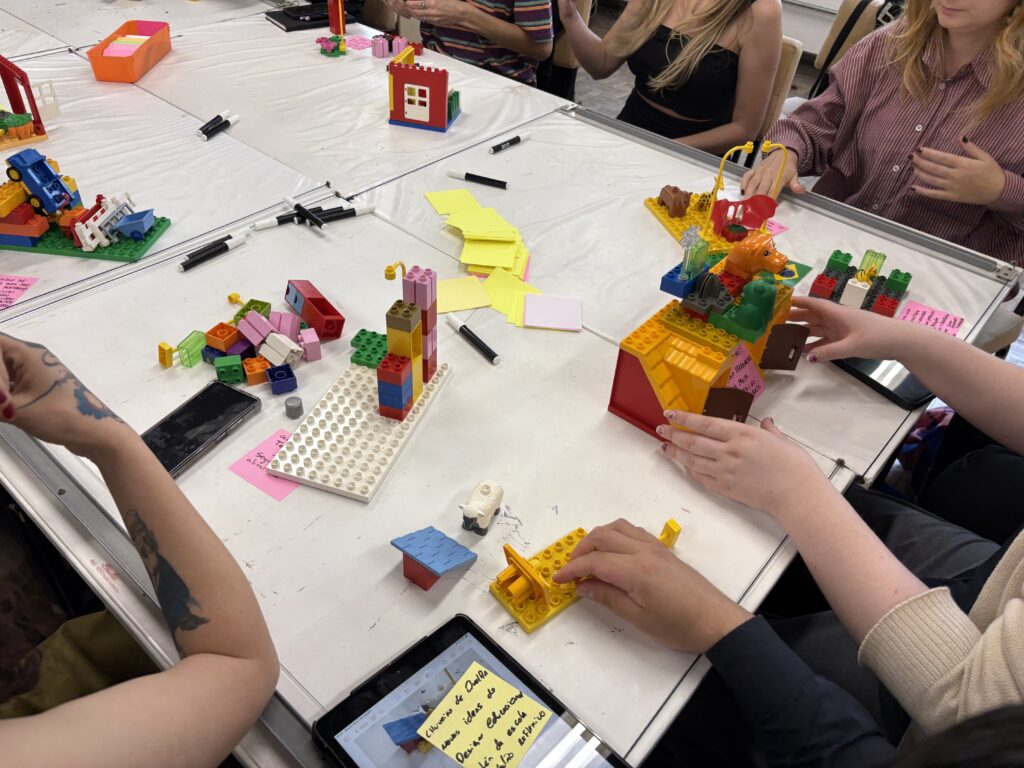
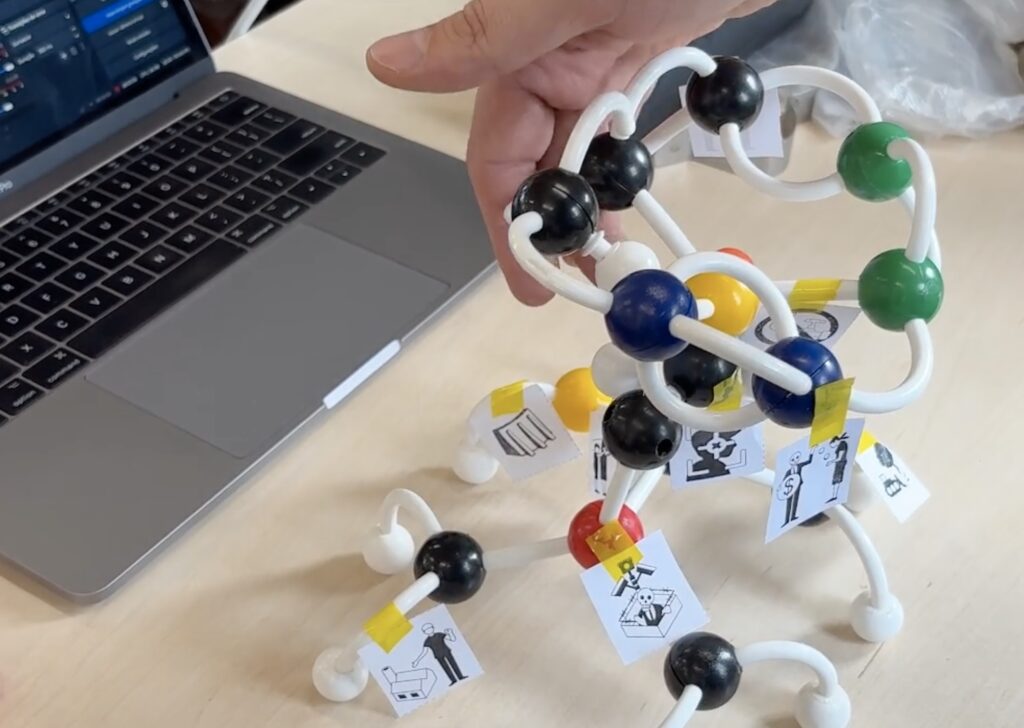
In this class, students modeled the existential structures they were studying in their thesis project using Lego Serious Play. They were prompted to use Lego’s modular system to represent a complex social structure.
- FRY, Tony. Capítulo 2: Made in America. A new design philosophy: an introduction to defuturing. Bloomsbury, 2020. p. 59-88.
- FRY, Tony. Prefácio. Prefácio do autor à edição brasileira. Introdução. Reconstruções: Ecologia, Design, Filosofia. São Paulo: Editora da Universidade de São Paulo, 2009. p. 9-59.
- DOS SANTOS, Maria Cecília Loschiavo. The vital package living on the streets in global cities: São Paulo, Los Angeles and Tokyo. Visual Studies, v. 15, n. 1, p. 101-118, 2000. Disponível em: http://dx.doi.org/10.1080/14725860008583818
- MARQUES, Pamela; MAASS, Marisa Cobbe. Design Espontâneo Periférico da América Latina: Uma forma de participação alternativa e subversiva. Anais… PDC 2020 Full Papers Proceedings, v. 3, p. 121-131, 2020. Disponível em: https://www.academia.edu/43410228/Design_Espontâneo_Periférico_da_América_Latina_uma_forma_de_participação_alternativa_e_subversiva
- ROOS, Johan; VICTOR, Bart. How it all began: the origins of LEGO® Serious Play®. International Journal of Management and Applied Research, v. 5, n. 4, p. 326-343, 2018. Disponível em: https://doi.org/10.18646/2056.54.18-025
08/10/25 – Existential time in interaction design
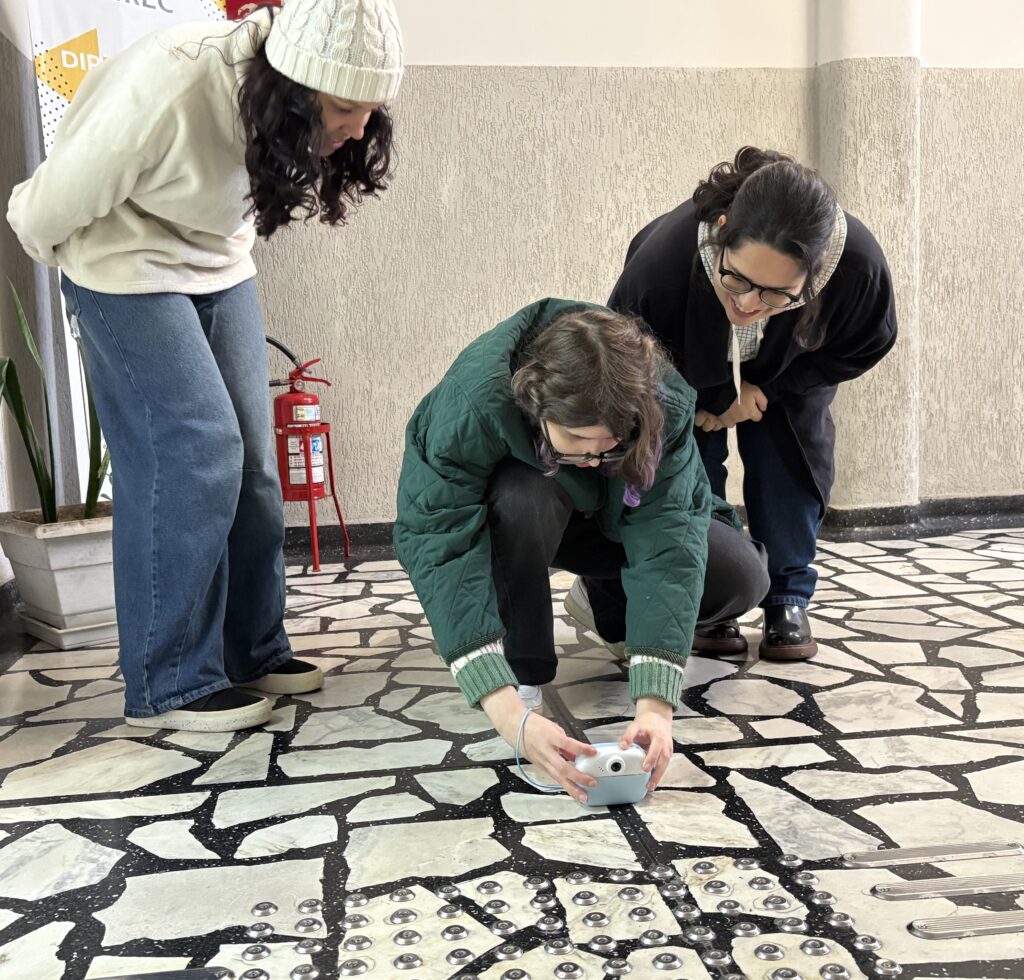
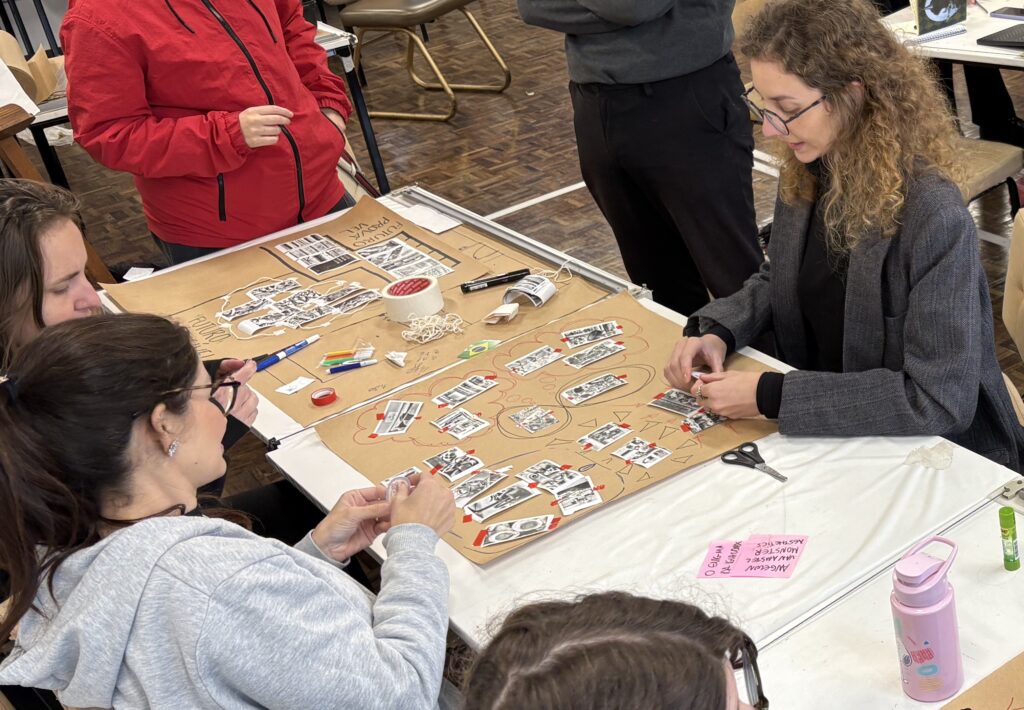
Existential time is best understood by producing an anachronistic photo. In this class, the photo was taken with a thermal instant kid’s camera. Taking a picture of the future in the present is a somewhat enticing explanation that draws people to such workshops. After a predefined time span, participants return to the studio to share their photos and compose a comprehensive design fiction by laying the photos on a wall or on brown paper. An annotation provides visual context and connection so that the narrative can be constructed in many ways. The final step is recording a smartphone improvised video in which the whole group tells the story by showing the images they produced in the most appropriate order.
- VAN AMSTEL, Frederick MC; GONZATTO, Rodrigo Freese. Existential time and historicity in interaction design. Human–Computer Interaction, v. 37, n. 1, p. 29-68, 2022. Disponível em: https://doi.org/10.1080/07370024.2021.1912607
- SILVA, Claudia Bordin Rodrigues da. Capítulo 2.1 O conceito de esperança na obra de Paulo Freire. In: SILVA, Claudia Bordin Rodrigues da. Consciência e ação em design de interação: recursos e práticas educacionais abertas para o esperançar. Tese (Doutorado em Tecnologia e Sociedade). Programa de Pós-Graduação em Tecnologia e Sociedade, Universidade Tecnológica Federal do Paraná, Curitiba, 2019. p. 35-40. Disponível em: https://repositorio.utfpr.edu.br/jspui/bitstream/1/4564/1/CT_PPGTE_D_Silva%2CClaudia_Bordin_Rodrigues_da_2019.pdf
- GONZATTO, Rodrigo F; MERKLE, Luiz E. Futuro da Tecnologia ou Tecnologia do Futuro? Críticas de Álvaro Vieira Pinto à ‘Futurologia’. In: Anais… ESOCITE – XI Jornadas Latino-Americanas de Estudos Sociais da Ciência e da Tecnologia), 2016. Disponível em: https://www.researchgate.net/profile/Rodrigo-Gonzatto/publication/305614160_Futuro_da_Tecnologia_ou_Tecnologia_do_Futuro_Criticas_de_Alvaro_Vieira_Pinto_a_Futurologia/links/5796868008aec89db7b85e43/Futuro-da-Tecnologia-ou-Tecnologia-do-Futuro-Criticas-de-Alvaro-Vieira-Pinto-a-Futurologia.pdf
- VIEIRA PINTO, Álvaro. Capítulo XV: itens 4-7 (4. Tecnologia, subdesenvolvimento e domesticação do futuro / 5. O futuro, projeção ideológica da tecnologia / 6. As bases sociais do futuro da tecnologia / 7. Os equívocos a respeito do “destino do homem”. A pergunta: “Quem produz o produtor?”). In: VIEIRA PINTO, Álvaro. O Conceito de Tecnologia. Volume 2. Rio de Janeiro: Editora Contraponto, 2005. p. 680-718
- ZMIEVSKI, Eduardo; VAN AMSTEL, Frederick M. C.; BECCARI, M. N.; “Percepção do tempo em ficções projetuais contemporâneas”, p. 2478-2491 . In: Anais… 13º Congresso Pesquisa e Desenvolvimento em Design (2018). São Paulo: Blucher, 2019. Disponível em: https://doi.org/10.5151/ped2018-3.3_ACO_60
15/10/25 – Existential space in expansive design
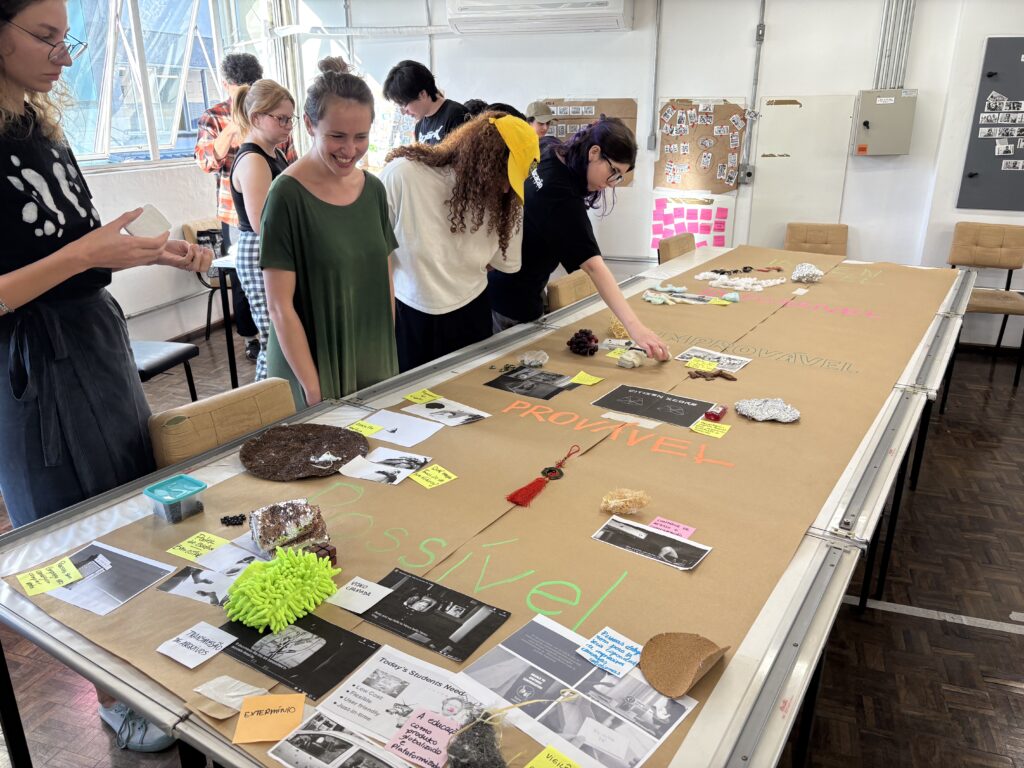
Mapping time over space helps to understand design as the production of a space of possibilities. Students watched design fictions included in the Futurologias Museum, printed a couple of screenshots, and classified whether these fictions were possible, impossible, unlikely, or unthinkable in the Brazilian time they lived in.
- VAN AMSTEL, Frederick Marinus Constant. Expansive design: designing with contradictions. Tese de Doutorado. Universidade de Twente, 2015. p. 151-154. Disponível em: https://fredvanamstel.com/publications/expansive-design-designing-with-contradictions-2
- VAN AMSTEL, Frederick; GUIMARÃES, Cayley; BOTTER, Fernanda. Prospecting a systemic design space for pandemic response. Strategic Design Research Journal, v. 14, n. 1, 2021. Disponível em: https://doi.org/10.4013/sdrj.2021.141.06
- VAN AMSTEL, Frederick Marinus Constant. Conservatism in Digital Trends: Findings from a differentialist analysis of influence graphs. InfoDesign, v. 18, n. 2, 2021. Disponível em: https://doi.org/10.51358/id.v18i2.933
- VAN AMSTEL, Frederick M.C. Revelando o Novo Possível. Blog Usabilidoido, 2022. Acessado em 09/08/2025. Disponível em: http://www.usabilidoido.com.br/revelando_o_novo_possivel.html
- VAN AMSTEL, Frederick. Designing between the possible and the impossible. Fredvanamstel.com. 2023. Disponível em: https://fredvanamstel.com/talks/designing-between-the-possible-and-the-impossible
- GONZATTO, Rodrigo Freese; MERKLE, Luiz Ernesto. Amanualidade em Álvaro Vieira Pinto: desenvolvimento situado de técnicas, conhecimentos e pessoas. Educação Unisinos, 2016, 20.3: 289-298. Disponível em: https://doi.org/10.4013/edu.2016.203.02
05/11/25 – Metastructure, metastructuring, and metadesign
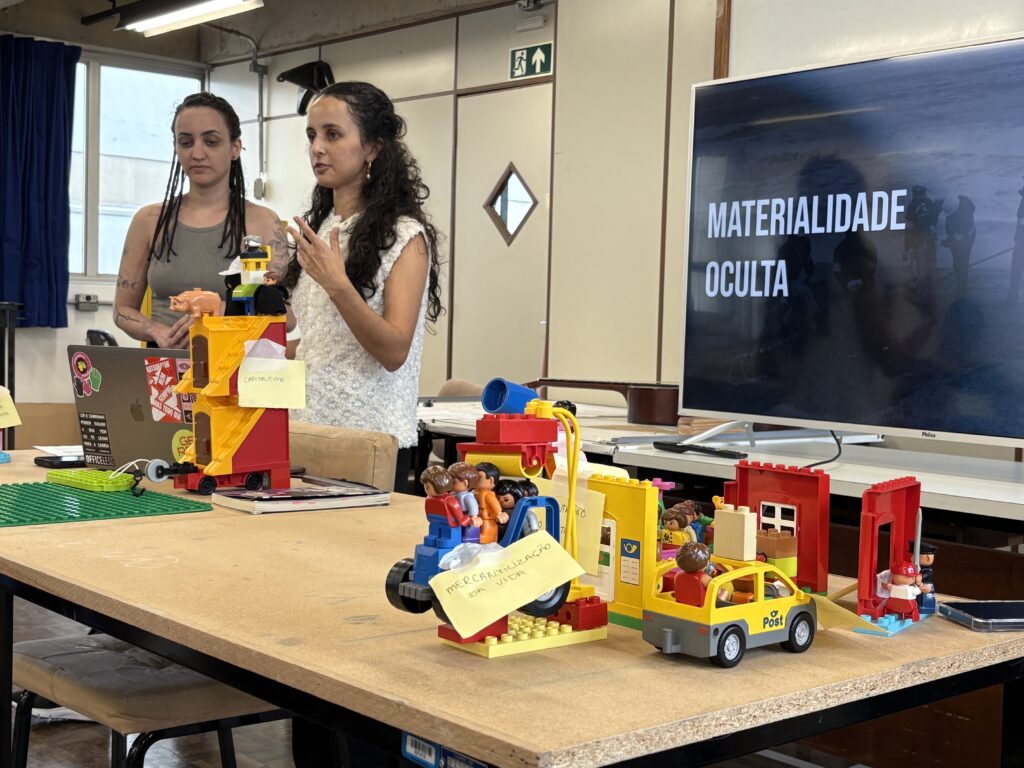
In this class, students experimented with making a generative model capable of representing complex relationships between metastructures and infrastructures. One example involved a collective exercise by faculty members and students to map the energy structures that sustain contemporary technofascism. The exercise traced connections between energy extraction, electronic devices, internet infrastructures, mass surveillance, and exploitative digital labor. The point was to demonstrate that techno-fascism does not emerge spontaneously as a fateful accident. It depends upon material infrastructures and metastructures that sustain and normalize it.
- MARX, Karl. Prefácio. Contribuição à crítica da economia política. trad. Florestan Fernandes. 2. ed. São Paulo (SP): Expressão Popular, 2008. v. 1, p. 45–50. Disponível em: https://gpect.files.wordpress.com/2013/11/contribuicao_a_critica_da_economia_politica.pdf
- ORLIKOWSKI, Wanda J. et al. Shaping electronic communication: The metastructuring of technology in the context of use. Organization science, v. 6, n. 4, p. 423-444, 1995. Disponível em: https://www.jstor.org/stable/2634996
- VASSÃO, Caio Adorno. Capítulo 2.1: Metadesign — Introdução. Arquitetura livre: complexidade, metadesign e ciência nômade. Tese de Doutorado. Faculdade de Arquitetura, Universidade de São Paulo, 2008. https://www.teses.usp.br/teses/disponiveis/16/16134/tde-17032010-140902/pt-br.php
- SIQUEIRA, Isabela L. M. de. Capítulo 3: Em busca do design como práxis. Em busca do design como práxis dialética: metadesign e infradesign da plataforma Rios. Trabalho de Conclusão de Curso (Bacharelado em Design) – Universidade Tecnológica Federal do Paraná, Campus Curitiba. Curitiba. 2019, p. 9-24. https://www.researchgate.net/publication/372460052_Em_Busca_do_Design_como_Praxis_Dialetica_Metadesign_e_Infradesign_da_Plataforma_Rios
- VIEIRA PINTO, Álvaro. Capítulo VI: O conceito de tecno-estrutura. VIEIRA PINTO, Álvaro. O Conceito de Tecnologia. Volume 1. Rio de Janeiro: Editora Contraponto, 2005. p. 437-468.
- KANGER, Laur. The spatial dynamics of deep transitions. Environmental Innovation and Societal Transitions, v. 44, p. 145-162, 2022. Disponível em: https://doi.org/10.1016/j.eist.2022.06.005
- NOVAES, Henrique Tahan; DAGNINO, Renato. O fetiche da tecnologia. ORG & DEMO, Marília, SP, v. 5, n. 2, p. 189–210, 2022. Disponível em: https://revistas.marilia.unesp.br/index.php/orgdemo/article/view/411
12/11/25 – Infrastructure, infrastructuring and infradesign
- STAR, Susan L. A etnografia da infraestrutura. Revista Anthropológicas, v. 31, n. 2, p. 61-85, 2020. Disponível em: https://doi.org/10.51359/2525-5223.2020.249896
- KARASTI, Helena. Infrastructuring in participatory design. In: Proceedings of the 13th Participatory Design Conference: Research Papers-Volume 1. 2014. p. 141-150. https://doi.org/10.1145/2661435.2661450
- PELANDA, Mateus. Capítulo 5: Resultados e discussões. Infradesign: reconhecendo a dimensão projetual do trabalho invisível em projetos de interação. Trabalho de Conclusão de Curso (Bacharelado em Design) – Universidade Tecnológica Federal do Paraná, Campus Curitiba. Curitiba. 2019. https://www.researchgate.net/profile/Mateus-Pelanda/publication/337991143_Infradesign_reconhecendo_a_dimensao_projetual_do_trabalho_invisivel_em_projetos_de_interacao/links/5df91352a6fdcc283728d42b/Infradesign-reconhecendo-a-dimensao-projetual-do-trabalho-invisivel-em-projetos-de-interacao.pdf
- PELANDA, Mateus FL; VAN AMSTEL, Frederick MC. A fumaça digital: inversão infraestrutural do COVID-19 pela perspectiva Yanomami. International Journal of Engineering, Social Justice, and Peace, v. 8, n. 1, p. 61-77, 2021. Disponível em: https://doi.org/10.24908/ijesjp.v8i1.14735
- PELANDA, Mateus FL; VAN AMSTEL, Frederick MC. Infraestruturando identidades visuais livres em coletivos autogestionários. In: Anais… 9o Congresso Internacional de Design da Informação/Proceedings of the 9th Information Design International Conference| CIDI. 2019. Disponível em: https://doi.org/10.5151/9cidi-congic-6.0074
- GROHMANN, Rafael. A soberania digital a partir dos movimentos sociais. Blog da Boitempo. 11 nov. 2022. Disponível em: https://www.boitempoeditorial.com.br/blog/2022/11/11/a-soberania-digital-a-partir-dos-movimentos-sociais/?srsltid=AfmBOoqcibfwFtan_T7QmFYH8mVI9z0eaPpYXMluDNe0gQ8-hgnt-jdW
19/11/25 – Brazilian prospective design
After studying the components of the entire Prospective Design aesthetic framework, students walked through their campus, taking instant photos of trajectories, projectories, metastructures, and infrastructures. These pictures were laid on brown paper and discussed for their similarities and differences. Taking examples from everyday observation helped them to grasp the theoretical concepts behind the framework.

- VAN AMSTEL, Frederick MC; BOTTER, Fernanda; GUIMARÃES, Cayley. Design Prospectivo: uma agenda de pesquisa para intervenção projetual em sistemas sociotécnicos. Estudos em Design, v. 30, n. 2, 2022. Disponível em: https://doi.org/10.35522/eed.v30i2.1458
- BOTTER, Fernanda; VAN AMSTEL, Frederick M. C.; MAZZAROTTO FILHO, Marco; GUIMARÃES, Cayley. Prospective design: A structuralist design aesthetic founded on relational qualities. In Gray, C., Ciliotta Chehade, E., Hekkert, P., Forlano, L., Ciuccarelli, P., Lloyd, P. (eds.). Anais… DRS2024: Boston, 23–28 June, Boston, USA, 2024. https://doi.org/10.21606/drs.2024.883
- VIEIRA PINTO, Alvaro. Ideologia e Desenvolvimento Nacional. Rio de Janeiro: Ministério da Educação e Cultura (MEC) / Instituto Superior de Estudos Brasileiros (ISEB), 1956.
- ENGELER, Bridgette. Towards prospective design. The Design Journal, v. 20, n. sup1, p. S4591-S4599, 2017. Disponível em: https://doi.org/10.1080/14606925.2017.1352956
- GALDON, Fernando; HALL, Ashley; WANG, Stephen. Prospective design: A future-led mixed-methodology to mitigate unintended consequences. In: International Association of Societies of Design Research Conference 2019. Disponível em: https://researchonline.rca.ac.uk/id/eprint/4098
- IRWIN, Terry; KOSSOFF, Gideon; TONKINWISE, Cameron. Transition design provocation. Design Philosophy Papers, v. 13, n. 1, p. 3-11, 2015. http://dx.doi.org/10.1080/14487136.2015.1085688
26/11/25 – Student-led seminars
A seminar proposed by student researchers digging deeper into any topic they have seen in class so far. These were the seminar topics and presenters for the 2025 cohort:
- LADO: Transgressing with bell hooks and Freire — Danka Oliveira and Letícia Bito
- Stitching Together Freire and Hooks — Déborah Sanches and Karin Candido
- The Invisible Teaching — Denise Torquato and Thais Muraro
- The Limitations of Colonial Experiences Through the Use of Language — Bruna Lyse Ferreira Moura, Lisa Mombach Schmidt, and Lucas Emanuel Pereira Lage
- Decolonizing the Digital — Polyana de Andrade Tavares, Suzane Santana, and Gustavo Polido
- Designing for the Worlds We Desire: Taking Responsibility for Our Role — Flávia Sousa Gonçalves, Luísa Sprenger de Oliveira, and Thais Regina Hamann