Despite all the hype and hope surrounding them, the technologies developed by universities and research institutions were not necessarily always good for society. Many of those have been instrumentalized to globalize fascism, xenophobia, sexism, and racism. Theater of the Techno-Oppressed is an outreach activity that brings universities closer to their surrounding communities to publicly question, prevent, regulate, and dismantle technology-amplified oppression.
The goal: to encourage critical users
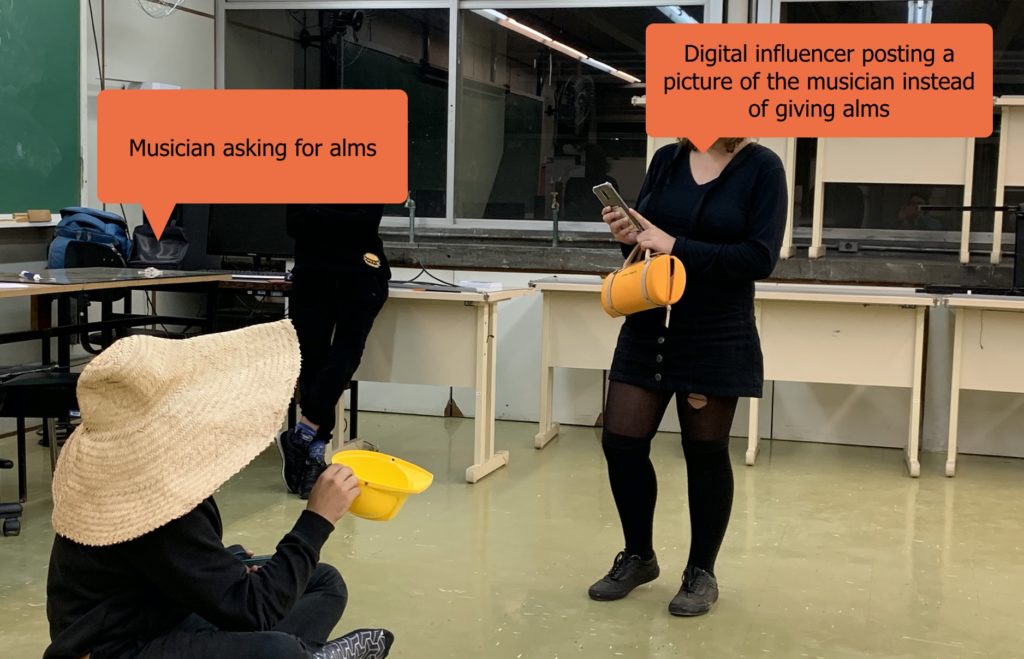
This activity raises critical body consciousness on the role played by technology in everyday lives, particularly how it constrains human bodies to specific physical and/or political postures that accept oppression as an inevitable reality. For example, dating apps, ride-hailing apps, work platforms, video streaming, and social networks depend on users lingering at specific postures several times a day to meet their economic and political ends. The anti-social habits shaped by these apps have already caused visible damage to worker rights, mental health, and democracy in many nations.

Theater of the Techno-Oppressed is mainly targeted at users, not technology designers. Designers can participate, but they must also enter the stage as users to understand the user oppression, effectively embodying the discovery of userism made by Dr. Van Amstel and his research collaborators. This activity helps people realize that critical users need to fight for user rights, just as consumer fought for consumer rights since the 1970s.
Definition of oppression
Technology critics often use concepts such as bias, prejudice, discrimination, injustice, redlining, stereotyping, and exclusion to account for the negative impacts of technology in society. This activity does not preclude these terms. Instead, it incorporates them under the larger concept of oppression.
Oppression is a body-based concept of inequality characterized by an intersubjective relationship in which a social group claims bodily superiority over another social group that, by its token, resists being treated as an inferior body. Oppression takes many forms, depending on the difference at stake. The classical form of oppression is authoritarianism, in which a state and its ruling class oppress its subjects. In modern capitalist societies, oppression takes the form of classism, which justifies worker exploitation due to their lack of an entrepreneurial mindset. Sexism is the oppression of a group differentiated by gender and sexual orientation. Racism, the oppression shaped by the categories of race. Ableism corresponds to the negative connotation of psychological or physical disability. The most evident oppression in the Theater of the Techno-Oppressed is userism, which reduces human beings to merely users of a technology, denying their potential growth as co-designers. Oppression may intersect and transect in each situation.
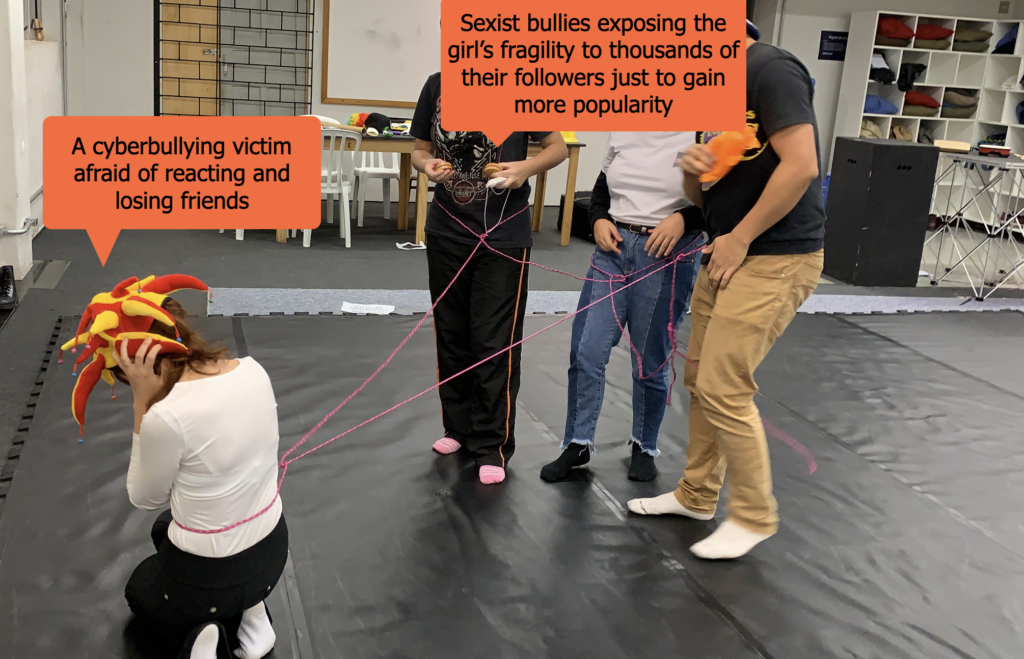
Due to the collective embodiment that oppression entails, individuals are not treated as individuals by other individuals; they are first and foremost treated as privileged oppressors or as underprivileged oppressed, irrespective of their deeds. Liberation, the opposite of oppression, is not achieved by individuals who can look beyond such collective embodiment but by reframing those collective body differences as positive, not just in intersubjective but also in interobjective relationships.
Technology-mediated oppression
Technology mediates social groups’ interactions in a way that, despite appearing completely transparent, is rather opaque to what is really going on at the structural level. For example, an oppressor who doesn’t want to be an oppressor might use a particular technology, unaware of its harms to an oppressed group. The harm comes from the not-so-obvious fact that using an oppressive technology entails using another human being, for instance, a courier, a content moderator, a miner, and other workers treated as a thing.
The following mediation processes can be unpacked and scrutinized by Theater of the Techno-Oppressed:
- FOMO (fear of missing out)
- Cyberbullying
- Body image disorder
- Occupational diseases
- Psychosomatic disorder
- Algorithmic discrimination
- Digital redlining
- Reputation-based gatekeeping
- Tragedy of the commons
- Infrastructure deserts
- Mass and intimate surveillance
- Data colonialism
- Platform labor precarity
- Disinformation amplification
- Biometric exclusion
- Normative body assumptions in design
- Assistive tech paternalism
- Quantified-self coercion
- Accessibility neglect
Theater of the Techno-Oppressed is a hopeful activity, nonetheless. It departs from the assumption that even a technology designed to oppress can be subverted, appropriated, and redesigned by the oppressed groups for their liberating ends. Distinguishing between technology-mediated oppression and technology-mediated liberation helps to overcome the false assumption that technology is the oppressor and liberation is a personal state of technology independence. Liberation in Theater of the Techno-Oppressed means changing the role of technology in society and the people who design and use that technology.
Why theater?
Scholars across many fields have produced critical discourses on technology, including Science and Technology Studies (STS), Philosophy of Technology, Critical Data Studies, Algorithm Studies, Feminist Technoscience, and more. These discourses, as relevant as they are to social movements, are largely communicated through academic texts and other channels with limited reach into everyday life. Theater of the Techno-Oppressed addresses that limitation by bringing body language to this dialogue. It draws primarily on Theater of the Oppressed, a method developed by Brazilian dramaturg Augusto Boal in the 1970s that has been tested in many worlds beyond Latin America. Dr. Van Amstel adapted this method by incorporating Embodied Interaction Design practices, typically used to conceptualize wearable devices, ubiquitous computing, robot interaction, and digital services. By enacting self and other bodies in action, Theater of the Techno-Oppressed fosters critical body consciousness and the collective will to design alter/native technologies for the liberation of the oppressed people.
Theater is an art form that draws on other arts and, as such, can include people with diverse artistic and amateur experiences. Theater often includes singing and dancing, as well as art forms closer to technology design, such as prop design, set design, and multimedia. Above all, theater is a performance art that can accurately depict oppression in everyday interactions.
Technology impersonation
Theater of the Techno-Oppressed works primarily by impersonating technology on stage. The actor impersonator acts toward the other actors like a scripted robot, a virtual assistant, or a physical machine. They, in turn, interact with the technology through the metaphorical body interface: they get information from the technology (inter)face, pull their arms as if they were levers, press their chests as if they were buttons, and talk to the technology as if it accepted voice commands. The oppressive nature of the interaction typically becomes more apparent when the actor playing the designer steps onto the stage and reveals their intentions for redesigning their initiative to oppressive reactions.
Impersonating technology is a way to deconstruct from the inside out both the discourse of neutrality and technological determinism that depoliticize technology development. The participant discovers its intentionality, origin, privileges, configurations, and functionalities by thinking and acting as a technology. On the other hand, they also discover how these constitutive aspects can be transformed through the critical appropriation of technology for different ends.
Technology impersonation builds upon Embodied Interaction Design techniques such as bodystorming and iterative prototyping. In contrast with bodystorming, though, Theater of the Oppressed invites political (and politicized) design bodies to enter the stage, bringing to the fore racial, gender, class, and other body-based differences.
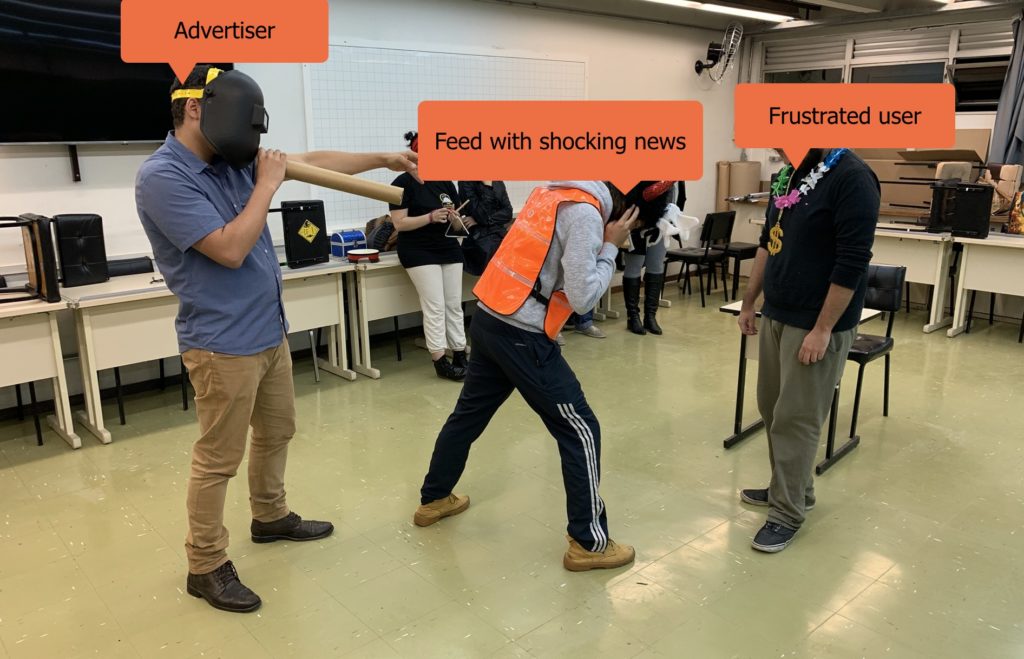
In this picture, the AI manifests a bias toward shocking news, so advertisers can take the opportunity to showcase products that exploit user vulnerabilities. The participants in this session did not understand the situation that clearly until they embodied the algorithm and experimented with its impact in everyday life.
Technology can also be impersonated by a collective body of multiple agents following a simple scripted algorithm. Embodied algorithms enables perceiving the dialectics between algorithmic rules and complex emergent behavior.
Workshop format
Theater of the Techno-Oppressed is an ongoing outreach activity, meaning that it spreads chronologically through many places and moments. Institutions that would like to join this outreach activity can host short-term workshops and long-term laboratories to train people in method multiplication.
Universities, schools, platform cooperatives, solidarity-economy enterprises, community associations, and art collectives are among the organizations that may be interested in hosting a workshop. For Universities, in particular, this workshop is a valuable educational tool that helps future designers learn to position themselves critically in a world where transnational and pluriversal technologies cross many worlds. The workshop can also be of interest to design activists, researchers, and practitioners concerned with the role of technology in mediating relations of oppression. These are usually people who have first-hand experience of oppression: users, women, Black and People of Color, indigenous, LGBTQIA+, people from the Global South, disabled, and generally non-White people. People who do not see themselves as oppressed can still join as allies of the oppressed.
The workshop is structured as follows:
- A very short introduction to Theater of the Oppressed and Embodied Interaction Design
- Workshop complicators’ introduction
- Why having a dialogue with the whole body (including body language) is so crucial for dealing with body-based oppression and designing alter/native embodied technology
- The tree of Theater of the Oppressed (overview of its major techniques)
- Warming up and demechanizing the body by playing dramatic games
- Participants’ introduction through “ice-breaking” games
- Activating touch
- Activating listening
- Activating all senses
- Activating collective body sensing
- Forming groups by shared experiences of oppression
- The theater technique (Image Theater, Newspaper Theater, Object Theater, Legislative Theater, or Interaction Design Theater, Embodied Algorithms, depending on the audience experience, historical context, and workshop duration)
- Sharing a personal story of oppression into small groups
- Choosing one story to tell to the larger group
- Rehearsing an improvised quick play that conveys the story in an ambivalent way
- Presenting and interacting with the audience
- Explore the design space of alter/native technologies
- Debriefing dialogue
- What have you learned today?
- What are the challenges of tackling technology-mediated oppression?
- What can we do against oppression beyond this workshop?
Space requirements
Theater of the Techno-Oppressed is very flexible and can be adapted to fit any space, including traditional classrooms. The ideal space is not a theater hall, but an acting studio. The ideal features are:
- Wide enough for collective body movement
- Soundproof enough for singing in choir
- Having movable or stackable chairs for the audience
- Soft, warm, and firm floors that people can lie on
- Close access to drinking water and bathrooms
Space determines the maximum number of participants. As a rule of thumb, each participant requires 2 square meters of floor space. A 40 m2 (e.g., 20 x 20 m) room affords 20 participants. An 80 m2 (e.g., 40 x 20 m) room affords 40 participants. Wider spaces are preferred over closed-knit spaces.
Body requirements
This activity is open to all human bodies, including those who think they have no talent to act. Special accommodations can be provided for people with disabilities, people with limited movements, racialized people living with racial trauma, survivors of sexual assault, and other people who would like to disclose special needs to the complicator prior to or during the workshop. The suggested clothing is casual and flexible. Bringing water bottles is recommended.
The theater technique relies on improvisation and everyday body language and does not require professional training or an extroverted personality. There are no written scripts or memorized lines, as it relies mainly on silent acting. Because of that simple setup, people who usually do not feel confident acting on stage feel encouraged to join the collective work.
At every step in the activity, participants can choose to be on stage or in the audience. What they cannot do, from an ethical standpoint, is remain neutral in the face of oppression. Extending the Brechtian tradition of theater and Freirean education style, in Theater of the Oppressed, the audience is constantly invited by the complicator to discuss and decode what is happening on stage. Staying in the audience is a relevant and valuable contribution for those who don’t feel comfortable acting with their whole body.
The workshop proponent acts as a complicator, the opposite of a facilitator. This role provides examples of using theater techniques to discuss technology-mediation issues, and the participants copy and develop them further. What is most difficult in Theater of the Techno-Oppressed is not the challenge of acting but the challenge of thinking through the oppressive aspects of technology that go largely unnoticed, and that produce privilege and silent complicity. The complicator’s primary goal is to keep the group focused on problematizing this troubled reality.
Workshops held at other institutions
Theater of the Techno-Oppressed was developed at UTFPR. By hosting workshops at other institutions, this outreach activity aims to train people to reproduce the method in new cultural-historical situations. So far, the following institutions hosted workshops:
- PUCPR, 2017
- Brazilian Human-Computer Interaciton (IHC) conference, 2019
- ESDI, 2022, 2023
- UFBA, 2022
- ServDes conference, 2023
- TU Delft, 2026
- University of Hasselt, 2026
Post-pandemic remote version
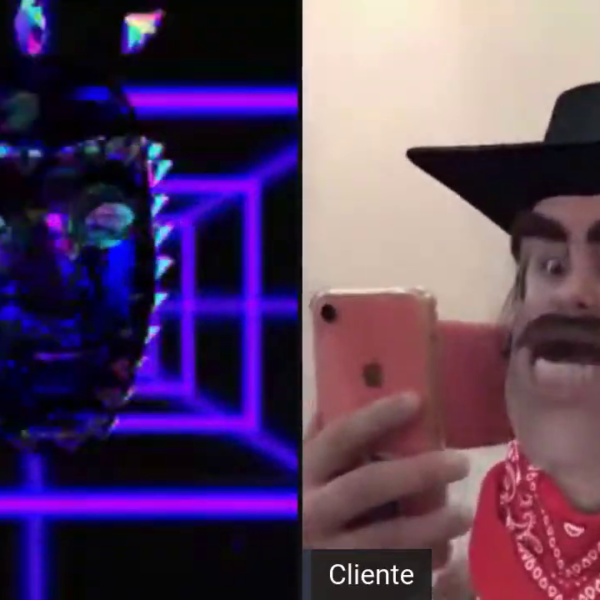
During the COVID-19 pandemic, the outreach activity that often led participants to realize they were relying too much on digital technology had to rely on digital technology itself. We integrated Jitsi, SnapCamera, StreamYard, and Youtube in an artful way to host remote theater forums using augmented reality masks. Later on, we developed remote image theater using 3D body modeling applications. Whenever health and economic conditions allow, face-to-face is preferred over remote.

Background research
Van Amstel, Frederick M. C. , and Fernando Secomandi. (2025) Collective Embodiment in Service Interfaces. In Penin, L. de S., Prendiville, A. and Sangiorgi, D. (Eds), Bloomsbury Handbook of Service Design: Plural perspectives and a critical contemporary agenda, 305–316. London New York: Bloomsbury Visual Arts, 2025. https://fredvanamstel.com/publications/collective-embodiment-in-service-interfaces
Secomandi, F., & Van Amstel, F. M. C. (2025). Coerced Recognition at the Service Interface: A Design Ethics Framework for Unveiling the User Oppression. Journal of Human-Technology Relations, 3, 1–25. https://doi.org/10.59490/jhtr.2025.3.7745
Van Amstel, Frederick M. C., Serpa, Bibibiana, Secomandi, Fernando. (2025). Systemic oppression in service design. In: Suoheimo, M., Jones, P., Lee, S., Sevaldson, B (Eds). Systemic service design. Routledge. http://dx.doi.org/10.4324/9781003501039-7
Bizotto dos Santos, W.B., Mazzarotto, M.,and Van Amstel, F. (2023). Learning design as a human right: the beginnings of a design lab founded on critical pedagogy, in Derek Jones, Naz Borekci, Violeta Clemente, James Corazzo, Nicole Lotz, Liv Merete Nielsen, Lesley-Ann Noel (eds.), The 7th International Conference for Design Education Researchers, 29 November – 1 December 2023, London, United Kingdom. https://doi.org/10.21606/drslxd.2023.104
Saito, Carmem; Van Amstel, Frederick M. C.; Serpa, Bibiana O; Angelon, Rafaela. Wicked rituals of contemporary design thinking. (2023). In: Mehl, Johanna and Höfler, Carolin (Eds). Attending [to] Futures. Matters of Politics in Design Education, Research, Practice. Hamburg: Adocs. p. 150-161. http://doi.org/10.53198/9783943253726
Gonzatto, R.F. and Van Amstel, F.M.C. (2022), “User oppression in human-computer interaction: a dialectical-existential perspective”, Aslib Journal of Information Management, Vol. 74 No. 5, pp. 758-781. https://doi.org/10.1108/AJIM-08-2021-0233
Saito, C., Serpa, B.O., Angelon, R., and van Amstel, F. (2022) Coming to terms with design wickedness: Reflections from a forum theatre on design thinking, in Lockton, D., Lenzi, S., Hekkert, P., Oak, A., Sádaba, J., Lloyd, P. (eds.), DRS2022: Bilbao, 25 June – 3 July, Bilbao, Spain. https://doi.org/10.21606/drs.2022.668
Gonzatto, R. F., & van Amstel, F. M. (2017, October). Designing oppressive and libertarian interactions with the conscious body. In Proceedings of the XVI Brazilian Symposium on Human Factors in Computing Systems (pp. 1-10). ACM, New York, NY, USA, Article 22, 10 pages. DOI: https://doi.org/10.1145/3160504.3160542